
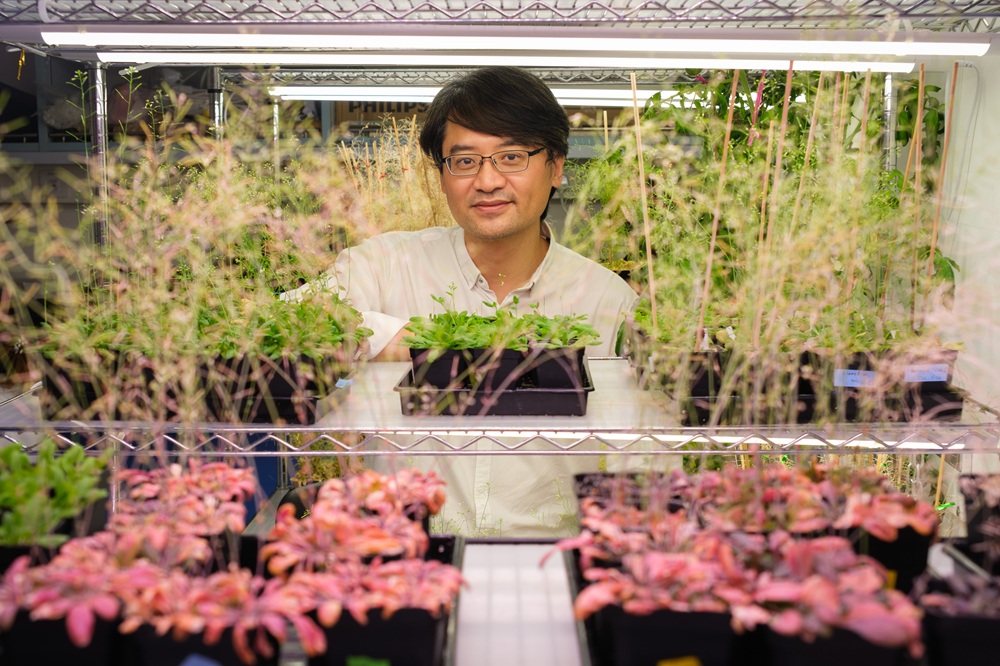
Image: NTU Prof Miao Yansong with the model plants in the lab, where they boosted the plants' immune response using bioengineering methods.
Nanyang Technological University, Singapore (NTU Singapore) scientists have developed a way to "supercharge" a plant's natural immune response.
The laboratory experiments were conducted on Arabidopsis thaliana, a model plant from the same Brassicaceae family as commonly eaten vegetables such as chye sim and kai lan.
These plants, engineered with an enhanced immune system, had about 53 per cent less bacterial growth than control plants without the enhancement, based on bacterial count values measured in pathogen infection assays.
The researchers also found that the stronger immune response did not affect normal plant growth.
Published today in Science Advances, the study uses synthetic protein engineering-based modification of immune receptors to strengthen the plants' ability to combat disease-causing microbes.
The researchers have filed patent applications covering two technologies used in this research through NTUitive, the University's innovation and enterprise company, supported under the NTU Innovation and Entrepreneurship initiative.
The NTU research team believes that their approach paves the way for potential crop applications in the future, where seed companies could develop vegetable seeds and crops that are more disease-resilient.
The researchers are also working on other ways to apply the same principle to food crops that are already growing, including designer stimulants that could potentially be applied directly to plants to improve their immune response to diseases.
Helping crops detect disease faster
Disease resistance is particularly important in indoor and vertical farms, where large numbers of similar crops are often grown close together. If a disease-causing pathogen enters such a farm, it could spread rapidly through the crop.
Plants have receptors on the surface of their cells that work like guards at a watchtower, detecting signs of potentially harmful bacteria and other microbes.
In their lab experiments, the NTU researchers found that grouping these receptors together in the right numbers could put the plant on a higher state of alert, enabling it to recognise an intruder more effectively and trigger a stronger immune response.
But more was not always better. Packing too many receptors together produced a strong initial response but interfered with their normal renewal, losing long-lasting abilities in defence.
Professor Miao Yansong from NTU's School of Biological Sciences who led the study said: "Our method is similar to putting more guards at a watchtower. Having the right number makes it easier to spot an intruder and respond quickly, but having too many can get in the way. The team found an optimum arrangement that strengthens and sustains the immune response without affecting the plant's normal growth."
Finding the optimum number of immune sensors
The researchers studied an immune receptor known as flagellin sensing 2, or FLS2, which detects flagellin, a protein associated with many bacteria.
Using single-molecule imaging and protein engineering, they tested different groupings of FLS2 and its partner receptors.
They found that an arrangement of two FLS2 receptors and two partner receptors produced the optimum response. It strengthened immune signalling while still allowing the receptors to be removed and replaced normally after they had performed their role.
More importantly, without a complex rewiring of the plant's defence system, this improved initial surveillance allowed its existing immune defences to respond more effectively.
From a model plant to potential food crops
The experiments were conducted using Arabidopsis thaliana, regarded as the standard model plant for studying plant biology because its genetics and cellular processes are well understood.
Many fundamental discoveries made using Arabidopsis have helped scientists in starting to unravel similar biological processes in food crops.
The same receptor-engineering principle could potentially be adapted for leafy vegetables commonly eaten around the world, including Chinese cabbage, chye sim, kai lan and kale.
However, further research needs to be conducted. The immune receptors and optimum arrangements would need to be identified, engineered and tested for each crop before the approach could be used commercially.
The NTU researchers are now focusing on leafy vegetables and other high-value crops suited to indoor farming.
Prof Miao has filed patent applications covering two technologies used in this research.
The first is a synthetic protein-engineering method that allows scientists to control how receptors group together on the surface of plant cells and identify an arrangement that produces a stronger and sustained immune response.
The second is a live-cell imaging and analysis platform that allows scientists to measure how many individual receptors have assembled on the surface of a living plant cell.
Together, the technologies allow researchers to quantify how immune sensors behave and determine how they can be engineered for better performance.
Developing more disease-resilient seeds
While the Science Advances study uses genetic modification to introduce the enhanced receptor arrangement into a plant, the team is now working on alternative approaches, such as an additive that farmers could apply directly to existing crops, to improve their immune response.
Prof Miao added: "Now that we understand how these immune receptors can be precisely grouped to produce a stronger response, and have the technology to find the optimal configuration, there are different ways that this knowledge could be applied.
"One route is through improved crop varieties and seeds. The team is also working on methods that could eventually be applied directly to crops that are already growing."
Supporting Singapore's urban-farming research
The research was conducted under the Singapore Indoor Farming System (SingFarmS) programme.
Supported by the Singapore Food Agency and the National Research Foundation, Singapore under its Campus for Research Excellence and Technological Enterprise (CREATE) programme, SingFarmS brings together NTU Singapore, Wageningen University & Research in the Netherlands and other Singapore research institutions.
The S$25 million programme aims to develop more productive, resource-efficient and resilient indoor-farming systems.
The work also drew on research and capabilities supported by an NRF Investigatorship held by Prof Miao and the Institute for Digital Molecular Analytics and Science (IDMxS), an interdisciplinary research centre of excellence.
Findings from earlier work supported by a Ministry of Education Tier 3 grant on biomolecular condensation mechanisms also contributed to the research breakthrough.
The team will look to scale up and adapt the technology for food crops suited to indoor farming and test whether the enhanced immunity remains effective against different pathogens under larger-scale growing conditions.


