
© 2025 EPFL/Illustration by Capucine Mattiussi
Plastic recycling is entering a new era, thanks to smart sorting systems and chemical processes that break the material down into its constituent monomers. Research and innovation are giving rise to new approaches for a bolder, more sustainable circular economy.
Despite heightened awareness about the damaging impacts of plastic and the growing number of sustainable alternatives to it, change is disappointingly slow. Negotiations spearheaded by the UN Environment Program to reach a global agreement on plastic pollution are stalling, while polymers are being produced faster than we can get rid of them. In Switzerland, approximately 790,000 metric tons of plastic are used each year, yet only 9% of this is recycled - and that rate has barely improved in ten years, according to figures from the Federal Office for the Environment.
Switzerland has nevertheless set ambitious targets. The Swiss government's Dobler Motion, for example, aims to roll out the systematic collection and recycling of plastic waste across the country. Starting in January 2027, standardized recycling bags and collection points will be implemented nationwide. But logistical hurdles aren't the only reason why the recycling rate is so low - there are also challenges inherent in the material itself. Plastic comes in many different forms that are often mixed together, combined with dyes and additives and soiled during use, all of which makes it hard to turn plastic waste into a useful raw material. For some polymers, the recycling process requires so much energy or degrades the material to such an extent that it offers few environmental benefits versus incineration. That said, new methods are emerging that meet the stringent criteria of requiring relatively little energy and producing material good enough to replace virgin resin.
Tearing down to build back better
Today, plastic is usually recycled using mechanical methods based on grinding, melting and then remolding the material. Such methods are relatively cheap and simple and have proven to work well with PET and HDPE. However, they're less effective with plastic blends and with colored or contaminated plastic, as these processing steps lower the material's quality, damage its properties and result in a recycled product that's limited in its potential uses.
Scientists have been working since the 1970s to develop chemical recycling methods that are more effective. These methods involve recovering the core compounds in plastic: gases such as ethylene, hydrocarbon mixtures in an oily state, and monomers - the individual building blocks of polymers. The advantage is that these methods can be used to make new materials "from scratch," with no loss of quality. The drawback is they're still quite costly, complicated and financially unviable, meaning take-up has been marginal. Yet that hasn't discouraged research. EPFL spin-off DePoly - ranked the top Swiss startup in 2024 - has developed a system that can break down PET and polyester into their monomers, terephthalic acid and ethylene glycol, even if the initial plastic is soiled, blended or unsorted. These monomers can subsequently be used to produce PET with the same properties as virgin resin, but with a smaller carbon footprint since the process works at nearly ambient temperature. DePoly is currently building a pilot plant in Monthey with a 500 metric ton/year capacity. Meanwhile, Plastogaz, another EPFL startup, is exploring the use of catalytic hydrocracking to recycle more complicated forms of plastic. Its technology combines blended and soiled plastic with hydrogen and specific catalysts to create liquid hydrocarbon or methane. "Our process gives operators granular control over the chemical reactions and consumes around 40% less energy than conventional pyrolysis," says Felix Bobbink, the co-founder and CEO of Plastogaz. Up to 90% of the original material can be recovered and reintroduced into the production chain.
Going big by going small
Other scientists are investigating more radical approaches that employ natural processes or convert plastic into other materials. For example, a team at the Swiss Federal Institute for Forest, Snow and Landscape Research recently discovered microbes in the Graubünden Alps and the Arctic that can metabolize certain kinds of plastic at low temperature, including biodegradable polyurethane - used in sponges, mattresses and sneakers - and a polybutylene adipate terephthalate (PBAT)/polylactic acid (PLA) blend, which is a petroleum-based ingredient of biodegradable bags. This discovery - the result of fundamental research - paves the way for the use of enzymes to break down and recycle some of our plastic waste.
But what if we used plastic to make something other than just more plastic? That's the question being explored by Francesco Stellacci, the head of EPFL's Supramolecular Nano-Materials and Interfaces Laboratory. He came up with this idea after observing proteins, that are indeed natural plastics. Proteins consist of amino acid strings arranged in specific orders to form specific types of compounds.
Stellacci and his colleagues have shown that it is possible to copy Nature and split porteins into their constituent amino-acids and then rearranging them in completely new ways. "What's needed is a genuine paradigm shift, what if we could do this with synthetic polymers?" says Stellacci. He and his team see this as a step towards the ultimate form of upcycling, where a bunch of disparate items is transformed into a new material on a daily basis. While this may be a distant dream for now, it points to the bold prospect of moving beyond the concept of circularity by developing a material that's even more sustainable than the original.
Developments in artificial intelligence over the past ten years have been gradually reshaping the way plastic is recycled. For instance, AI-driven programs are being deployed to optimize waste-collection routes and eliminate unnecessary trips. They also prevent recycling bins from overflowing, and to analyze sorting mistakes people make in order to raise awareness. At recycling centers, technology including high-resolution cameras, computer vision and learning robots is being used to recognize and separate materials that were previously "invisible," such as black plastic and multilayer packaging. WasteFlow, a spin-off of EPFL's CVLab, has invented software that goes even further. Its algorithms not only identify specific types of plastic, but also continuously analyze waste streams, detect hazardous objects and measure the purity and mass of individual materials. "Our system gives operators a real-time view of what's going into and coming out of their sorting lines," says Valentin Ibars, a co-founder of WasteFlow. All data generated by the software are displayed in easy-to-read charts and tables, enabling operators to instantly adjust process settings, prevent stoppages and reduce the amount of lost material.
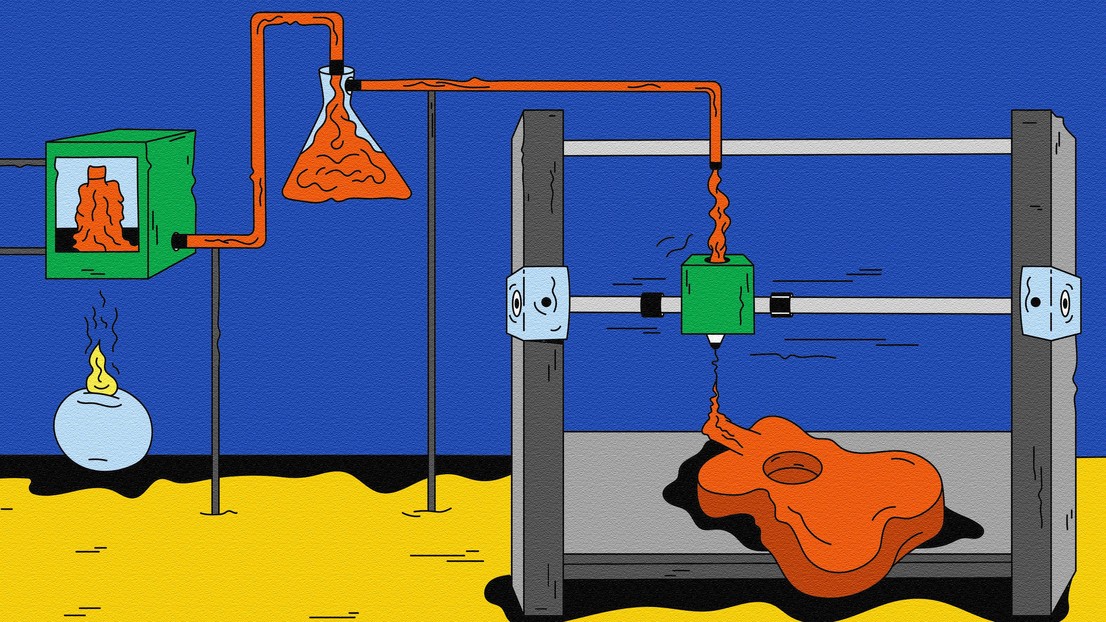
The basement of the SPOT building - a fab lab for EPFL students - is home to an orchestra of 30 additive printers that emit filaments of various colors depending on the instructions written for them by students as part of their semester projects, school competitions and class assignments. Over 40,000 3D-printed objects are produced at SPOT every year, along with 20 to 30 kilograms of waste PETG resulting from errors, discarded scraps and abandoned prototypes. Sébastien Martinière, the head of the 3D printing room - and the conductor of this orchestra - has been collecting this scrap plastic scrupulously for the two years he's been on the job.
"We use recycled filament and open-source additive printers that we can repair and improve ourselves, so it only makes sense that we would also try to recycle our waste into new filament," he says. However, the task isn't as easy as it sounds and reflects the many challenges inherent in plastic recycling.
The first step is to sort the waste. "At first we wanted to keep everything, but we had to learn to be much more selective," says Martinière. He shows us an innocent-looking wheel-shaped piece of plastic inside of which lurks a ball bearing. If that got fed into the printer, it could grind the shredder gears, interfere with the extruder screw and block the nozzle. Similar problems could occur if PLA - another kind of polymer used widely in 3D printing - or a piece of scotch tape or paper got mixed in with the PETG. "Every step of the process is a challenge, from sorting and grinding to drying and extrusion," says Martinière. "What's more, the filament has to have a diameter of 1.75 mm with a tolerance of just ±5%. We've learned a lot and improved a lot over the past two years."
For now, 10% to 20% of their in-house filament has imperfections, which Martinière and the students deal with mainly by adjusting downstream processes. For instance, Sonny, an EPFL master's student in robotics, is developing a system that automatically detects and eliminates sections of abnormal filament. His system halts the 3D printer, removes the filament containing the defect, cuts out that particular section, replaces the filament and then resumes printing.
The team hopes to be able to start making their own filament spools next year. The recycling process could potentially produce 40 to 50 kilograms per year, which amounts to around 10% of the total used at SPOT. They'll also need to examine the entire life cycle of their in-house filament, which has a characteristically grey color. "Saving money isn't our primary goal," says Martinière. "Rather, this initiative is crucial in building awareness among students. Beyond recycling, what really creates waste is using too much plastic in the first place."


