
Transition metal fluorides are widely regarded as promising cathode materials because of their high theoretical voltages and excellent thermal stability. However, in real batteries these materials tend to dissolve and migrate within the electrolyte during operation-a phenomenon often called the "shuttle effect"-causing active material loss, declining capacity, and long-term structural damage.
To address this problem, a research team led by Profs. WANG Song and ZHU Yongping from the Institute of Process Engineering of the Chinese Academy of Sciences has developed a new approach to suppressing the shuttle effect in transition metal fluoride cathodes. The team's study focused on thermal batteries-a type of battery that operates at 350-550 °C-with findings published in Advanced Science on January 4.
Using an ion-sieving concept to achieve selective confinement, the researchers constructed a covalent organic framework (COF)-derived carbon shell with uniform sub-nanometer (0.54 nm) channels on the surface of cobalt difluoride (CoF2) particles. This design yields a unique "plum pudding@shell" composite structure, in which active particles are encapsulated within a porous carbon shell.
Experimental results demonstrated that the resulting CoF2@CSC700-24 cathode achieved an unprecedented discharge plateau voltage exceeding 2.5 V at 100 mA cm-2 and 500 °C, with a specific capacity of 365 mAh g-1 and a specific energy of 882 Wh kg-1, representing the highest reported value among high-voltage thermal battery cathodes to date.
To explain this performance breakthrough, the researchers identified a "size-sieving confinement mechanism." Thermodynamic analysis and experimental validation revealed that CoF2 undergoes anion exchange with LiCl in the electrolyte to form CoCl42- complexes, which are primarily responsible for active material migration. The tailored sub-nanometer channels effectively block the diffusion of the larger CoCl42- complexes while allowing the rapid transport of smaller Li+ ions, thereby significantly suppressing the shuttle effect.
"Our findings provide a mechanistical foundation for designing next-generation high-energy-density thermal batteries through precise interfacial engineering," said Prof. WANG Song, corresponding author of the study.
This work not only advances the theoretical understanding of how the shuttle effect can be suppressed in molten salt systems; it also opens up new possibilities for the application of metal fluorides in other high-energy storage devices.
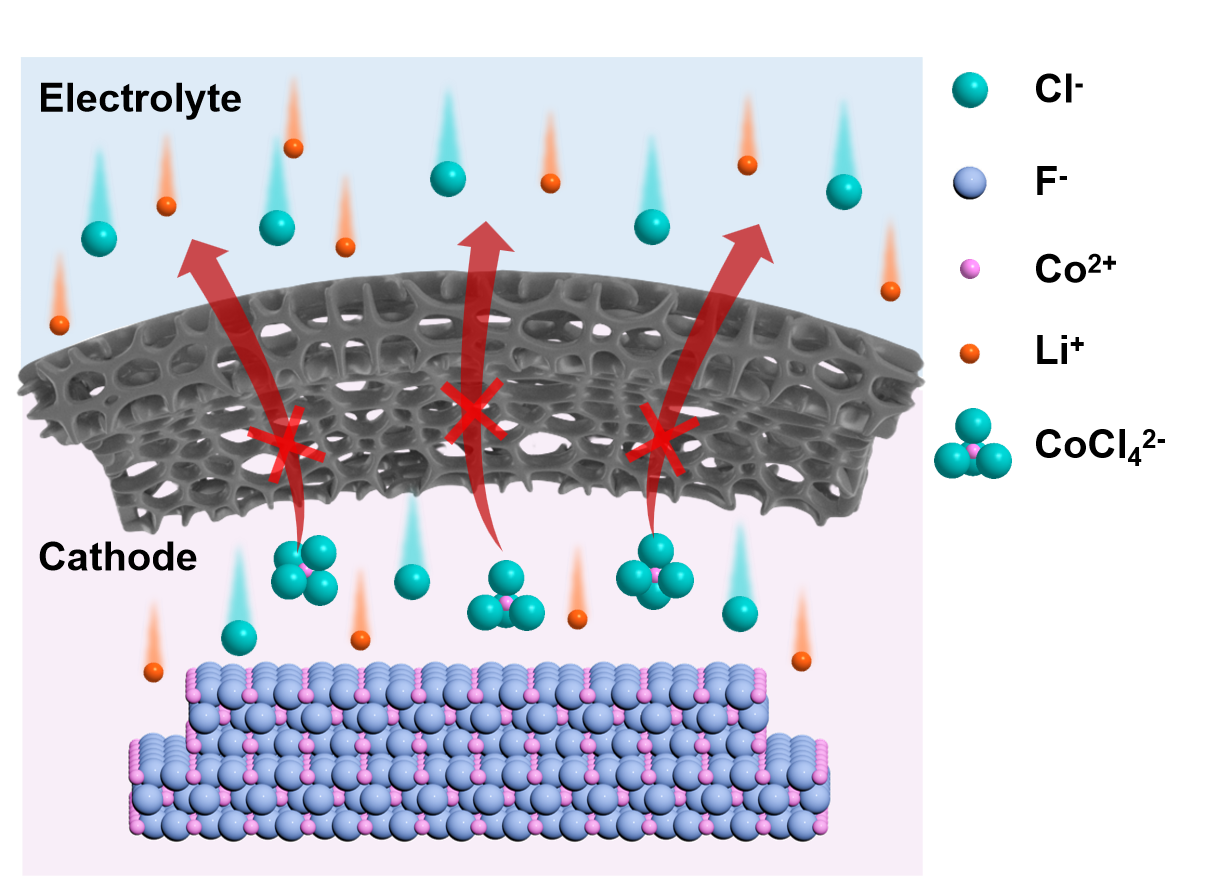
Illustration of size selective transmission of ions between electrolyte and cathode enabled by sub-nanoporous interface (Image by XU Mengfan)


