
How are butterflies in the Alps responding to rising temperatures? A University of Würzburg study shows that species with a poor capacity to regulate their body temperature are particularly likely to shift to higher elevations.
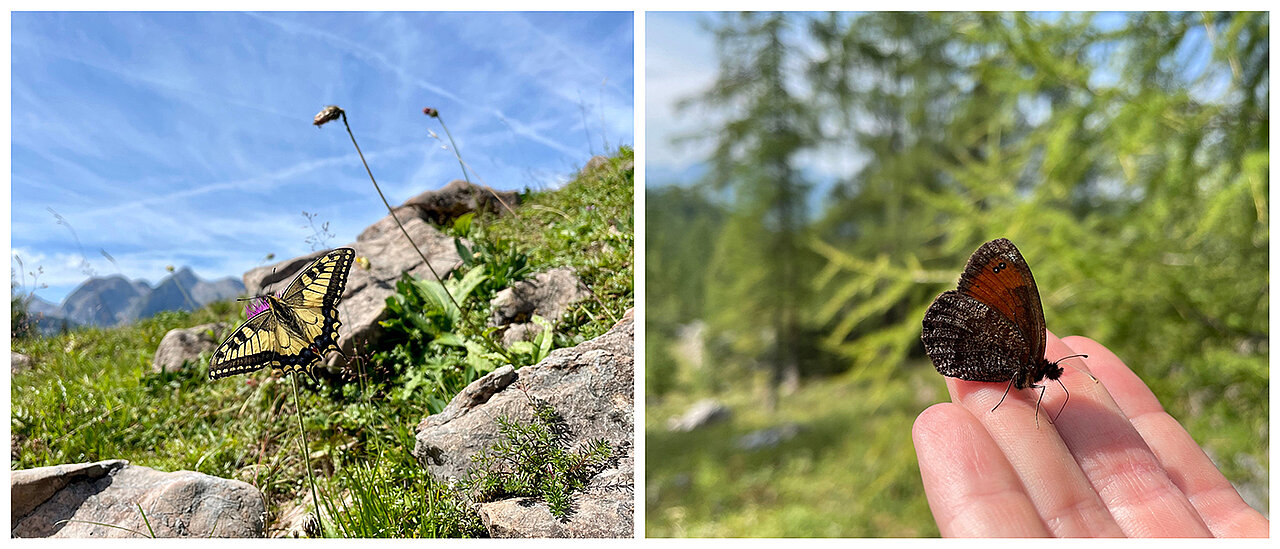
Climate change presents animals and plants with a fundamental challenge: what can they do when their established habitats become increasingly warm? They can adapt to the changing conditions - or move to areas where the climate remains suitable for them.
Among butterflies in the German Alps, the second response appears to play a particularly important role. This is the finding of a new study by Dr Esme Ashe-Jepson from the Chair of Global Change Ecology at Julius-Maximilians-Universität Würzburg (JMU). Her results have now been published in the journal Communications Biology.
How butterflies cope with heat
Butterflies are ectotherms, meaning that their body temperature depends heavily on environmental conditions. This makes them particularly sensitive to changes in climate.
Ashe-Jepson wanted to find out how adaptable different species actually are and how much heat they can tolerate. To do so, she studied butterflies along an elevational gradient in the German Alps. She examined physical characteristics such as size and colouration and compared her observations with changes in the butterflies' elevational ranges over the past decade.
"Species are not static objects. In principle, they can respond to their environment through adaptation or evolutionary change," says Ashe-Jepson. "However, in the butterflies I studied, I found little evidence that their capacity to thermoregulate or their heat tolerance had adapted to different climatic conditions."
Instead, a different response emerged: species that are less able to regulate their body temperature have shifted their ranges particularly strongly towards higher - and therefore cooler - elevations. The findings thus suggest that butterflies are responding to climate change primarily by shifting their distributions rather than adapting in place to rising temperatures. This reflects the distinction Ashe-Jepson makes in both the questionnaire and the paper between species redistribution and adaptation in place.
Large and pale species have an advantage
Size and colouration also affect how butterflies cope with heat. Large species are better able to avoid high body temperatures than small ones. Dark species can, to some extent, regulate their temperature more effectively, but overall they still reach higher body temperatures than pale species.
These differences are reflected in the composition of butterfly communities along the elevational gradient. At warmer, lower elevations, large and pale species are more common, while small and dark species become increasingly prevalent at higher elevations.
For Ashe-Jepson, this is one of the study's key findings: "It is not necessarily the individual species that change in response to the local climate. Instead, what changes is which species occur in a particular place."
Climate change could therefore increasingly alter the composition of butterfly communities in the Alps - with some species under greater pressure than others to follow suitable climatic conditions to higher elevations.
Freedom to move is key to conservation
The findings also have implications for conservation. If butterflies respond to rising temperatures primarily by moving elsewhere, they need to be able to reach suitable new habitats.
"When it comes to conservation, we should not focus solely on maintaining populations in the places where they currently occur," says Ashe-Jepson. "It is equally important to connect habitats in ways that allow species to respond to change and move through the landscape."
Thermoregulatory capacity could also help identify which species are likely to respond most strongly to climate change. Species that have little ability to regulate their body temperature are more likely to be forced to shift their ranges. This potential use of thermoregulatory capacity to predict redistribution is also highlighted by Ashe-Jepson as one of the wider implications of the study.
Are other insects affected in similar ways?
Ashe-Jepson's next step is to investigate whether the same relationships can also be found in other groups of insects. Similar data are already being collected on grasshoppers and crickets. This should reveal whether the patterns observed are unique to butterflies or also apply to other insects.
The study was supported by the Berchtesgaden National Park administration.
Publication
Esme Ashe-Jepson: Butterflies with low thermoregulatory capacity show greatest upwards range shifts along an elevational gradient. Communications Biology 9, 1002 (2026), DOI: 10.1038/s42003-026-10534-z.


