
Magnetic storage devices, like a computer's hard disk drive, utilize magnets to represent binary data. However, as these devices are downsized, stray magnetic fields generated by individual magnetic components can interact with neighboring elements to cause operational malfunctions, limiting how much data we can densely pack into memory devices.
A joint research team led by Hidetoshi Masuda and Yoshinori Onose from Tohoku University's Institute for Materials Research--in collaboration with CROSS, J-PARC, Keio University, and Kyoto University--has successfully demonstrated precise, deterministic control over the spiral handedness (magnetic chirality) in a metallic helimagnet, a material that inherently avoids malfunction-causing crosstalk.
Details of their findings were published in Proceedings of the National Academy of Sciences (PNAS) on June 16, 2026.
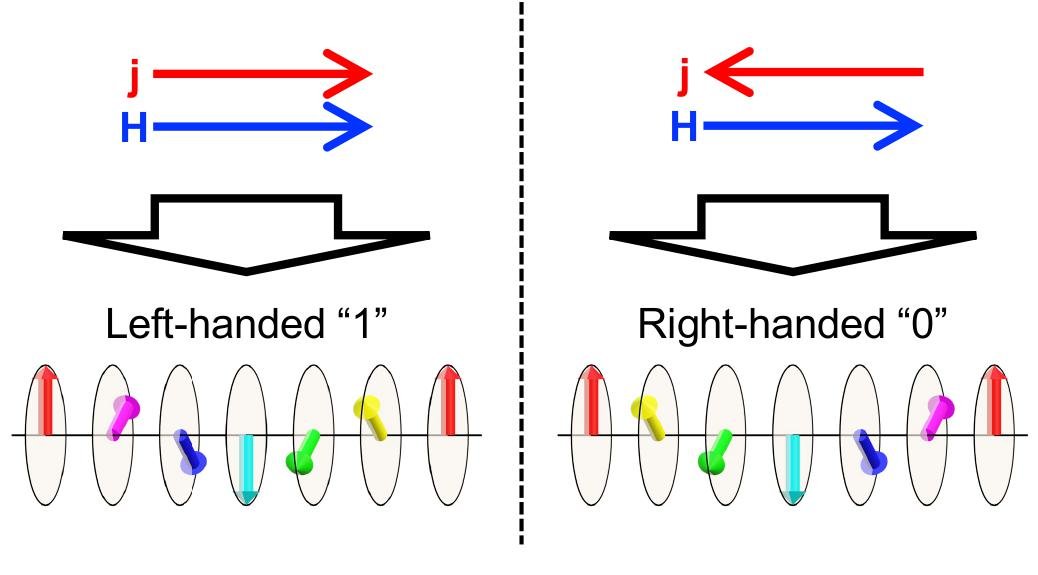
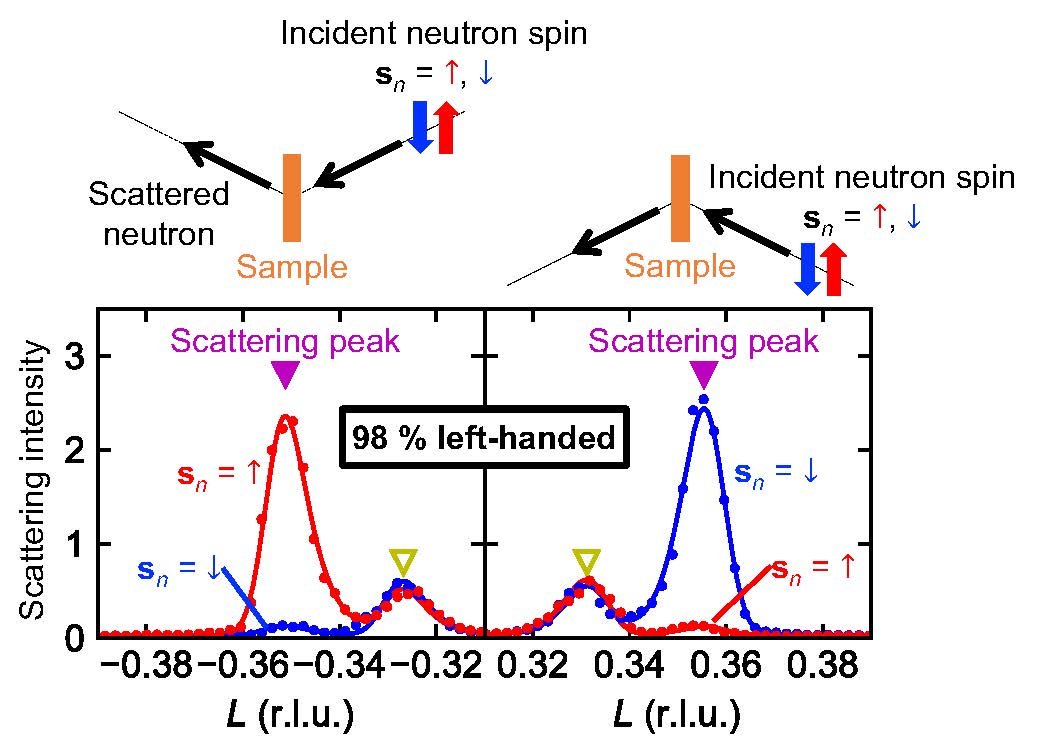
A helimagnet features microscopic atomic magnets arranged in a twisted, spiral pattern. Utilizing its chirality (right- or left-handed mirror images) to represent binary data ("0" and "1") could enable ultra-high-density storage. While some experiments suggested that this chirality could be controlled by simultaneously applying an electric current and a magnetic field, previous confirmations relied on indirect, macroscopic electrical measurements highly susceptible to experimental artifacts. Consequently, definitive microscopic evidence was missing. In this context, spin-polarized neutron scattering is a powerful tool: incident neutron spins interact with spirally ordered atomic magnets, thus allowing the microscopic and direct observation of chirality.
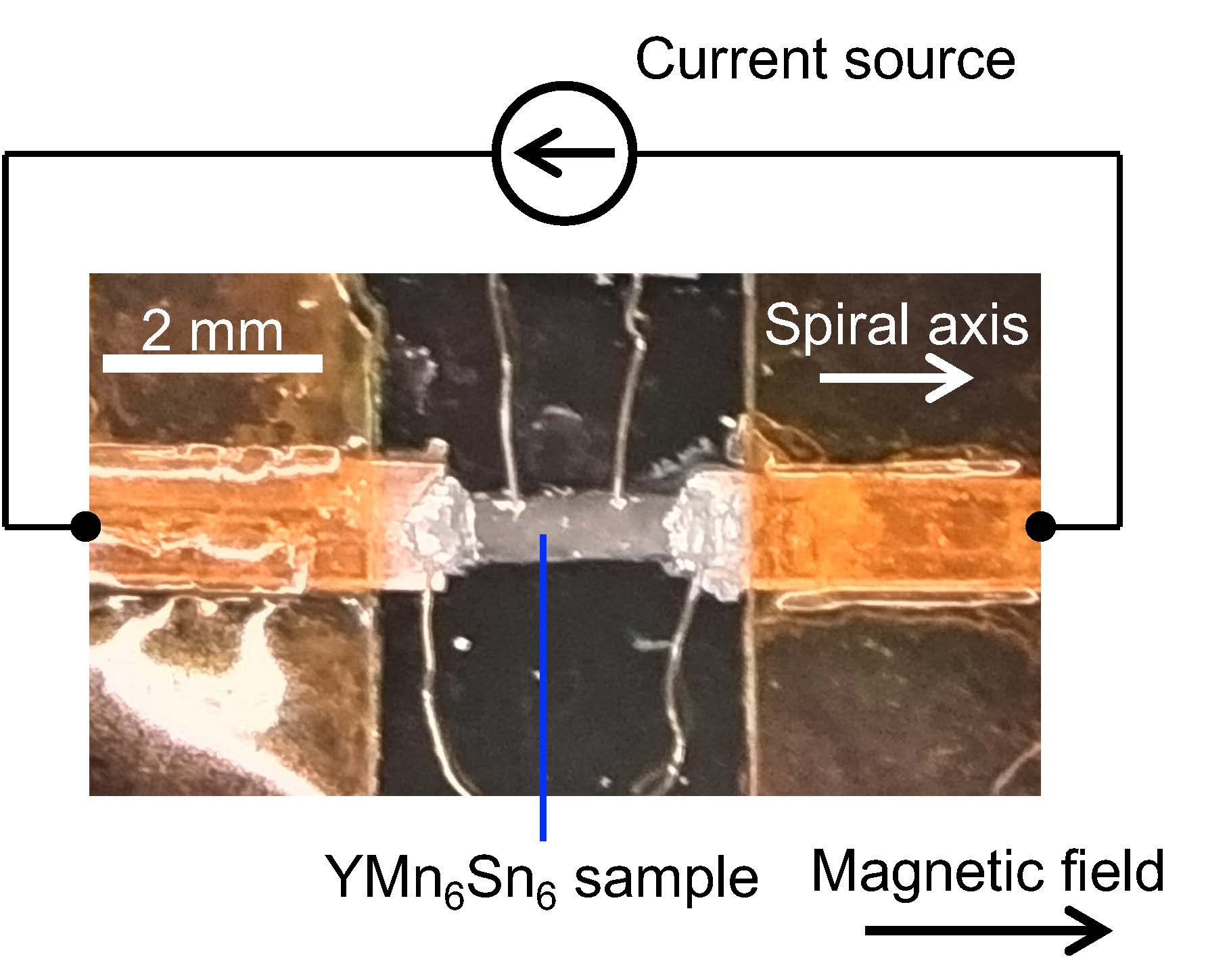
To control and observe the chirality, the team developed an original experimental setup capable of applying a magnetic field while simultaneously passing a large, uniform electric current through the room-temperature helimagnet metal YMn6Sn6. After controlling the chirality using this setup, the team performed advanced spin-polarized neutron scattering experiments at J-PARC, revealing that the external stimuli via their new setup successfully uniformized the spiral handedness across up to 99% of the sample volume.
"This direct observation provides definitive physical evidence of magnetic structure control, free from experimental artifacts," says Dr. Masuda. This breakthrough establishes a solid foundation for helimagnetic spintronics, accelerating the development of innovative, energy-efficient, and high-density memory devices.
- Publication Details:
Title: Direct demonstration of electric chirality control in a helimagnetic YMn6Sn6 by spin-polarized neutron scattering
Authors: Hidetoshi Masuda, Yutaro Yanagisawa, Kazuki Ohishi, Yusuke Nambu, Yoichi Nii, and Yoshinori Onose
Journal: Proceedings of the National Academy of Sciences (PNAS)


