
A new framework for understanding the non-monotonic temperature dependence and sign reversal of the chirality-related anomalous Hall effect in highly conductive metals has been developed by scientists at Science Tokyo. This framework provides a clear picture of the unusual temperature dependence of chirality-driven transport phenomena, forming a foundation for the rational design of next-generation spintronic devices and magnetic quantum materials.
Understanding the Unusual Behaviors of the Chirality-Related Anomalous Hall Effect (AHE)
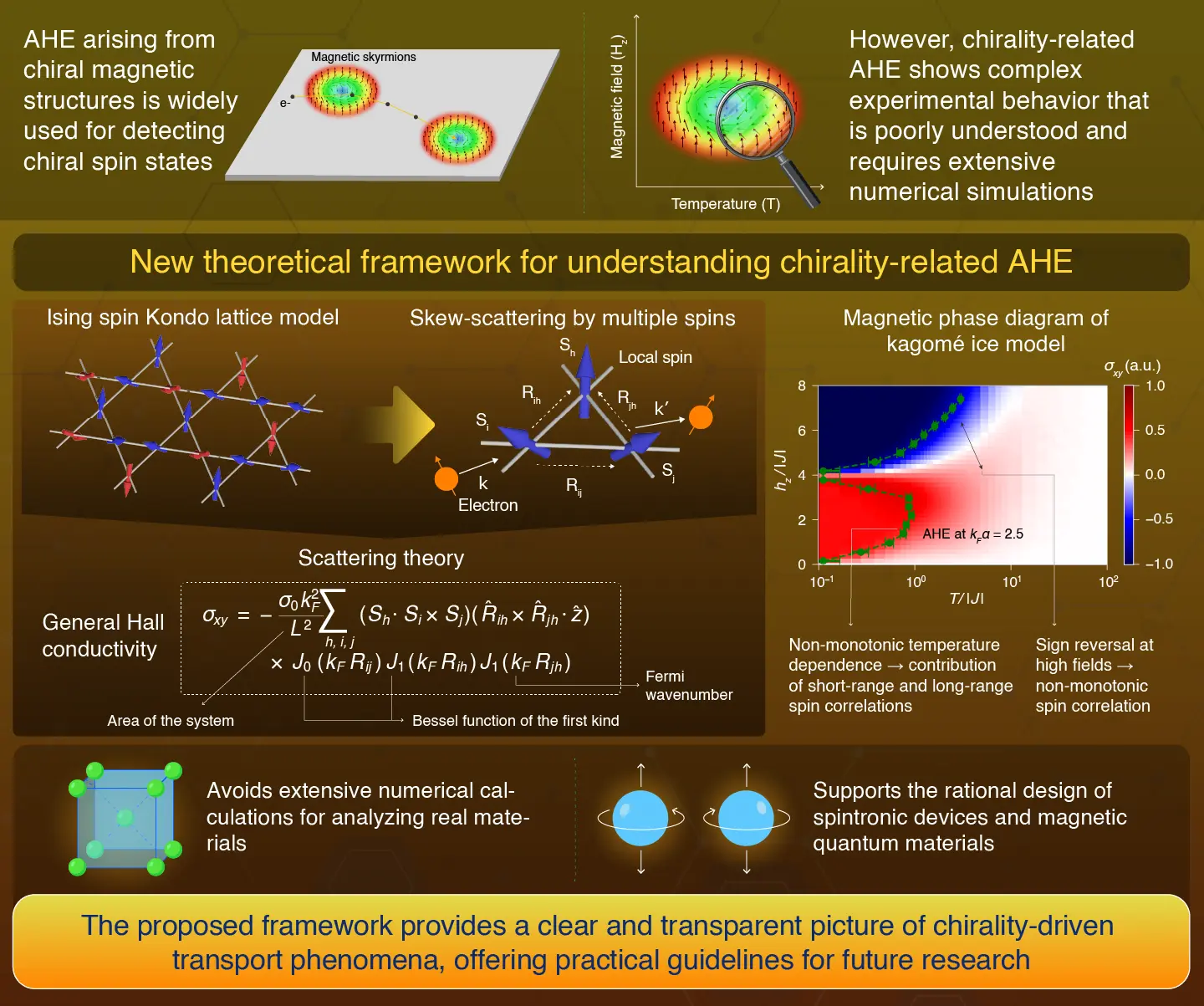
Magnetic materials exhibit a variety of intriguing properties during their magnetization process that reflect their magnetic states and excitations. These properties are studied by applying an external magnetic field to the material, producing the magnetization curve. Magnetic metals additionally demonstrate rich behavior in transport phenomena, referring to the flow of charge, heat, or spin under the influence of magnetic fields. However, some of these behaviors are difficult to probe using the magnetization curve. The anomalous Hall effect (AHE) is one such effect. In the AHE, when an electric current passes through a magnetic metal, a voltage perpendicular to the current arises even in the absence of an external magnetic field. By contrast, in the traditional Hall effect, such a transverse voltage appears only when an external magnetic field is applied.
Recently, AHE, originating from spin chirality, has become a popular method for detecting chiral magnetic structures, such as skyrmions, which are key to the development of next-generation spintronics and quantum technologies. However, in experiments, chirality-related AHE often exhibits complex behaviors, including unusual non-monotonic temperature dependence and even sign reversals, making clear detection of these structures difficult. A systematic understanding of such behaviors is currently lacking and, moreover, requires extensive numerical calculations.
To address this challenge, a research team led by Associate Professor Hiroaki Ishizuka from the Department of Physics at Institute of Science Tokyo (Science Tokyo), Japan, in collaboration with Professor Masafumi Udagawa from the Department of Physics, Gakushuin University, Japan, has developed a novel theoretical framework. "Our theory focuses on quantum phase interference during electron scattering by chiral spin textures, clearly explaining the puzzling temperature- and magnetic-field dependence of the AHE in highly conductive metals," explains Ishizuka. Their study was published in Volume 135, Issue 25 of the journal Physical Review Letters on December 16, 2025.
The researchers studied the AHE using an Ising-spin Kondo-lattice model on a kagomé lattice, called kagomé ice, which is considered a basic model for investigating chirality-related AHE. Using scattering theory, they first derived a general formula for the skew-scattering AHE. The formula incorporates scalar spin chirality and radial wavefunctions of electrons at the Fermi level, capturing contributions from different spin correlations. To examine the temperature and transverse magnetic-field dependence of the AHE, the researchers applied this formula in a Monte Carlo simulation.
The analysis revealed that the AHE exhibits non-monotonic Fermi wavenumber dependence and sign reversal across the magnetic phase diagram. "The Hall response oscillates and reverses sign as the Fermi wavelength changes—an effect rooted in the nodal structure of Bessel functions governing quantum interference," notes Ishizuka.
Importantly, the theoretical model clarified the origin of these behaviors. At low magnetic fields, the competition between contributions from short-range and long-range spin correlations gives rise to non-monotonic behavior as temperature decreases. At high magnetic fields, the non-monotonic temperature evolution of spin correlations leads to a sign reversal of the AHE.
"These findings paint a clear picture of chirality-driven transport phenomena," remarks Ishizuka. "Our theoretical framework thus offers practical guidelines for analyzing real magnetic materials using first-principles calculations and experimental data, while also forming a foundation for the rational design of upcoming spintronic devices and magnetic quantum materials."
Overall, this study deepens our understanding of the AHE and may accelerate the development of next-generation spintronic and quantum technologies.
Reference
- Authors:
- Ryunosuke Terasawa1, Masafumi Udagawa2, and Hiroaki Ishizuka1
- Title:
- Sign reversal and nonmonotonicity of chirality-related anomalous Hall effect in highly conductive metals
- Journal:
- Physical Review Letters
- DOI:
- 10.1103/v97v-wpyx
- Affiliations:
- 1Department of Physics, Institute of Science Tokyo, Japan
2Department of Physics, Gakushuin University, Japan


