Newly developed method allows for dynamically switching chirality-a particular lack of mirror symmetry-to generate spin currents in semiconductors, report researchers from Science Tokyo. Their approach relies on reversible insertion and removal of small chiral molecules from the interlayer gaps of a layered, non-chiral semiconductor material using electrochemistry. The findings could pave the way for the development of novel chiral spintronic materials and technologies that do not rely on magnets or magnetic fields.
Controlling Chirality by Dynamic Electrochemical Intercalation
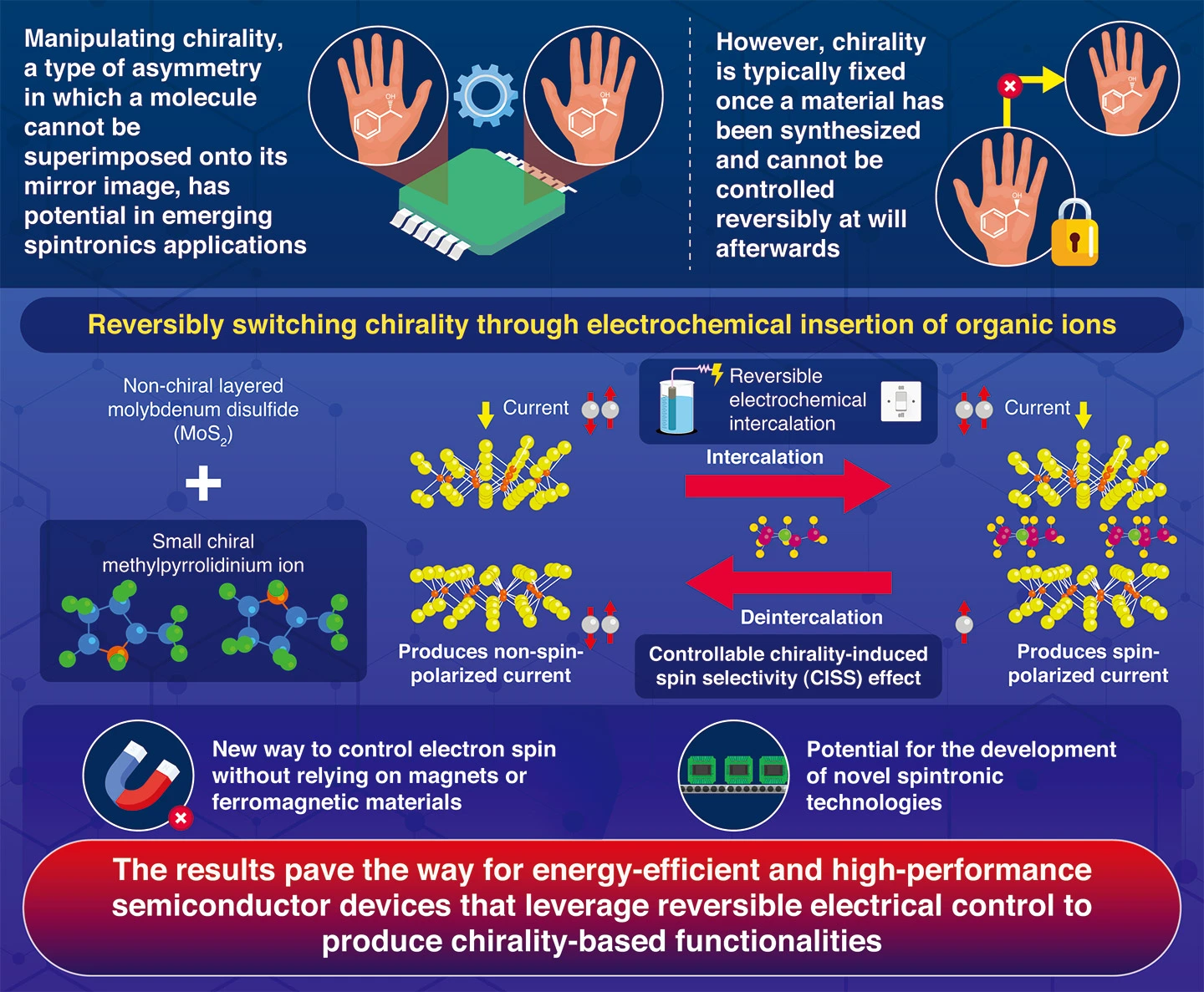
Modern electronics are rapidly approaching their fundamental limits as transistors continue to shrink, and challenges such as heat generation and energy consumption are becoming harder to overcome. For decades, researchers have looked to spintronics as a possible route toward faster and more efficient semiconductor technologies. This field exploits not only the electric charge of electrons, but also one of their intrinsic quantum properties known as spin. While spintronics is already used in modern hard disks, generating and controlling spin-polarized currents typically requires magnetic materials or external magnetic fields, limiting the possible designs of future devices.
A promising solution to this issue may lie in chirality-a geometric property where an object or molecule is distinct from its mirror image, just as your left hand cannot be superimposed on your right one. Certain materials made from chiral molecules can naturally filter electrons by spin when current flows through them via a phenomenon known as chirality-induced spin selectivity (CISS). However, chirality is usually a fixed property of materials and cannot be dynamically changed at will. Without a practical way to reversibly control chirality, scientists have been unable to use it in spintronic devices.
Now, a research team led by Professor Kouji Taniguchi from the Department of Chemistry, Institute of Science Tokyo (Science Tokyo), Japan, has cleared that hurdle. Their latest study was made available online on May 18, 2026, and published in Volume 20, Issue 21 of the journal ACS Nano on June 02, 2026. The team demonstrates that chirality can be reversibly switched on and off in a layered semiconductor by inserting (intercalation process) and removing (deintercalation process) small chiral molecules.
The team focused on molybdenum disulfide (MoS2), a layered semiconductor material whose atomic sheets are separated by nanoscale gaps. Using an electrochemical technique, they were able to reversibly intercalate and deintercalate small chiral molecular ions within the interlayer spaces. These molecules were small enough to enter and leave the material uniformly without damaging its crystal structure, allowing the process to be repeated multiple times.
The researchers then investigated whether the intercalated molecules altered the way electrons moved through the semiconductor. They found that when chiral molecules were present, the material exhibited the CISS effect, producing spin-polarized currents whose spin orientation depended on the "handedness" of the inserted molecules. When the molecules were removed, the effect disappeared. These findings indicate the existence of a chiral electronic state in a semiconductor material that is intrinsically achiral.
"Because the method developed in this study enables electrochemically reversible control of the insertion and extraction of chiral molecules, it becomes possible to switch the generation of spin-polarized currents on and off through chirality at will," explains Taniguchi. Interestingly, detailed analysis revealed that the chiral molecules do more than simply act as electron filters; they induce a chiral electronic state within the bulk of the non-chiral semiconductor.
The ability to repeatedly write and erase chirality in a semiconductor could open new directions for developing versatile, ultrafast, and energy-efficient devices. "Our results not only contribute to the development of a new principle for controlling electron spins, but also open the way to novel spintronic technologies that do not rely on external magnetic fields or ferromagnetic materials," concludes Taniguchi.
Reference
- Authors:
- Po-Jung Huang1,*, Hiroaki Kusunoki1, Daisuke Nishio-Hamane2, and Kouji Taniguchi1,*
*Corresponding authors
- Title:
- Reversible On-Off Switching of Chirality via Electrochemical Intercalation Control of Enantiopure Molecular Cations in a Layered van der Waals Material
- Journal:
- ACS Nano
- Affiliations:
- 1Department of Chemistry, School of Science, Institute of Science Tokyo, Japan
2Institute for Solid State Physics, The University of Tokyo, Kashiwa, Japan