
A group of Connecticut researchers now better understand the current coronaviral landscape of wild and domestic animals in the northeastern United States
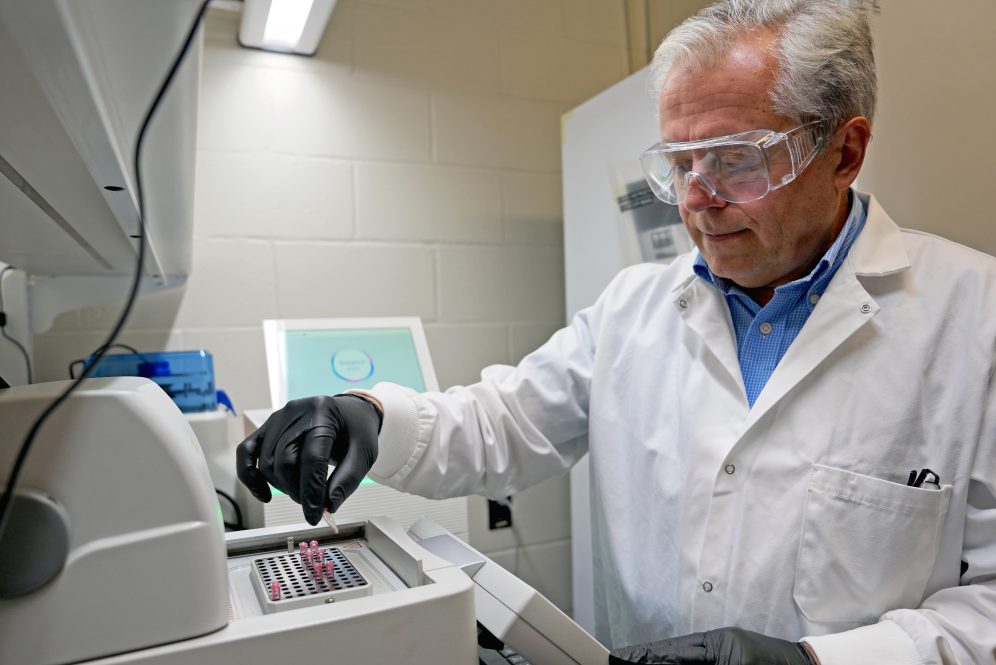
Guillermo Risatti of the Department of Pathobiology and Veterinary Sciences (PVS) in the College of Agriculture, Health and Natural Resources (CAHNR) works in the Connecticut Veterinary Medical Diagnostic Laboratory (CVMDL) in the Wilbur O. Atwater Laboratory (ATWR). Sept. 12, 2023. (Jason Sheldon/UConn Photo)
During the first few years of the COVID-19 pandemic, the virus SARS-CoV-2 was detected in a number of non-human animal species. This included wild animal species as well as domestic animals such as dogs and cats.
The Connecticut Veterinary Medical Diagnostic Laboratory (CVMDL) confirmed the first instance of SARS-CoV-2 in a dog in Connecticut in 2021.
Coronaviruses can have a very broad host range and jump across animal species. This ability was at the root of the SARS CoV-2 virus crossing the animal-human boundary to trigger the COVID-19 pandemic.
In some animals, like the white-tailed deer and mink, scientists found that the virus spread readily within the species, and then, with newly acquired mutations, spilled back into the human population. This sparked concern that a parallel evolution of SARS-CoV-2 in animals could create a more transmissible or pathogenic variant that could reignite a surge in human infection.
A group of Connecticut researchers recently conducted surveillance studies to understand the current coronaviral landscape of wild and domestic animals in the northeastern United States.
This study was a collaborative effort between the CVMDL in UConn's College of Agriculture, Health and Natural Resources (CAHNR), Yale University, and the Connecticut Agricultural Experiment Station. The study appears in Scientific Reports and was previously highlighted in Yale News.
They found that while SARS-CoV-2 continues evolving in humans, its grip on the animal kingdom seems to be weakening.
"This is good news as this reduces the chance of spillback of newly evolved animal variants into humans," says Caroline Zeiss, professor of comparative medicine and of ophthalmology and visual science at Yale School of Medicine (YSM) and senior author of the study.
"Ongoing monitoring is essential, particularly for viruses that are capable of infecting many species such as corona and influenza viruses. Long-term surveillance of wildlife and animals living close to humans gives us a unique chance to spot new pathogens that might spread to humans or affect animal health."
UConn's CVMDL collected samples from wild and domestic animal species in the northeastern U.S. submitted for other diagnostics. These species included cats, dogs, ferrets, woodchucks, cattle, and more. They collected fecal swabs, oral swabs, or stool specimens. Deer and white-footed mice samples were collected either by Zeiss or through the CT Agricultural Experiment Station. In total, 889 animal samples were tested across these institutions.
Guillermo Risatti, CVMDL director and professor of pathobiology and veterinary science, says that many of the samples the CVMDL collected were from wildlife rather than domestic animals since people in Connecticut are more likely to come in contact with something like a deer or a mouse than a cow.
"We looked at a large number of wildlife [samples]," Risatti says. "We have very limited agriculture in Connecticut. But there could be a risk because of the wildlife infringement we have."
The CVMDL then sent the samples to Yale for analysis. There, researchers searched for coronaviral RNA using an assay method that can detect a broad range of coronavirus types. Positive samples were then sequenced to identify the coronavirus species within the sample.
To complement the surveillance study, they conducted experimental infections of white-footed mice, the most common wild rodents in the area, at Yale using the original strain of SARS-CoV-2 and the more recent Omicron variant.
Through both the surveillance and lab studies, the researchers detected several kinds of animal coronaviruses in samples from seven different species, though none of them had SARS-CoV-2.
When they infected the white-footed mice with SARS-CoV-2, the mice could catch both the original and Omicron variants, though they didn't shed as much of the virus with the Omicron variant and did not transmit it between them. Importantly, the original strain could spread among the mice, but neither the original nor the Omicron version could jump to another species like hamsters.
Taken together, researchers say, the findings suggest that as SARS-CoV-2 continues evolving in its preferred host (humans), successive variants may be losing their affinity for non-human animals.
While the risk of animal-to-human transmission for SARS-CoV-2 may be waning, new diseases with the potential to spread between species are a constant threat.
"For us, this was a project looking forward," Risatti says. "[We hope federal agencies] will support this kind of surveillance, in this case coronaviruses, but also pathogens that may show up that we don't know anything about."
Risatti says he also hopes that the CVMDL will be able to transfer the expertise the researchers at Yale developed through this project to their own facilities.
"The idea is to bring this to UConn and make it a center for the northeast for emerging diseases in animal health and public health, a concept known as One Health," Risatti says.
This research was funded by the United States Department of Agriculture (Zeiss, PI) and by the Centers for Disease Control and Prevention as part of integrated tick management studies
This work relates to CAHNR's Strategic Vision area focused on Enhancing Health and Well-Being Locally, Nationally, and Globally.


