
Blacksmith and artist Gustav Thane has developed a theory in his doctoral thesis that explores how craft knowledge can be used as an analytical tool in research.
How does a craftsperson think through their hands? And what happens when the knowledge developed in the workshop is given a place within academia?
In his doctoral thesis, blacksmith and artist Gustav Thane investigates how craft experience can function as a way of producing and analysing knowledge. Drawing on the practice of blacksmithing, he has developed what he calls Workshop Floor Theory - a theoretical framework for describing the kind of thinking that emerges through materials, movement and practical experience.
- Craft is often used as research material, but more rarely as a way of thinking and analysing research. I wanted to develop a language for the knowledge that exists from within craft practice, says Gustav Thane.
A Way of Getting to Know the World
Thane's research is rooted in many years of work as a metal designer and artist, specialising in liturgical metalwork and ecclesiastical art such as altarpieces, gravestones and candle holders. For him, craft is not merely a matter of technique, but a way of understanding the world.
- We place our thoughts into the physical environment around us, and the material responds to our actions. Craft is a way of getting to know the world that is both deeply personal and universally relevant at the same time.
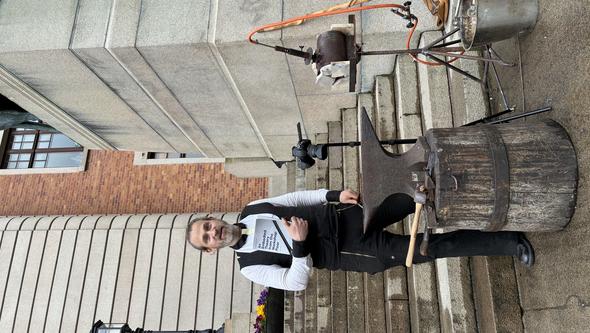
In his thesis, Thane describes how experienced craftspeople develop knowledge by reading and responding to the properties of materials. A blacksmith working with iron, for example, must constantly compensate for the way the material wants to move and change during the forging process. Thane argues that this kind of practical understanding can contribute new perspectives far beyond the field of craft itself.
- If we want to understand what craft skills can actually contribute to research, we also need a language for the thinking that is guided by craft experience. We can think through action, and the hands are among the parts of the body that most clearly bring together our intentions, experiences and surrounding materials. I am convinced that we can use this dual nature to reach entirely new ideas and solutions to academic problems.
For Gustav Thane, craft is not only about technique, but about a way of investigating and understanding the world. He hopes that his research will help experienced craftspeople make greater use of their practical expertise as a research method and a form of knowledge production.
- Craft contains a highly developed and productive way of generating new insights. I hope more people will have the opportunity to conduct research through the abilities they have spent years developing and refining.


