
Australian researchers have played a central role in a landmark result from the LUX-ZEPLIN (LZ) experiment in South Dakota - the world's most sensitive dark matter detector. Today, scientists working on the experiment report they have further narrowed constraints on proposed dark matter particles. And, for the first time, the experiment has detected elusive neutrinos produced deep inside the Sun.
Scientists hypothesise that dark matter makes up about a quarter of the Universe's mass (or 85 percent of its matter) but have yet to detect exactly what makes up this strange phenomenon. The result announced today by the LZ experiment is one of the world's most sensitive measurements in the hunt for dark matter. It has expanded its search for WIMPs (weakly interacting massive particles) down to masses approximately between that of three and nine times that of a proton, the positively charged particle in the nucleus of an atom.
Dr Theresa Fruth , from the University of Sydney's School of Physics, is one of only two Australian-based researchers in the 250-member international collaboration.
Dr Fruth, who was instrumental in commissioning the LZ detector in South Dakota, said the result marks a major milestone for the field.
"It's extraordinary that our detector is now sensitive enough to catch neutrinos from the Sun," Dr Fruth said. "We're opening a new window into solar and neutrino physics while simultaneously continuing the hunt for dark matter."
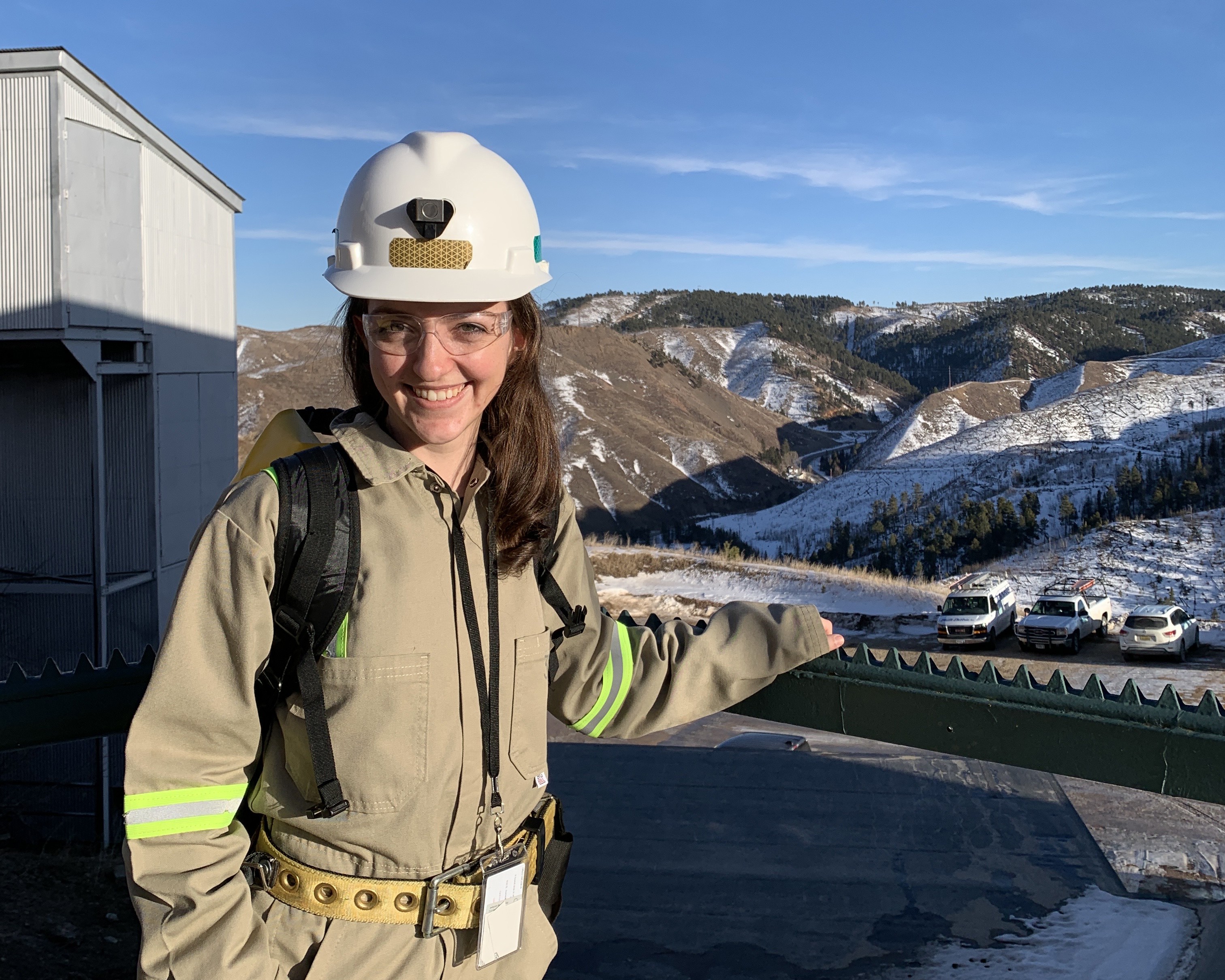
Dr Theresa Fruth at the LZ Experiment site in South Dakota.
Dr Fruth has worked on LZ for a decade, including at the University of Oxford and University College London, and continues to play an active role in operations and data analysis.
Joining her is fellow Australian collaborator Dr Robert James from the University of Melbourne, who led key aspects of the statistical inference underpinning the new results.
Dr James said: "LZ now boasts the world's first statistically significant observation of boron-8 solar neutrinos via neutrino-nucleus scattering, as well as world-leading dark matter exclusion limits above 5 GeV.
"It's been an exciting challenge to model the detector in this new regime, and I'm very excited for what comes next."
Both Dr Fruth and Dr James are members of the ARC Centre of Excellence for Dark Matter Particle Physics .
How the LZ Experiment works
Animation: Greg Stewart/SLAC National Accelerator Laboratory
Deeper into dark matter parameter space
To produce this result, the LZ detector - a 10-tonne, ultrapure liquid xenon experiment located a kilometre underground at the Sanford Underground Research Facility in South Dakota - completed the largest dataset ever collected by a dark matter experiment: 417 live days of data taken between March 2023 and April 2025.
The analysis, released today by LZ Experiment in the US, found no evidence yet for weakly interacting massive particles (WIMPs) - one of the strongest candidates for dark matter - between masses of 3 and 9 giga-electronvolts (GeV). This is the first search by LZ below 9 GeV, and the results set world-leading constraints above 5 GeV, narrowing the possibilities for what dark matter could be.
Dr James said: "These results confirm LZ's outstanding performance and pave the way for deeper exploration as the detector keeps collecting data through to 2028."
Dr Fruth said: "It might seem strange that scientists get excited by not finding dark matter. But by continuing to probe new possibilities, we are getting closer to our goal."
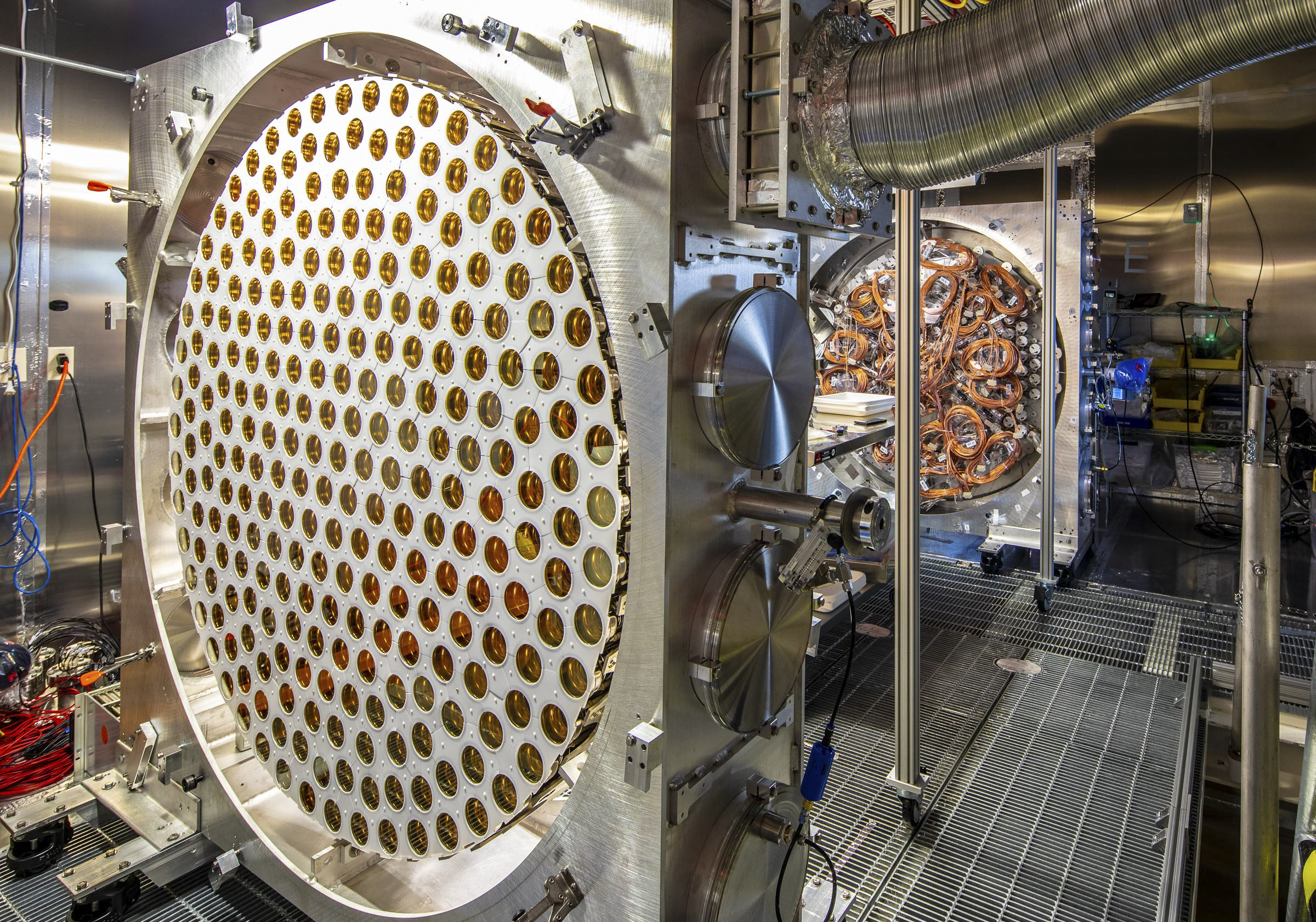
Lower and upper photomultiplier tube arrays are prepared for LZ at the Sanford Underground Research Facility in South Dakota. Photo: Matthew Kapust/SURL
Entering the neutrino fog: sensitive enough to see the Sun
LZ's sensitivity has now reached the point where it can detect neutrinos: ghostly, nearly massless particles that pass through matter almost undisturbed. Specifically, LZ has observed boron-8 solar neutrinos, produced by fusion reactions at the Sun's core.
Dr Ann Wang, a scientist at SLAC National Accelerator Laboratory in the US and co-lead of the analysis, said: "To maximize our dark matter sensitivity, we had to reduce and carefully model our instrumental backgrounds, and worked hard in calibrating our detector to understand what types of signals solar neutrinos would produce.
"With this dataset, we have officially entered the neutrino fog, but only when searching for dark matter with these smaller masses. If dark matter is heavier - say, 100 times the mass of a proton - we're still far away from neutrinos being a significant background, and our discovery power there is unaffected."
The boron-8 solar neutrinos interact in the detector through a process that was only observed for the first time in 2017: coherent elastic neutrino-nucleus scattering, or CEvNS. In this process, a neutrino interacts with an atomic nucleus as a whole, rather than just one of the particles inside it (a proton or neutron). Hints of boron-8 solar neutrinos interacting with xenon appeared in two detectors last year: PandaX-4T and XENONnT .
This sensitivity is both a triumph and a challenge: solar neutrinos can mimic the faint signals that LZ is designed to detect from dark matter. This so-called "neutrino fog" marks the point where neutrinos become a background for low-mass dark matter searches but also enables new neutrino and solar physics.
The results were presented on Monday 8 December in a scientific talk at the Sanford Underground Research Facility in South Dakota and will be released on the online repository arXiv. The paper will also be submitted to the journal Physical Review Letters.
The next generation: the XLZD detector
Members of the LZ collaboration - including Dr Fruth - are already working on the design of the next major dark matter experiment: XLZD, a next-generation liquid xenon detector combining the best technologies from LZ, XENONnT and DARWIN.
Dr Fruth served as lead editor of the XLZD Design Book, recently published in the European Physical Journal C , outlining how XLZD will become a true rare-event observatory capable of detecting a much wider range of neutrinos and dark matter candidates.
Australian excellence on the global stage
The ARC Centre of Excellence for Dark Matter Particle Physics is one of LZ's international partners, and Australian researchers continue to make substantial contributions to the global search for dark matter - one of the most profound questions in modern physics.
Dr Fruth said discoveries in this field often come from "many deliberate steps" over long periods.
"We know dark matter is out there - we see its gravitational fingerprints everywhere," she said. "This result shows our experiment is operating at incredible sensitivity. If dark matter interacts with normal matter in the range we're testing, LZ or its successors will find it."
Original media release
Media release from the Berkeley Lab is at this link .
Declaration
The researchers declare no competing interests. Dr Fruth's research is supported by the Australian Research Council Centre of Excellence for Dark Matter Particle Physics.
About the LUX-ZEPPELIN Experiment
LZ is supported by the U.S. Department of Energy, Office of Science, Office of High Energy Physics, and the National Energy Research Scientific Computing Center, a DOE Office of Science user facility. LZ is also supported by the Science & Technology Facilities Council of the United Kingdom; the Portuguese Foundation for Science and Technology; the Swiss National Science Foundation; the Australian Research Council Centre of Excellence for Dark Matter Particle Physics; and the Institute for Basic Science, Korea. Thirty-seven institutions of higher education and advanced research provided support to LZ. The LZ collaboration acknowledges the assistance of the Sanford Underground Research Facility.


