After 10 years of observing the shapes of 61 million distant galaxies, the UNIONS (Ultraviolet Near Infrared Optical Northern Survey) collaboration is sharing data that provides strong evidence supporting the standard model of cosmology that the universe is dominated by dark matter and dark energy.
The data was collected with the Canada-France-Hawaii Telescope using its ultra-widefield MegaCam instrument and covers 3,500 square degrees of the sky. This is the first survey of this scale conducted in the Northern Hemisphere. By measuring how gravity from dark matter distorts the appearance of the galaxies across the northern sky, which is an effect called weak gravitational lensing, they have revealed how matter is distributed across the Universe.
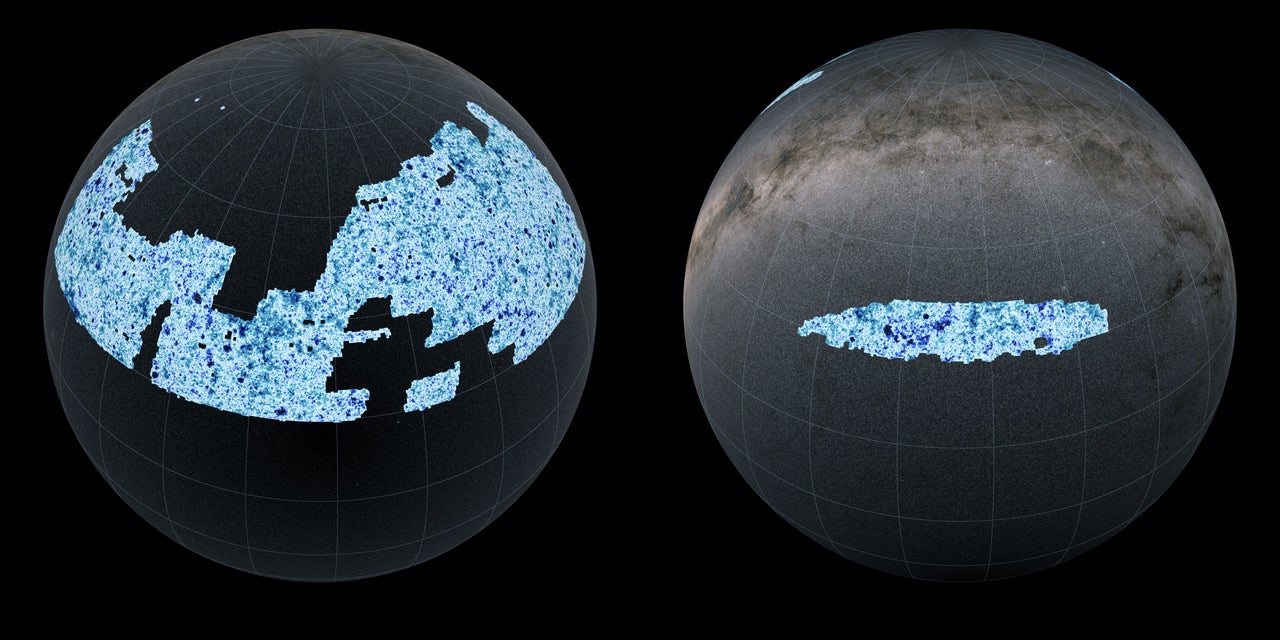
The UNIONS dark matter map projected onto the two hemispheres of the sky, with the Milky Way as seen by ESA's Gaia mission in the background. Dark blue marks regions denser than average, white the emptier voids between them. The gaps within the survey are from areas where the observations have not yet been processed, in the future these missing regions of the dark matter map will be filled in. Background: ESA/Gaia/DPAC. [Image credit: Calum Murray, Cail Daley, Andreas Tersenov]
"Previous work by other groups focused on the southern sky. What makes these data so exciting is that we used them to make the largest dark matter map of the northern sky," said Dr. Mike Hudson, lead of the UNIONS weak lensing team and Professor of astrophysics and cosmology at the University of Waterloo. "These results deepen our understanding of dark matter and the formation of structure in the universe."
Animated version of the dark matter map.
Along with these results supporting the standard cosmological model that the universe is dominated by dark matter and dark energy, they also set the stage for more advanced 3D mapping of the sky. The collaboration is now combining observations taken in multiple colours from CFHT-MegaCam, Subaru Telescope, and the Pan-STARRS telescope to reveal distances to individual galaxies. This takes a flat map of the sky and turns it into a 3D one.
The UNION collaboration's work is also tied to other important projects, such as the Euclid Space Mission, which Hudson is also involved in along with colleague Will Percival, a Professor in Waterloo's Department of Physics and Astronomy and Director of the Waterloo Centre for Astrophysics.