
The UAB, in collaboration with the helicopter company Helipistas, the risk management company Mitiga Solutions, and the Barcelona Supercomputing Centre (BSC-CNS), has developed a new wildfire propagation simulator with an innovative architecture that increases the speed and reliability of traditional systems, facilitating a faster and better-informed response.
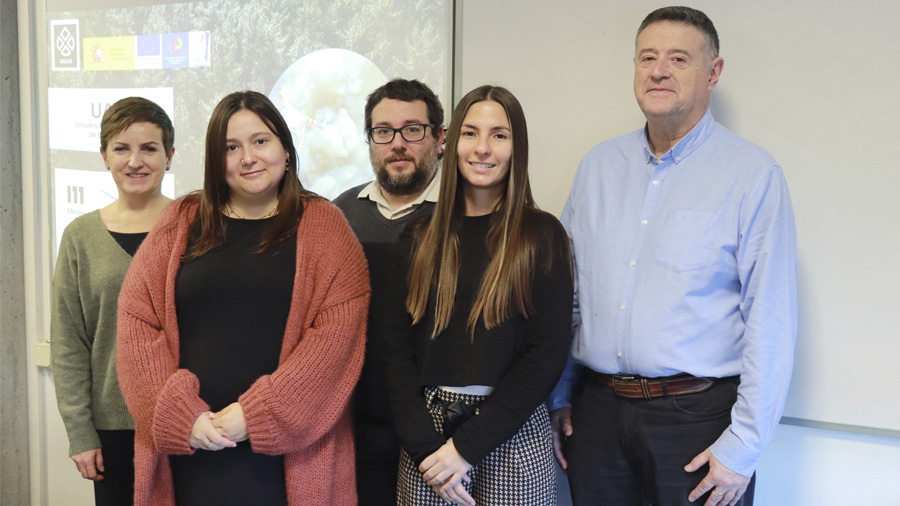
The new wildfire propagation simulator was developed by the High Performance Computing Applications for Science and Engineering (HPCA4SE) reseach group at the UAB as part of the Wildfire Risk Solutions for Spain (SALUS) project, funded by the Ministry for Science and Innovation through a call for public-private partnership projects. The project aims to improve the capacity for wildfire prediction, alerts and risk management in Spain.
The tool can predict how a forest fire will evolve in near real time, which is crucial for deciding where to act, what resources to deploy, and which areas need urgent protection. The simulator is based on an innovative propagation paradigm that uses a point cloud to represent the fire perimeter, instead of the traditional ellipse-based model. This new technique allows making much more accurate calculations of how the fire will advance at any given moment and at any given location, and guarantees fast, stable, high-resolution simulations.
"Unlike classic simulators, our prototype always reaches a result, solving problems encountered in other systems that either do not finish correctly or enter infinite loops", explains Ana Cortés, researcher at the UAB Department of Computer Architecture and Operating Systems. Participating in the simulator's development were also pre-doctoral researchers at the UAB Irene González Fernández and Paula Sánchez Gayet, and researchers Carles Carrillo and Tomàs Margalef.
Collaborating with Mitiga Solutions, a BSC spin-off, and Helipistas was key to making the project possible. The simulator is integrated into an early warning system developed jointly with BSC and Mitiga Solutions which is automatically activated when a potential fire is detected. The system can be activated in several ways, including via alerts from citizens using a mobile application, the detection of thermal anomalies by satellite, and information captured by operational helicopters.
In this sense, Helipistas has equipped its helicopters with LiDAR sensors, optical cameras and thermal cameras to capture the fire perimeter and the state of the vegetation in almost real time. This data is integrated with automatically updated meteorological information and vegetation maps using open data and artificial intelligence techniques, significantly improving the quality of predictions about the fire's evolution.
Once activated, the system runs hundreds of simulations simultaneously to show the potential spread of the fire. These are presented in the form of clear visual maps that can be viewed using a web viewer designed specifically to facilitate decision-making by emergency managers
Once activated, the system runs hundreds of simulations simultaneously to show the potential spread of the fire. These are presented in the form of clear visual maps that can be consulted using a web viewer designed specifically to facilitate decision-making by emergency managers.
"This visualiser has been designed based on simulation data that allows us to explore the evolution of the fire in space and time, and makes it easier to identify where, when and what type of infrastructure (for example, buildings or the railway network) could be affected", explains Jonas von Ruette, researcher in the Natural Hazards and Risk Analysis (NHaRA) group at the BSC.
Helicopter equipped with LiDAR sensors, optical cameras and thermal cameras. On the right, image of a simulation using the propagation probability map. @UAB
Improving risk management and insurance applications
As well as giving support to firefighting efforts, the tool developed by the UAB research team can be used to assess potential damage to infrastructure, such as the electricity grid, roads, and buildings. This information is crucial for public administrations and emergency services to plan protective measures and minimise the economic and environmental impact of fires.


