RICHLAND, Wash.-Two related discoveries detailing nanocrystalline mineral formation and dynamics have broad implications for managing nuclear waste, predicting soil weathering, designing advanced bioproducts and materials and optimizing commercial alumina production.
The two recently published studies combine detailed molecular imaging and molecular modeling to sort out how gibbsite, a common aluminum-containing mineral, forms and dissolves in exquisite detail.
Gibbsite self-assembly proceeds in a Tetris™-like fashion
Researchers at the Department of Energy's Pacific Northwest National Laboratory showed that small crystals orient themselves so their crystal lattices line up, then fuse to form larger gibbsite crystals. The resulting so-called mesocrystals are structures built from smaller, perfectly aligned nanocrystals. The study was published in Nature Communications.

The effect is similar to how players in the popular digital game Tetris™ rotate, align and translate pieces to form a solid plane of uniform blocks. In the game, players rotate a piece so it lines up with a slot. Oriented attachment requires particles to rotate so their crystal lattices co-align before they fuse. Likewise, particles must not only rotate but also slide into the right lateral position for particle stacking and crystal formation. Once a Tetris™ piece fits and the line completes, it locks and disappears. When nanoparticles align and slide into place, they lock together to form a larger, ordered crystal. The stronger the fit in a good lattice match, the easier the particles stick like a Tetris™ piece snapping into a perfect gap.
In the newly published study, the researchers found that in addition to attraction and twisting forces, the additional set of "sliding" forces is crucial for docking particles into uniform stacks. These sliding forces depend on particle shape, edge charge, and the water solvent where they are immersed.
"Recognizing the role of sliding gives us design knobs to steer whether particles assemble or stay dispersed," Zhang said. "That's valuable for both environmental prediction and process control."
Advanced electron microscopy, synchrotron-based X-ray scattering and molecular simulations combined to reveal the energy landscape that explains how two-dimensional nanocrystals move into place to build complex materials.
Gibbsite dissolves in pairs
In the complementary study, the research team discovered that gibbsite dissolves not by single building blocks peeling off one at a time, but in pairs or "dimers" from the crystal surface. This discovery challenges a long-standing assumption about how minerals break down and simultaneously helps explain puzzling patterns seen at the crystal surface during dissolution. The results are expected to have significant consequences for predicting dissolution rates under a wide range of natural and industrial conditions.
"You can think of the dissolution process like a team of water molecules taking apart a perfectly built brick structure," said PNNL postdoctoral researcher Xiaoxu Li, the study's first author. "For a long time, no one could directly see what those brick pieces looked like and how they were removed. We discovered that only one surface, or step edge, was actively dissolving and that one controls how fast the mineral dissolves."
Using high-speed atomic force microscopy to study dynamic processes, the scientists watched the zigzag edges on gibbsite crystals retreat as the mineral dissolved in an alkaline solution. Once started, this process is self-propagating, they noted, continuously driving the dissolution.
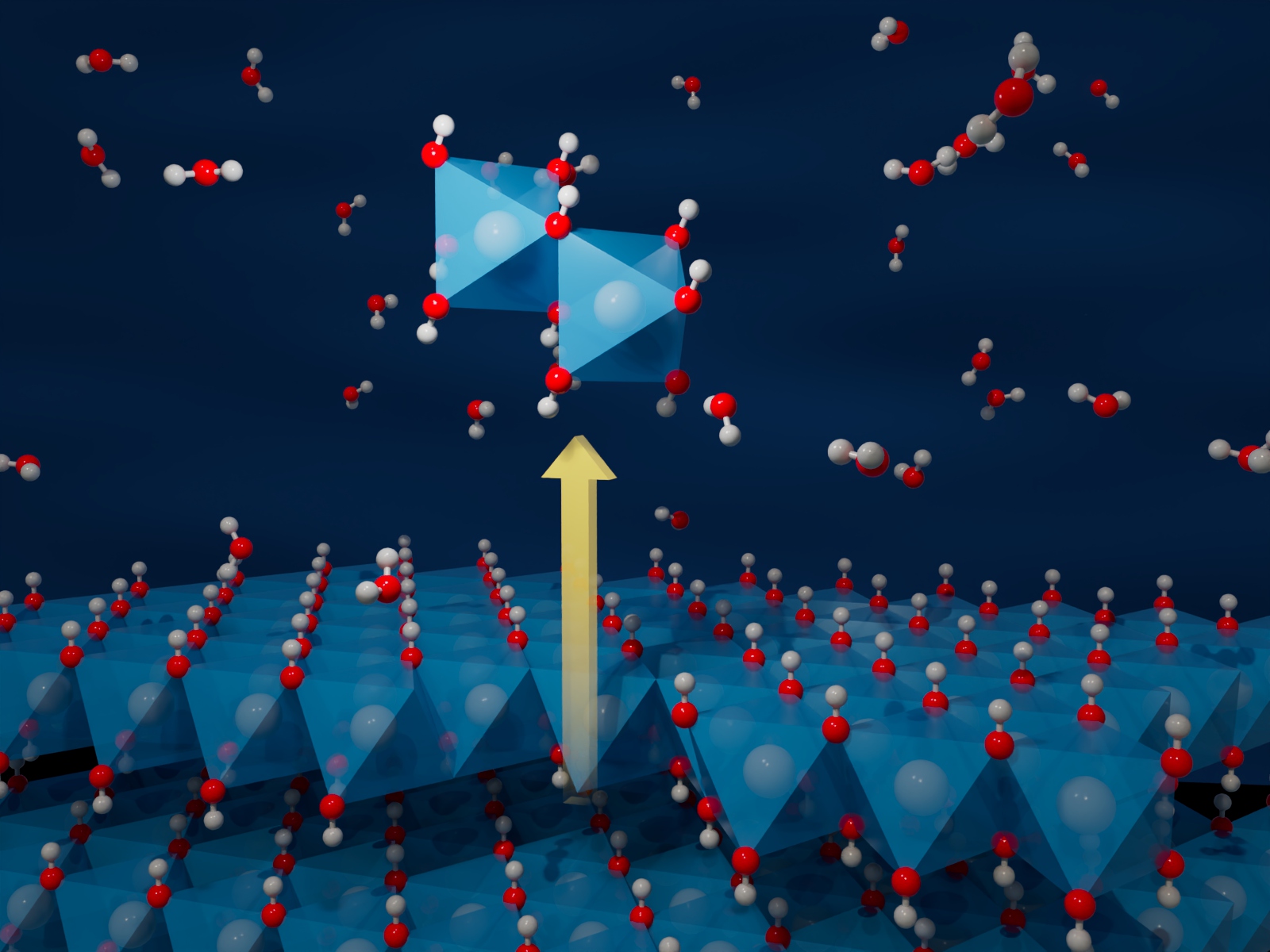
"The dissolution proceeds dominated by dimers, producing the jagged step edge that we observe," Li explained.
Machine-learning-assisted image analysis developed by collaborators at the University of Illinois at Urbana-Champaign helped to reconstruct the surface structure and track detachment events.
"The integration of high-speed high-resolution AFM imaging, machine learning, and theory was crucial," the PNNL project lead Xin Zhang added. "It's a true team result that lets us go from pictures to mechanisms."
The discovery that gibbsite can dissolve in larger units than previously thought connects crystal growth and dissolution pathways. In recent years, researchers have found that crystals can self-assemble by addition of dimers or even larger pieces, rather than only by single atoms or ions. This modern understanding of crystal growth by self-assembly has been advanced in large part by a team of PNNL scientists led by team member James De Yoreo, a PNNL materials scientist, a Battelle Fellow, and a co-author on the research.
"These findings now show that the myriad non-classical pathways by which crystals grow through self-assembly of multi-molecular units have their parallels in crystal dissolution and force us to rethink the way we interpret dissolution phenomena," De Yoreo said.
Challenging gibbsite crystals in nuclear waste
Together, these two discoveries improve the molecular understanding of processes central to fundamental materials science, designing advanced bioproducts and materials, geological weathering, and environmental management of aluminum-containing alkaline nuclear wastes such as those found in Cold War-era nuclear tank waste.
The challenge of remediating complex chemical waste found at the Hanford Site near Richland, Washington, where Pacific Northwest National Laboratory is located, motivates the work. One-third of the waste stored in underground tanks includes solid gibbsite crystals that resist being broken down from solid into liquid form.
Radiation chemists, geochemists, physicists, computational chemists, material scientists and chemical engineers are working together to understand the chemical phenomena of the hazardous tank waste through the Ion Dynamics in Radioactive Environments and Materials (IDREAM) Energy Frontier Research Center.
A recent analysis of gibbsite samples from wastes in Hanford tanks showed that similar mechanisms seen in the mesocrystal research may be at work in gibbsite aggregation under the complex chemical conditions present in Hanford radioactive tank waste. The Hanford-based gibbsite research was supported by an internal investment from PNNL.
In addition to Li, De Yoreo and Zhang, lead authors also include Kevin Rosso