
Key Takeaways
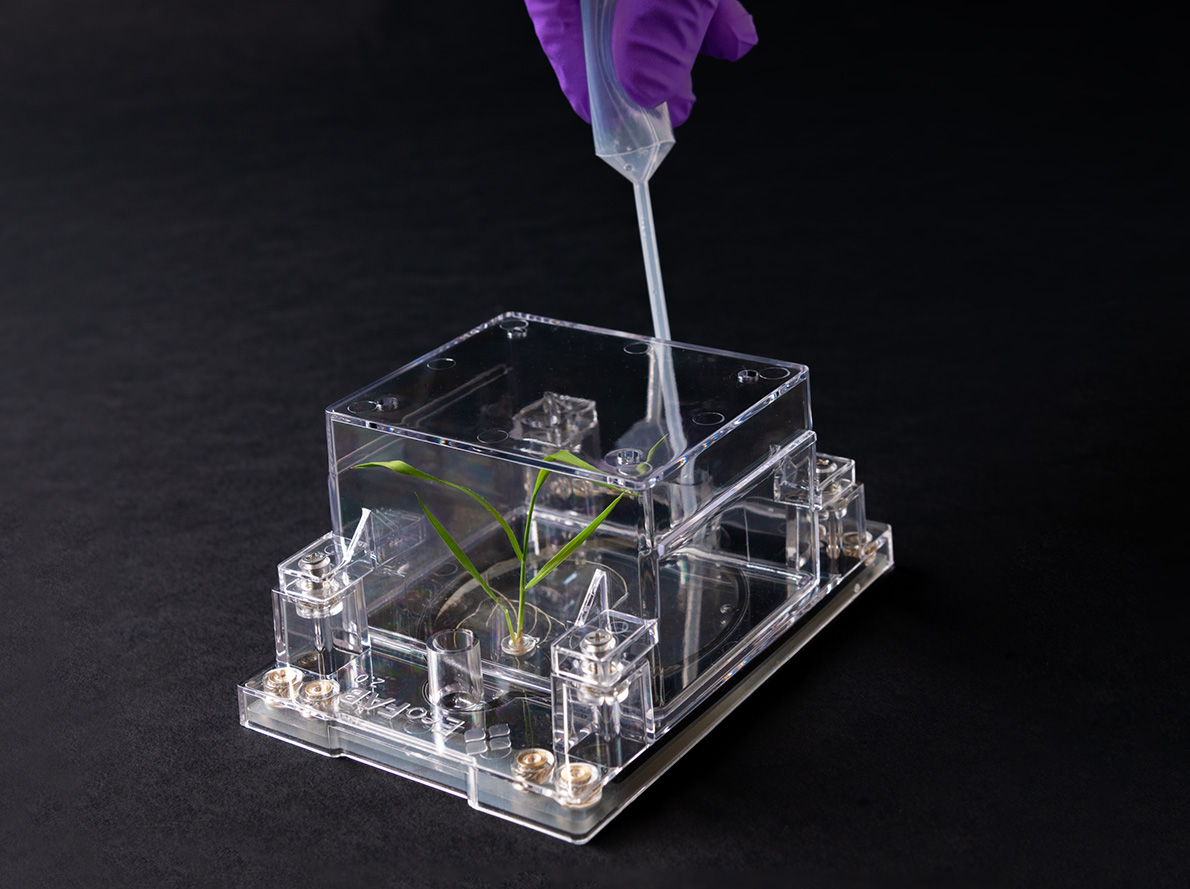
- EcoFABs are takeout-box-sized plastic chambers that give scientists a reproducible way to study plants and their root microbes.
- In a first-of-its-kind global study, scientists showed EcoFABs can deliver consistent results across labs on three continents, supported by open protocols, tools, and datasets.
- The reliable, large-scale data EcoFABs generate are ideal for training AI, which could help accelerate discoveries in crop development, soil health, and agriculture.
Harnessing the power of artificial intelligence to study plant microbiomes - communities of microbes living in and around plants - could help improve soil health, boost crop yields, and restore degraded lands. But there's a catch: AI needs massive amounts of reliable data to learn from, and that kind of consistent information about plant-microbe interactions has been hard to come by.
In a new paper in PLOS Biology, researchers in the Biosciences Area at Lawrence Berkeley National Laboratory (Berkeley Lab) led an international consortium of scientists to study whether small plastic growth chambers called EcoFABs could help solve this problem. Building on their previous work with microbe-free plants, the scientists used the Berkeley Lab-developed devices to run identical plant-microbe experiments across labs on three continents and got matching results. The breakthrough shows that EcoFABs can remove one of the biggest barriers in microbiome research: the difficulty of reproducing experiments in different places.
"If you want to make meaningful predictions about microbes and plants, especially with future AI models, you need clean, consistent datasets. EcoFABs provide exactly that." – Vlastimil Novak
"We all know the saying 'bad data in, bad data out," said Vlastimil Novak, first author of the paper and a research scientist in Berkeley Lab's Environmental Genomics and Systems Biology (EGSB) Division. "If you want to make meaningful predictions about microbes and plants, especially with future AI models, you need clean, consistent datasets. EcoFABs provide exactly that."
Study co-author John Vogel, who leads the Plant Functional Genomics Group at the Joint Genome Institute (JGI), added that the work builds on years of investment in model grasses. The JGI is a DOE Office of Science national user facility located at Berkeley Lab. "This project leverages the resources JGI has developed for Brachypodium to create a system where we can control the microbiome, the environment, and even the plant's genetics," Vogel said. "That makes it a powerful platform for reproducible integrative science."
A worldwide test
EGSB research scientist Peter Andeer developed the EcoFAB devices, simple clear boxes about the size of a takeout container, to enable scientists to grow plants in a controlled way. For this project, Novak and his colleagues provided EcoFAB kits and detailed protocols to labs led by Jeff Dangl at the University of North Carolina at Chapel Hill, Paul Schulze-Lefert at the Max Planck Institute for Plant Breeding Research in Germany, Borjana Arsova at the Jülich Research Center in Germany, and Michelle Watt at the University of Melbourne in Australia. Each kit came with the same seeds, the same set of 16 or 17 microbes, and step-by-step instructions.
"Deploying beneficial microbes in agriculture isn't as simple as adding them to soil," Dangl said. "They need to survive, establish inside the plant, and work alongside existing microbial communities. The EcoFAB Ring Trial helps us understand how to design microbes that thrive in diverse environments."
The need for these types of studies was highlighted in several workshops organized by Trent Northen, a senior scientist in the EGSB Division, to address the fundamental question: how can we perform microbiome experiments in a standardized and reproducible way? In reality, it was a logistical challenge. Shipping live microbes overseas required piles of paperwork, strict safety rules, and almost comical amounts of dry ice. "Just two small tubes of microbes had to be packed with 50 pounds of dry ice, and even then, one shipment melted in customs," Novak said.
Despite the headaches, every lab managed to grow plants in EcoFABs, inoculate them with microbes, and send back samples for testing at Berkeley Lab.
For the study, the researchers compared the effects of two microbial communities: one with 16 species of bacteria, and another with 17. The only difference was the presence of one particularly aggressive root colonizer, Paraburkholderia sp. OAS925.
Across every lab, this microbe consistently took over the plant's root environment when it was included. Plants with the microbe grew slightly smaller than those without it - a clear, repeatable result on three continents.
Scientists also studied root exudates, small molecules released by plant roots, that microbes feed on and serve as the "chemical language" between roots and microbes. Using specialized instruments, the team measured dozens of these chemicals and found that most patterns were the same across labs, proving the experiments were reproducible. A few unstable compounds, like dopamine, varied more, and some growth chambers ran warmer or cooler than expected, causing minor differences in plant size. But the big picture was clear: EcoFABs produced consistent results worldwide.
"The unique design of the EcoFAB allows us to monitor multiple interaction partners with different levels of complexity, reproducibly across labs worldwide," said co-author Borjana Arsova of the Jülich Research Center. "Because we can precisely control growth conditions and track development over time, we can start to untangle these multidirectional relationships - and ultimately apply that knowledge to improve agriculture."
Breaking the reproducibility barrier
Plant microbiomes play important roles in farming and the environment. The right microbes can help plants fight disease, grow in poor soil, and help build soil organics. But without a common system to study them, results from different labs have often been difficult to compare.
EcoFABs change that by acting like a "model system" for plant microbiomes - the way fruit flies transformed genetics or the plant Arabidopsis revolutionized plant biology. When scientists everywhere use the same tool, discoveries can add up faster.
Watt, who led the EcoFAB experiments in Australia, said the breakthrough is long overdue. "Translation of plant-microbiome benefits to the field has been slow because results vary so much between labs," Watt said. "This global study shows that EcoFABs break through that reproducibility barrier."
Fueling AI
The ability to generate big, reliable datasets is especially valuable for artificial intelligence. Training AI requires consistent information. With EcoFABs, scientists can feed AI clean data on how microbes affect plants and start to build models that predict what might happen in the real world.
"This study also provides some of the first data on the experimental variation between labs for these types of plant-microbiome studies which will be important to account for in AI models integrating data from multiple labs," Northen said.
Tools for the community
EcoFAB 2.0 devices can be accessed at no cost by scientists through the JGI's Community Science Program and the Facilities Integrating Collaborations for User Science (FICUS), which are proposal-based initiatives where projects are selected according to scientific merit and DOE relevance. The 17-microbe mix can be ordered from DSMZ-German Collection of Microorganisms and Cell Cultures GmbH, and detailed instructions - complete with narrated videos - are available online. Data from the new study are also freely available through the National Microbiome Data Collaborative, giving future researchers a benchmark to compare their own experiments. The project reflects Berkeley Lab's core values of collaboration and innovation, uniting teams with expertise to solve challenges.
Looking forward
Next, the team hopes to pair EcoFABs with robotics and advanced sensors to create a self-driving lab for these types of experiments. The current system, the 'EcoBOT,' could one day run experiments automatically, producing streams of high-quality data.
The ultimate goal is to design helpful microbial communities that promote bioenergy crop growth and soil health.
"Rigorous science means getting consistent results when asking the same question," said Paul Schulze-Lefert of the Max Planck Institute. "By collecting data from laboratories on three continents, this work shows reproducibility is possible in plant microbiome research - an essential step toward developing microbial probiotics for real-world agriculture."
Companies interested in licensing EcoFAB technology for production should contact Berkeley Lab's Intellectual Property Office at .
This research was funded in part by the Department of Energy's Office of Science.


