
16 December 2025
It's purple, sometimes white, sometimes prickly - and it has many different forms: the eggplant (also known as the aubergine). For the very first time, researchers have created a complete catalogue of genes and traits of the eggplant. Their findings pave the way for more robust, climate-adapted, and high-quality varieties that secure long-term crop yields and preserve diversity in agriculture. Jülich scientists were involved in the study along with teams from six other countries. Their findings have now been published in Nature Communications.
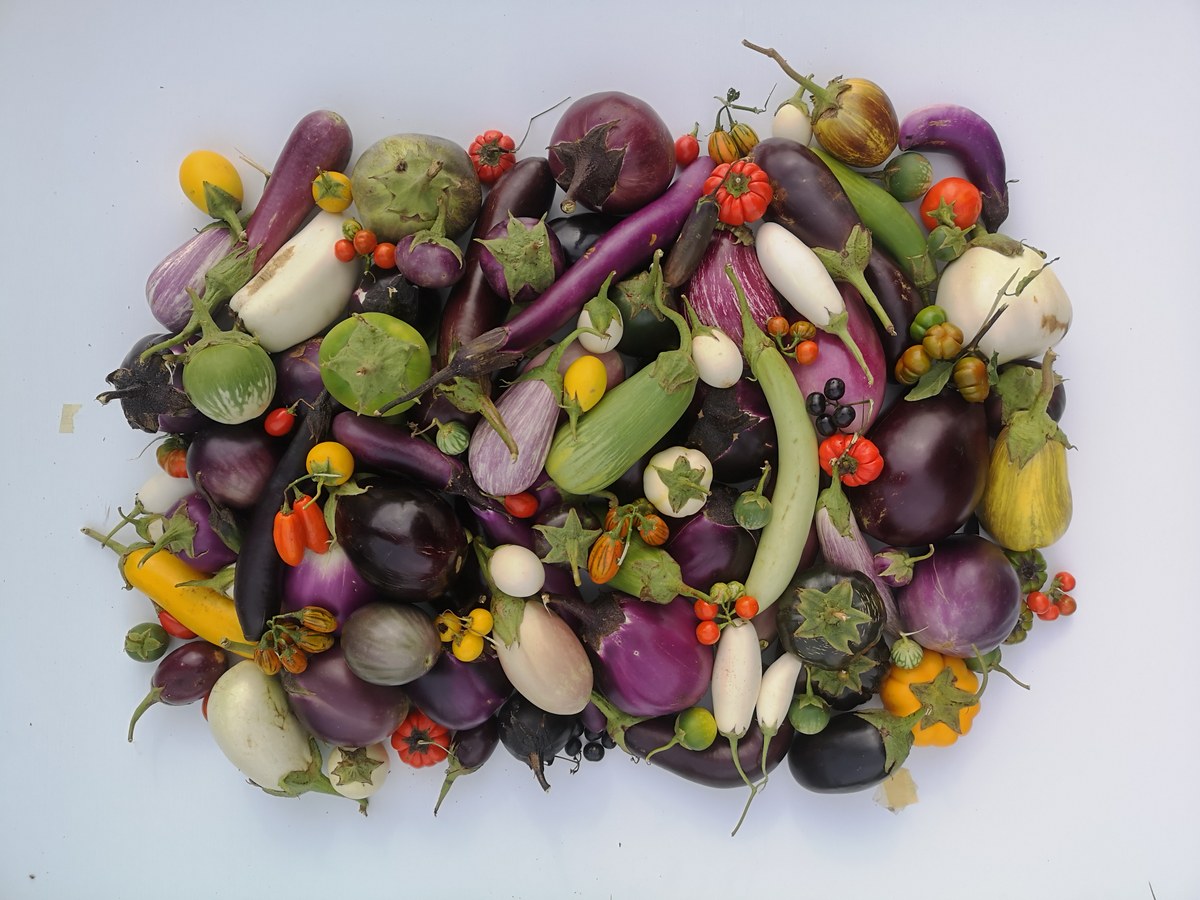
By decoding the "pangenome" - the entire gene set of all strains of a species - and the pan-phenome, which is the entire range of external and internal characteristics of a species, the collaboration has pioneered the creation of a dataset. The data show exactly which traits are genetic and which depend on the environment. This will enable a more targeted and accelerated breeding of new strains - with enhanced resistance or improved nutrient profiles. All of the genomic data and many of the investigated varieties will be made publicly available to the global research community.
Jülich expertise in an international collaboration
The project was jointly coordinated by Prof. Dr. Björn Usadel from the Institute of Bio- and Geosciences - Bioinformatics (IBG-4) at Forschungszentrum Jülich, Prof. Dr. Lorenzo Barchi from the University of Turin, and Dr. Giovanni Giuliano from the Italian National Agency for New Technologies. The Jülich team was responsible for sequencing and central bioinformatics analyses.
The project started with a collection of 3,400 varieties of eggplant, which the researchers used to reconstruct the plant's domestication history in India and South-East Asia and its expansion through Arab and Chinese trading routes to Europe and East Asia. This revealed how the characteristics diversified during the domestication: the varieties coming from India and South-East Asia have retained the non-purple skin colour and the spiny leaves characteristic of their wild ancestors, while these traits were progressively lost in the other geographical areas.
Project structure: from global diversity to genetic precision
For a detailed genetic and characteristic analysis, the team then focused on 368 representative varieties, including their wild ancestors. Their full genome sequences and 218 characteristics were determined - including characteristics that are important for agriculture, such as how well the plant can survive diseases, pests, or drought as well as the composition of the fruit. The trials were carried out in three different locations in Spain, Italy, and Turkey.
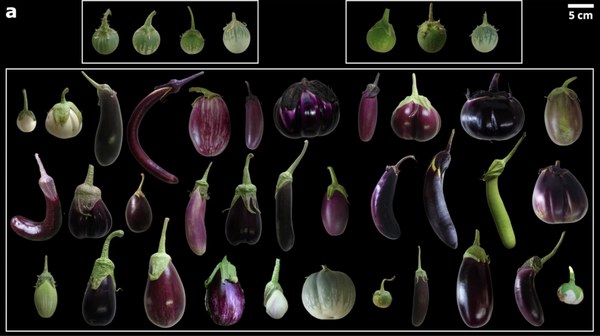
It was found that some characteristics were similar across all locations. These include, for example, the typical shape of the fruit or the number of seeds - characteristics that are primarily genetically determined. Other characteristics, however, changed considerably depending on the environment, such as the size of the fruit or the intensity of certain colours or aromas. Such characteristics are strongly influenced by climate and local conditions and are particularly important for breeding varieties adapted to the location.
In their work, the researchers used state-of-the-art nanopore sequencing. This is a technology that analyses ultra-long DNA fragments, enabling very precise insights into genomes. Combined with advanced bioinformatic techniques, a core genome was identified consisting of around 16,300 gene families, while around 4,000 variable gene families were found to create regional varieties.
"The pangenome that we have created using nanopore technology is really impressive," says Björn Usadel. "Thanks to intelligent bioinformatics, even complex characteristics can now be traced back to individual DNA mutations. This understanding helps us to identify specific characteristics that make plants more resistant - a crucial step for breeding under changing environmental conditions."
Key findings: from prickles to fruit quality
The team identified over 3,000 associations between genes and observable traits. These associations are particularly clear in the case of prickle formation, which complicates harvesting; the resistance to Fusarium, which is a fungal disease affecting eggplant productivity; and the contents of isochlorogenic acids, which ae antioxidants that cause the flesh of the fruit to brown. The results of analyses on the remaining 215 traits will be published in a follow-up paper.
Original Publication
Luciana Gaccione, Laura Toppino, Marie Bolger, Maximilian Schmidt, Maria Rosaria Tassone, Maria Sulli, Emily Idahl, David Alonso, Giuseppe Aprea, Paola Ferrante, Véronique Lefebvre, Hatice Filiz Boyaci, Roland Schafleitner, Stefano Gattolin, Richard Finkers, Matthijs Brouwer, Arnaud Bovy, Jaime Prohens, Ezio Portis, Sergio Lanteri, Giuseppe Leonardo Rotino, Giovanni Giuliano, Björn Usadel & Lorenzo Barchi. Graph-based pangenomes and pan-phenome provide a cornerstone for eggplant biology and breeding. Nat Commun 16, 9919 (2025). https://doi.org/10.1038/s41467-025-64866-1


