

<(From Left) Professor Jimin Park, Dr. Jaewoong Lee, M.S candidate Lian Lim, Ph.D candidate Changho Lee>
KAIST Research Team Develops a 'Bioelectronic Platform' for Precision Hydrogen Sulfide Delivery, Opening New Doors for Digital Healthcare and Precision Medicine
A toxic gas known for its "rotten egg smell" has been transformed into a therapeutic tool. A research team at KAIST has developed a technology to precisely control hydrogen sulfide (H2S) using electrical signals, bringing us one step closer to precision medicine that targets only the desired areas while minimizing side effects.
KAIST announced on March 23 that a research team led by Professor Jimin Park from the Department of Chemical and Biomolecular Engineering has developed a "bioelectronic H2S delivery platform." This platform can precisely regulate the generation and delivery of H2S at specific times and locations.

< Schematic Diagram of a Hydrogen Sulfide–Generating Bioelectronic Platform (AI-Generated Image) >
While H2S has long been recognized as a hazardous substance due to its odor and toxicity, it has recently gained attention as a "biological signaling molecule" that maintains cellular health and regulates protein functions.
In particular, H2S acts as a "chemical switch" that can modulate protein functions by subtly altering their conformations. However, its use in clinical therapy has been limited because it is difficult to control its concentration and deliver it precisely to specific sites. The research team solved these issues by implementing a technology that controls H2S delivery precisely like an electrical switch.
Inspired by the metabolic cycles of bacteria in nature, the team designed a system that generates H2S by applying electricity to thiosulfate ions (S2O32-), a precursor harmless to the human body. This method offers higher safety and precision compared to conventional chemical administration methods.
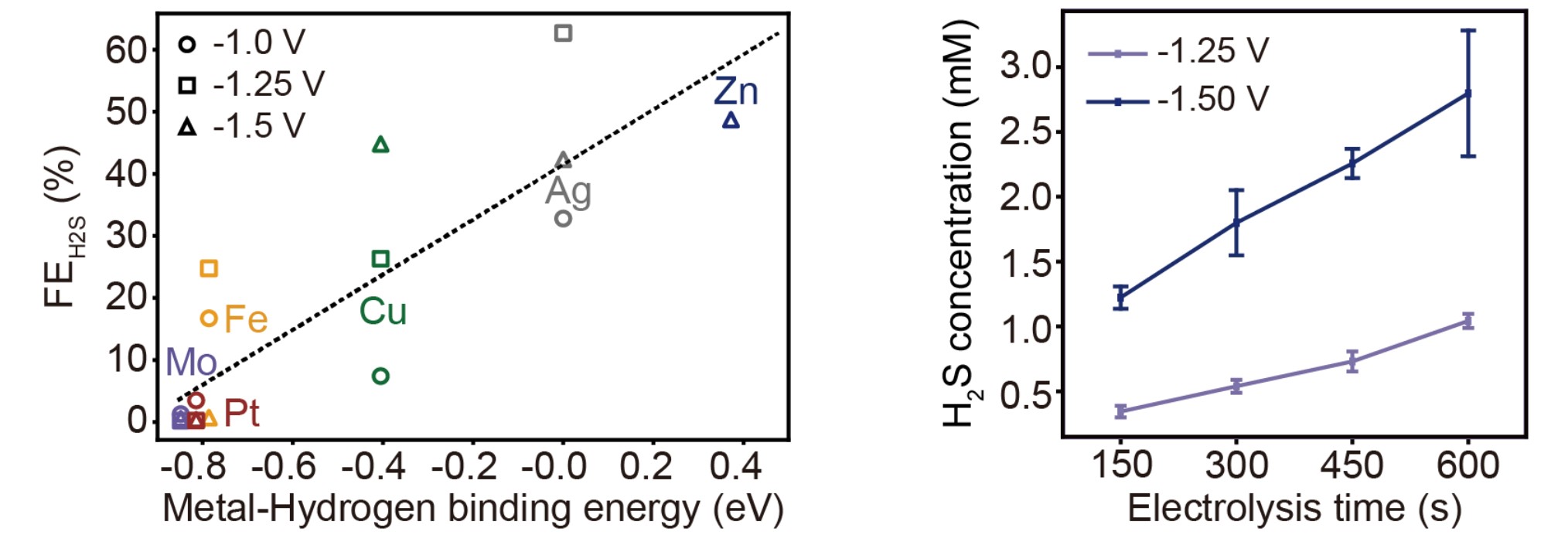
< Hydrogen Sulfide Regulation Capability Depending on Electrode Materials and Input Parameters >
Furthermore, through a comparative analysis of various metal electrodes, the team identified the "silver (Ag) electrode" as the most efficient material for H2S electrosynthesis. The Ag electrode selectively generates H2S with high electron transfer efficiency, allowing precise control over its production. Using this platform, both the amount and release kinetics of H2S can be finely tuned by adjusting the voltage and electrolysis time, enabling delivery at the optimal time based on the patient's condition or the treatment site.
When applied to human-derived cells (HEK293T), the research team successfully regulated ion channels (TRPA1), which act as an internal cellular "switch" for sensing pain and irritation. Notably, when applied to cells under oxidative stress (such as those with increased reactive oxygen species), the delivered H2S restored cellular redox balance and demonstrated protective effects. Minimal cytotoxicity was observed, confirming its safety for potential human applications.

< Spatiotemporal Regulation of TRPA1 Activation by a Hydrogen Sulfide–Delivering Bioelectronic Platform >

< Spatiotemporal Recovery of Oxidative Stress Using a Hydrogen Sulfide–Delivering Bioelectronic Platform >
Professor Jimin Park explained, "This study is significant in that it transforms H2S, once regarded solely as a toxic substance, into a new tool for regulating biological systems through precise electrical control." He added, "This technology holds great potential for expansion into precision medical devices for treating neurological and cardiovascular diseases, as well as digital healthcare for real-time health management."
This research involved Lian Lim, Changho Lee, and Jaewoong Lee as co-first authors. The study also included contributions from Myeongeun Lee, Yongha Kim, Tae Kyoung Lee, Gwangbin Lee, Jinsoo Kim, and Sang Yeon Oh, with Professor Jihan Kim as a co-author and Professor Jimin Park as the corresponding author.
The findings were published on March 19 in the internationally renowned academic journal Science Advances.
- Paper Title: Bioelectronic Synthesis of Hydrogen Sulfide Enables Spatiotemporal Regulation of Protein Modification and Cellular Redox
- DOI: https://doi.org/10.1126/sciadv.aeb3401
This research was supported by the National Research Foundation of Korea (NRF) through the Young Researcher Program and the Global Matching Program.

< Research Illustration (AI-Generated Image) >


