A brand-new exhibition jointly curated by the University of Nottingham Museum and Nottingham City Museums brings together, for the first time since the 1960s, the extraordinary discoveries from an early medieval cemetery at Broughton Lodge, Willoughby-on-the-Wolds.
Excavated between 1948 and 1968 as one of Nottinghamshire's pioneering community archaeology projects, the site – which contained around 120 graves dating from c. 475 to 580 CE (the Common Era) – is now recognised as the wealthiest and most exceptional cemetery of its date in the county, and among the most significant sixth-century burial grounds in England.
Curated by Christopher Loveluck, Professor of Medieval European Archaeology in the Department of Classics and Archaeology, and Ann Inscker of Nottingham City Museums and Galleries, the free-to-visit exhibition – The Anglo-Saxon Cemetery at Broughton Lodge, Willoughby-on-the-Wolds – opens on Friday 30 January and runs until Sunday 12 July at the University of Nottingham Museum at Lakeside Arts.
New research behind the 40 artefacts on display – which have never been reunited until now – draws on the recent advances in archaeological science, and reinterprets the evidence from the cemetery, creating a picture of a Nottinghamshire community with pan-European connections in the sixth century.
The remains of the sixth-century community at Broughton Lodge show us people in Nottinghamshire using objects and materials imported via river and sea-routes from across Europe, the Baltic and Mediterranean Seas, in a time of abrupt climate change and pandemics that has resonance with the present day.
Early excavations in the late 1940s and early 1950s found evidence of the Roman Fosse Way (now the modern A46), and the cemetery site was later discovered in 1963 due to additional roadworks for the construction of a flyover linking the A46 with the roads to Willoughby and Upper Broughton in Leicestershire.
It was these threats posed by the road construction which prompted local mathematics teacher and amateur archaeologist Malcolm Dean, working with volunteers, to make records of the cemetery from 1963 to 1968.
The Broughton Lodge excavations are a fantastic example of the power of a local community to save their own threatened heritage, unearthing what turned out to be one of the most important Anglo-Saxon cemeteries in the country. This new exhibition demonstrates community archaeology at its very best and I am delighted the public can enjoy the two collections together for the first time!
Continued study of the cemetery culminated in a full publication in 1993 by archaeologist Gavin Kinsley, which revealed the sites exceptional character and rare features – particularly the presence of 12 multiple burials, the largest number yet identified in any sixth-century English cemetery, and four horse burials. But since then, advances in archaeological science and new research questions have given the site renewed international significance.
The exhibition addresses the cemetery's remarkable concentration of multiple burials (single graves with two or more people interred), many dating to the mid-sixth century. Comparable sites elsewhere in England have shown links to the Justinianic plague pandemic, while climatic disruption following a major volcanic eruption in 536 CE may also have contributed to crisis conditions. Ancient DNA does not always survive, and preservation of skeletal material yielding DNA (teeth, the inner-ear bone) is poor at Broughton Lodge, so the academic team could not be certain that all the multiple burials represent plague deaths, but the cemetery aligns closely with wider evidence for population stress, famine, and disruption across early medieval Europe.
Professor Loveluck – who drew on findings from his previously published research on economic and climate evidence of the sixth century, from ice, and other sediment cores (Antiquity papers 2018 and 2025) – added: "The number of multiple burials is startling and clear evidence of societal stress or change in mid-sixth-century Nottinghamshire, perhaps resulting from a combination of volcanic-induced climate change making the climate wetter or colder and impacting on food production; bubonic plague, known to have been in eastern England from the mid-540s, and local stimuli. Recent research at Aldborough, in Yorkshire has shown that iron and lead production also crashed in the mid sixth century, in the same period as the multiple burials."
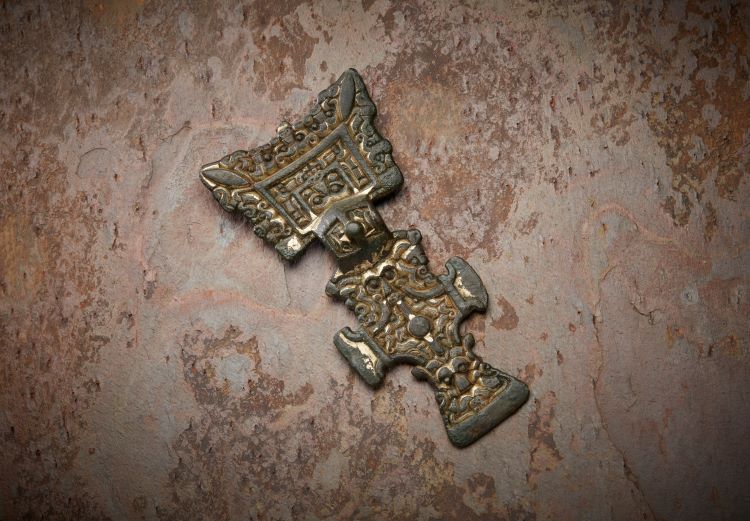
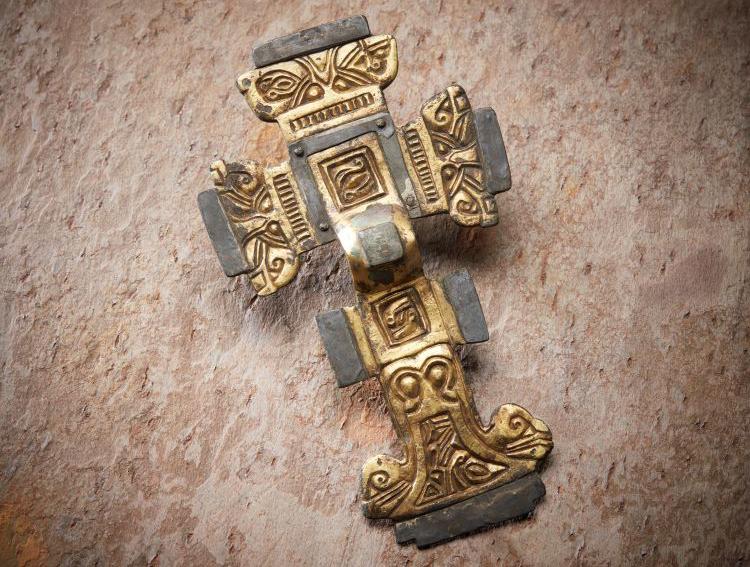
Objects displayed in the exhibition reveal the extraordinary reach of the community's connections. Raw materials travelled from the Baltic Sea and Mediterranean and the Indian Ocean, linking Nottinghamshire to global networks of exchange. Highlights include elephant ivory purse rings, traced to elephants probably from eastern Africa, and richly gilded brooches whose materials originated in the Byzantine world. These objects also provide rare data for studying long-term human impacts on biodiversity and global trade.
By uniting archaeological finds with cutting-edge research, the exhibition demonstrates how new scientific approaches continue to transform our understanding of early medieval Britain — and how a community excavation begun over 70 years ago now speaks to global questions of identity, crisis, connectivity and environment.
It highlights the long histories of resilience, adaptation and interdependence that underpin society today, reminding us that responses to climate stress, pandemics and cultural change have deep roots — and that understanding them can help inform how we face similar challenges in the present and future.
Professor Chris Loveluck, with Gavin Kinsley of York Archaeology will present an accompanying lecture at Lakeside Arts on 3 June 2026, about the pioneering community archaeology project at Broughton Lodge, where they will discuss the original published research from 1993, and add new perspectives from it on pandemics, climate change and biodiversity.
This exhibition has provided a wonderful opportunity to bring the finds together, show pioneering community archaeology work and share exciting new interpretations. The exhibition also has a wider public programme starting during the February half term with a free family drop in event on Saturday 14 February. Visitors can undertake craft related activities inspired by Anglo Saxon metalwork.
The Anglo-Saxon Cemetery at Broughton Lodge, Willoughby-on-the-Wolds, will be on display at the University of Nottingham Museum at Lakeside Arts, University of Nottingham, from Friday 30 January to Sunday 12 July 2026. Admission is free. Museum opening times are Thursday to Sunday, 12 noon to 4pm.
Visitors can also explore the metalwork and intricate knotwork designs of Anglo-Saxon artefacts in a free family-friendly workshop on Saturday 14 February 2026.