
Dr Charlotte Spence , Departmental Lecturer in Ancient History in the Faculty of Classics and Merton College , examines what lead curse tablets reveal about bargaining with the dead, and argues that cursing belonged to the wider religious life of the ancient world.

It is the season when the nights draw in, the mornings are misty, and the veil between worlds is thinnest. For thousands of years, festivals such as Samhain, All Hallows' Eve, and Halloween have drawn worshippers in an acknowledgement of the power of the dead. It is this power of the dead which is the focus of my research at Oxford.
My research initially takes an unassuming form: small pieces of heavily oxidised lead, which have lain undiscovered for thousands of years. I work on curse tablets; small lead tablets inscribed by hand by individuals from the ancient Greek and Roman worlds.
Our earliest tablets date to the late sixth century BCE and their use continues well into the next millennium, with scattered examples from the eighth and ninth centuries CE. The earliest examples are at times long and complex and deal with legal trials in Sicily; from Sicily their use spreads to mainland Greece until we have a pattern of use which stretches across every country surrounding the Mediterranean, up into the Northern European countries which were once part of the Roman Empire, as well as Russia and Ukraine.
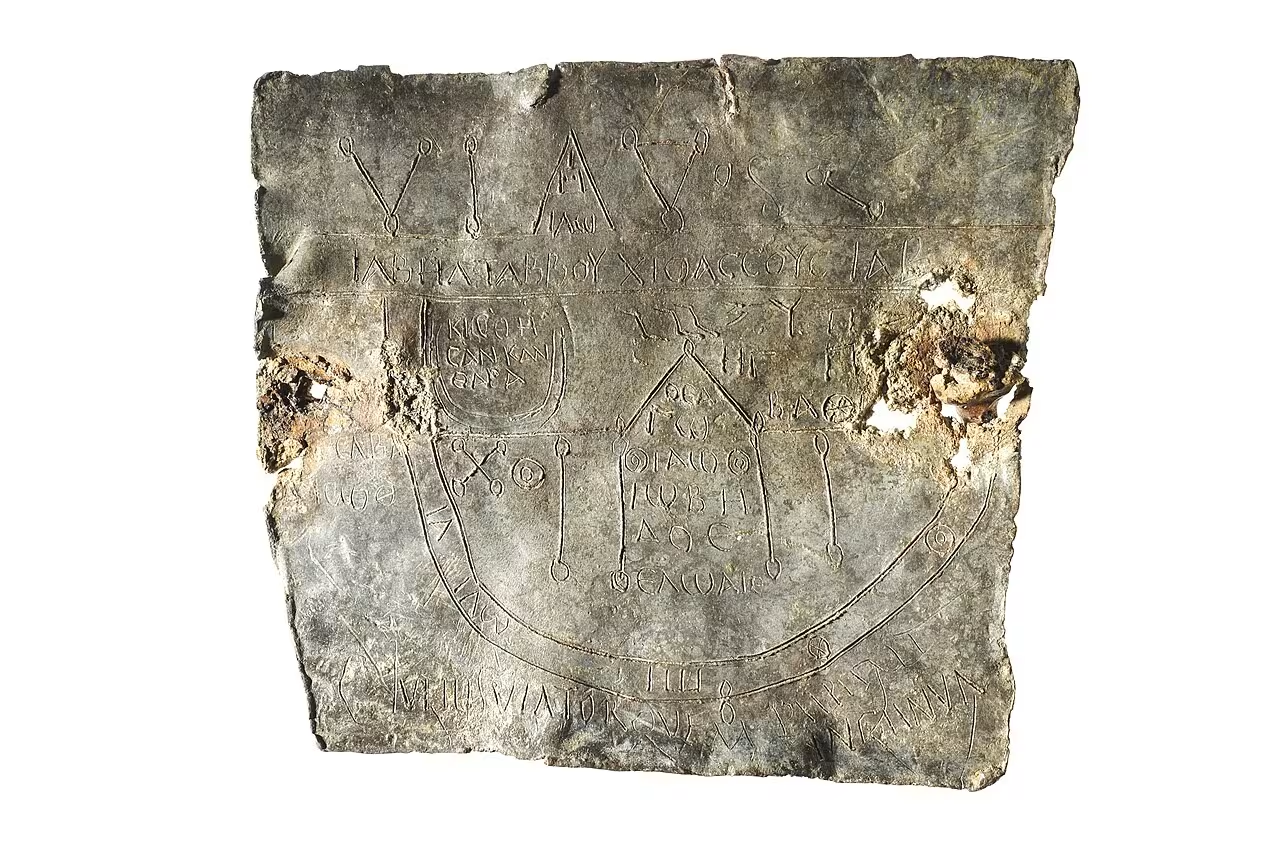
By GRM Tongeren - CC0, https://commons.wikimedia.org/w/index.php?curid=125613034

"Reciprocity, the act of giving something in return for the help of the gods (or people), is a cornerstone of ancient religion. You cannot visit a museum without being confronted by masses of objects which are described as votive offerings given in thanks. So, why is this element so absent in curse tablets? People are still engaging with supernatural powers, and there are festivals in honour of these powers, so they still fit within the wider religious culture or register. Is this therefore an issue of the magic versus religion debate? Should these acts be seen as being separate from those undertaken in more public religious worship?"
Curses that were never meant for human eyes
I find these tablets extraordinary because they were never meant to be viewed by other humans once they had been deposited (be that down a well, thrown into fire or a spring/fountain at a sanctuary site, or hidden in a grave), and this means that we are offered a direct glimpse into the worlds of ancient individuals and the trials they faced. Curse tablets have traditionally been divided into the following categories:
- Curses against thieves (also known as prayers for justice)
- Competition curses (those against charioteers and their horses, or choral competitions)
- Business curses (those against rival tavern owners or bronze workers)
- Erotic curses (sometimes referred to as 'love spells', but I assure you there is no love involved)
- Legal curses (often these are against witnesses in trials, where the curse asks that their tongues be bound so that they are unable to speak)
- Miscellaneous curses (those where the exact cause of their creation is unclear to us; usually these tablets consist of lists of names)
As well as being words inscribed on lead (usually, but not always; lead is just better preserved and therefore dominates our surviving examples), there are other interesting elements to their ritual creation. They can be folded or rolled (which makes depositing them into graves via offering tubes much easier); they can be pierced with a nail, once or multiple times; sometimes they are folded and then have a nail driven through; they can be written backwards, or in a spiral, or the letters can be completely scrambled; there might be powerful symbols or strings of vowels and letters; and they can include drawings of the victims or the powers invoked.
The powers invoked range from gods and goddesses, most commonly Hermes, to corpse-demons and members of the restless dead. It is this latter group which particularly interests me. There are four groups of the dead which can be considered restless, and these groups make sense to us in the modern world:
- Those who died before their time
- Those who died before marriage (particularly young girls and women)
- Those who died by violence
- Those who did not receive proper burial rites
A curse that offered the dead a reward
One of my favourite examples of a curse comes from ancient Olbia in the Black Sea region and dates to between the late fourth and early third centuries BCE. As there is often no way of internally dating these texts, such as through any mention of a known event, dating often relies on handwriting analysis known as palaeography, which is not an exact science and can lead to quite broad date ranges, such as this. It is from a grave and makes promises to the deceased person inhabiting it, in return for their help:
[ὥ]σπερ σε ἡμεῖς οὐ γεινώσκομε- ν οὔτως Εὔπο[λ]ις καὶ Διονύσιος Μακαρεύς, Ἀρι[σ]τοκράτης κα Δημόπολις, [Κ]ωμαῖος Ἡραγόρης ἐπὶ [δ]ινὸν πρᾶγμα παρα- γείνονται κ[α]ὶ Λεπτίνας, Ἐπικράτης, Ἐστιαῖος ἐπ᾽ ὅ τι πρᾶγμα [π]αρ αγ ϵίνονται, ἐπ᾽ ὅτι [---] να μαρτυρίην ο̣[ὗ]τοι <ἐκοι>νώ<ν>ησαν, ὧ[σπε]ρ ἡμεῖς σε. [ἤ]ν δἐ αὐτοὺς κατάσχῃς καὶ κι[ατα]λάβῃς (or π̣[αρα]λάβῃ?) ἐ<γ>ὼ δέ σὲ τειμήσω καὶ σο[ὶ] ἄριστον δ[ῶ]ρ- ρον παρασκε[υῶ]
Just as we do not know you, in the same way (we know) Eupolis, and Dionysios, Makareus, Aristokrates and Dēmopolis, Kōmaios, Hēragorēs are going to support a terrible case and Leptinas. Epikratēs, Hestiaios (we know) for whatever business they are going to support, for whatever act of witness they are coming together, in the same way that we (do not know) you. But if you restrain and hold down these men, I will honour you and I will give you the best present.
Greek text: Bravo (1987); translation: Esther Eidinow, Oracles, Curses, and Risk Among the Ancient Greeks (2013).
In this example, the plural is used by the people who have created the curse, so we have a kind of group effort in response to an upcoming trial. I love to think of this group discussing the exact language they are going to use, where they are going to deposit the tablet, and how they will actually carry out their promises to the deceased if the curse is successful. They list 10 names as victims and unusually do not include the names of their mothers (this level of specificity is useful in curses to make sure the exact victim is clearly identifiable to the power(s) carrying out the curse). I have highlighted in my work that special emphasis is given to the unknown nature of the person in the grave, which leads me to suggest that they fit into the category of having not received proper burial.
Interestingly here, the people creating the curse promise to release the deceased from this state if they help. This is a case of reciprocity not found widely elsewhere in curses, where it is much more normal to command the powers invoked to act. An exception is the prayers for justice category of tablets where individuals may give over a portion, or all of, what has been stolen to the gods. This therefore makes the theft a crime against the god rather than just the mortal victim.
Why do curses so rarely offer anything in return?
Reciprocity, the act of giving something in return for the help of the gods (or people), is a cornerstone of ancient religion. You cannot visit a museum without being confronted by masses of objects which are described as votive offerings given in thanks. So, why is this element so absent in curse tablets? People are still engaging with supernatural powers, and there are festivals in honour of these powers, so they still fit within the wider religious culture or register. Is this therefore an issue of the magic versus religion debate? Should these acts be seen as being separate from those undertaken in more public religious worship? I think not. I think individuals turned to the ritual practices which they thought most appropriate in that particular moment. They drew upon their wider socio-cultural experiences. The dead were understood to be powerful, and they were venerated at festivals; why would they not help?
So, as the nights get more restless and the dead become more accessible, with a skeleton to be found outside of every pub, perhaps we should beware of the requests being put to them.


