The UAB is hosting a new edition of the Ibero-American Congress of Egyptology, organised by the Institute of Ancient Near Eastern Studies, which began this Monday. The event has established itself as the premier showcase for Ibero-American Egyptology and will run until Wednesday 9 September, bringing together more than 160 participants from ten different countries.
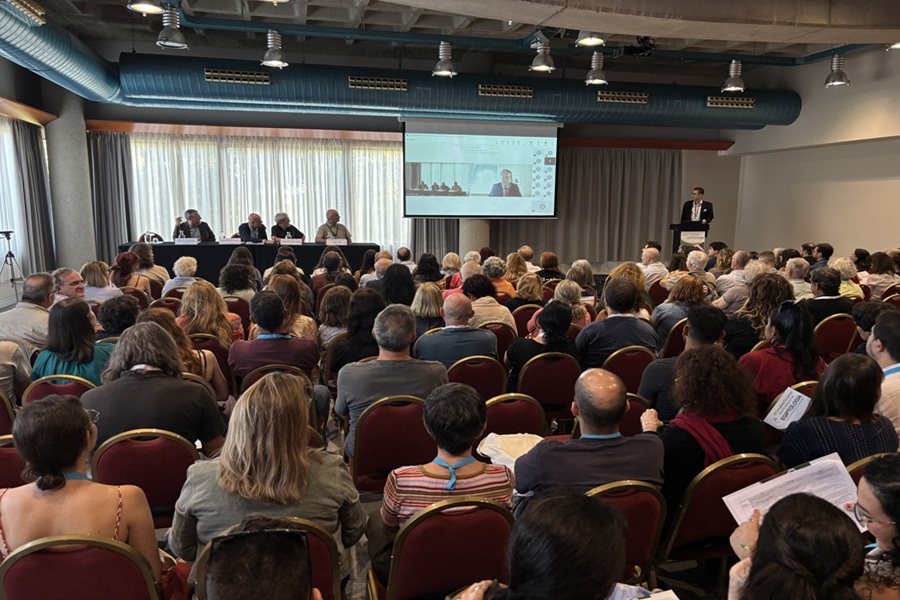
Deputy Vice-Rector for Strategic Planning, Francisco Morente, was responsible for welcoming the attendees, emphasising that the congress's extensive programme is a testament to the vitality of Egyptology in both Spain and Ibero-America. Morente highlighted the work of the UAB's Interuniversity Institute of Ancient Near Eastern Studies, directed by Egyptology Professor Josep Cervelló, and the importance of the Master's Degree in Egyptology offered at the UAB since 2009.
The Spanish ambassador to Egypt, Sergio Roman also took part online in the opening session, noting that this gathering "demonstrates the vitality and excellence of Spanish and Ibero-American Egyptology", and adding that "the dynamism of the current missions in Egypt is a testament to the excellence of our scientists".
Egyptology lecturer José Lull, chair of the organising committee, noted that this is the second time in history that the UAB has hosted this gathering. The first occasion was in 2001—twenty-five years ago—a period "in which the changes in Ibero-American Egyptology have been remarkable", he said, "not only due to the vast number of archaeological missions currently operating in Egypt but also because of the progressive consolidation of Egyptology within universities—a crucial development, given that training is vital as the source of future Egyptologists".
Marcelo Campagno, lecturer at the University of Buenos Aires and member of the congress's scientific committee, expressed similar views, highlighting how, over the past 25 years, Egyptology has "established itself as a discipline in the Ibero-American world, with students who train, work, travel, and compete on equal footing with their counterparts from other countries".
The latest discoveries in Saqqara
Josep Cervelló pointed out that although the field of Egyptology is in a very healthy state in Spain, it lacks its own area of expertise "that would allow us to grow properly, as happens in other countries". Cervelló presented the first paper at the congress, dedicated to the new discoveries made by the Spanish-Egyptian archaeological mission in the cemetery of Mariette, in the northern part of the Saqqara site. The Egyptologist explained the finds made in the latest campaign–April, May and June 2026–at the double mastaba of Yunmin and Iti. Work at this site began in 2023, although it was not until 2024 that the first on-site archaeological campaign was carried out. The discoveries made in the past year have enabled research not only into the tombs of the high priests from the late Old Kingdom but also into interesting aspects of the cemetery's urban planning. This has allowed for an understanding and study of the urban context and the relationship between buildings and streets, the dynamics of the landscape, and the use of the urban layout.
Three days of talks and presentations
Among the other notable contributions of the first day are the presentation of a unique Middle Kingdom tomb located at the funerary temple site of Thutmose III; the results of the C2 Project in the Valley of the Royal Cache; and a review of the origins of the Egyptian State. The second day will include presentations on the results of the 2024 and 2026 archaeological campaigns at the necropolis of Qaw el-Kebir, the recent excavations at tomb QH36 in Qubbet el-Hawa, a session on embalmers' workshops and another on the representation of the sky during the Amarna period. On the third day, a study on magical artefacts from ancient Egypt preserved in Spanish collections; an experimental study on bread-making during the Old Kingdom; an unpublished corpus of Egyptian amulets found in the necropolis of Cadiz, and new archaeological results from the Coptic church of Kom el-Ahmar will be presented. Before the closing, there will be the premiere of the documentary KKh19-22: Archaeological Diary in the presence of its director, Albert Triviño Massó.