
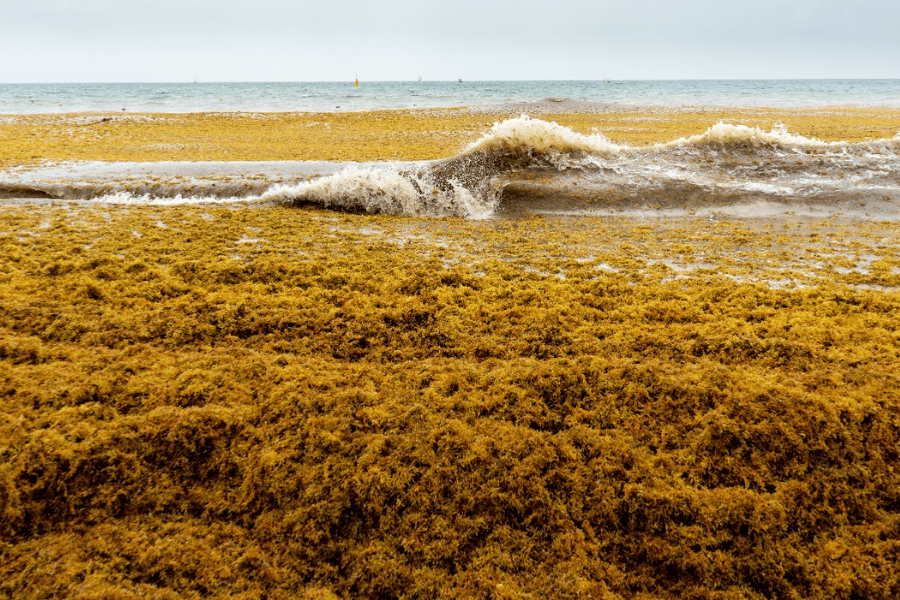
Each year, massive mats of pelagic sargassum drift across the Atlantic Ocean and wash ashore along coastlines from West Africa to the Florida Gulf. What begins at sea as a floating habitat for marine life quickly becomes a serious problem once it reaches land, smothering beaches, disrupting ecosystems and generating the familiar smell of rotten eggs as it decays.
As the scale of the sargassum blooms continues to grow, researchers at Florida State University are working on a different question: How to transform this mounting environmental challenge into a sustainable opportunity. A team of scientists at FSU, collaborating with colleagues at Florida Atlantic University (FAU) and Florida International University (FIU), has demonstrated that pelagic sargassum can be converted into a potential high-quality, functional food ingredient through targeted extraction and purification. Their findings were recently published in the journal Food Hydrocolloids.
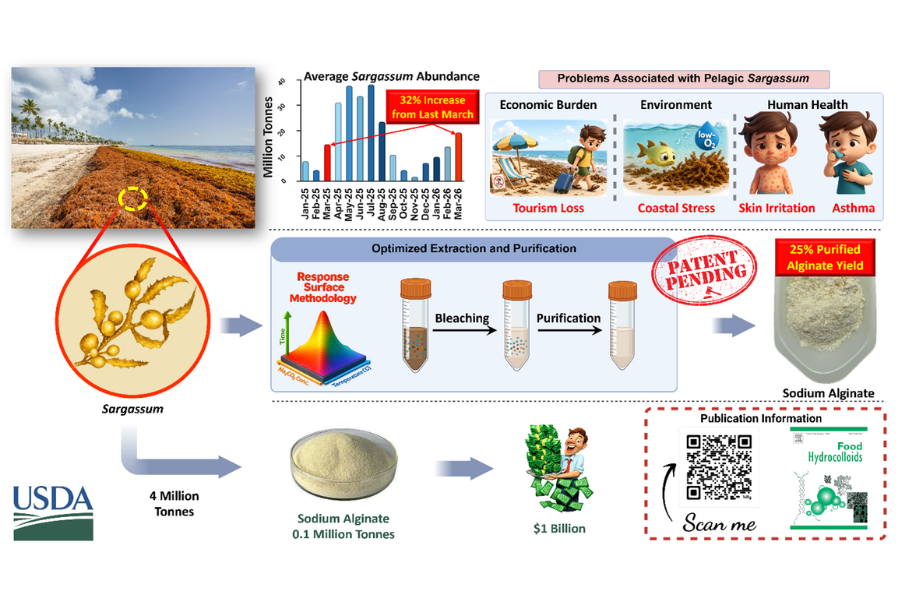
Their work comes at a crucial moment: In 2026, pelagic sargassum quantities are expected to reach unprecedented levels. Marine scientists estimate that this year's bloom is on track to be the largest ever recorded, potentially surpassing last year's peak of about 37.5 million metric tons (MMT). As of February 2026, more than 13 MMT of sargassum were already drifting toward Florida and the Caribbean, forming earlier than usual due to warming ocean temperatures and strong trade winds. Cleanup comes at a steep price: In Miami-Dade County alone, sargassum removal has previously cost an estimated $35 million per year.
Rather than focusing on removing sargassum and discarding it, the researchers investigated how to recover sodium alginate, a naturally occurring compound widely used in foods for thickening, gelling and stabilizing products such as salad dressings, desserts and plant-based alternatives.
"Right now, most washed ashore sargassum is treated as waste," said Qinchun Rao, corresponding author of the study and professor in FSU's Department of Health, Nutrition, and Food Sciences. "We wanted to explore whether this abundant biomass could be responsibly transformed into something useful."
"One of the most encouraging findings was that the recovered alginate retained useful functional properties," added Aravind Kumar Bingi, first author of the study and a doctoral candidate in Rao's lab. "That suggests this biomass may have value beyond cleanup and disposal."
Addressing safety and functionality
Pelagic sargassum is not suitable for direct human consumption due to its high salt content, fibrous structure and potential accumulation of heavy metals. However, the FSU-led team found that selective extraction and purification can isolate alginate while removing much of the unwanted material.
Crucially, the study showed that alginate derived from pelagic sargassum retains strong functional performance, comparable to that of commercially available alginates already used in food systems. Advanced analytical techniques confirmed that the alginate's chemical backbone remains intact, meaning functional differences are driven by physical structure rather than chemical alteration.
Looking ahead
The research team emphasizes that more work is needed before large-scale adoption, including performance testing in real food systems and continued monitoring of batch-to-batch safety. Still, the findings represent a critical step toward changing how pelagic sargassum is viewed - from an expensive nuisance to a renewable resource with real-world applications.
"Our long-term goal is to help turn an environmental burden into a safe, sustainable and value-added resource," Rao said. "If pelagic sargassum can be responsibly processed into functional ingredients, it could create new opportunities for food innovation while also supporting more sustainable approaches to managing coastal biomass."
With forecasts pointing to yet another record-breaking sargassum season, such solutions are becoming increasingly urgent.
This research was supported by the U.S. Department of Agriculture's National Institute of Food and Agriculture.


