
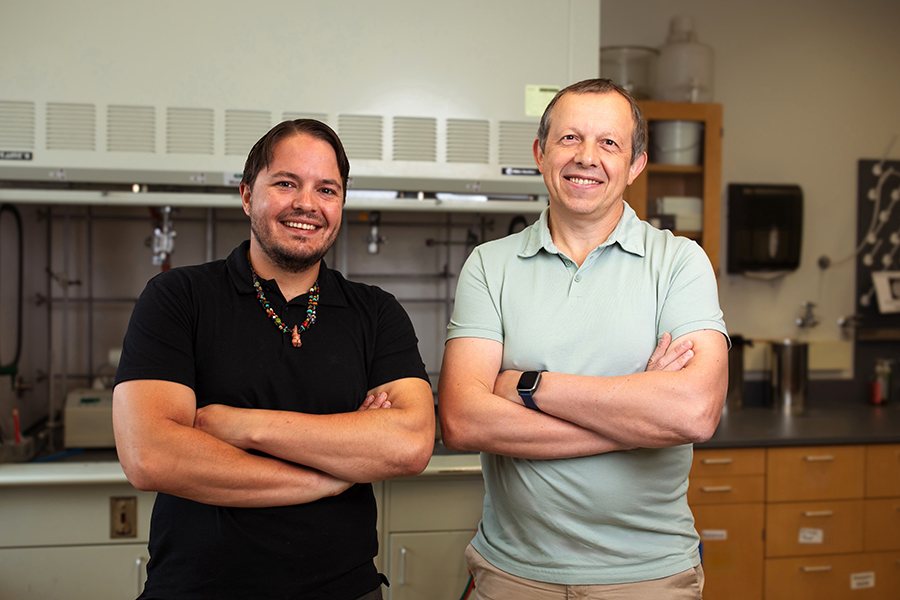
Florida State University researchers have created a new crystalline material with unusual magnetic patterns that could be used for breakthroughs in data storage and quantum technologies.
In a study published in the Journal of the American Chemical Society, the research team showed that when two materials with neighboring chemical compositions but different structure types are combined, they can form a new material that exhibits a third structure type with highly unusual magnetic properties.
Atoms in magnetic materials act as extremely small magnets, due to the property known as atomic spin. The spin can be imagined as an arrow indicating the direction of the tiny magnetic field produced by each atom. When many such spins add up, they can produce bulk magnetism by aligning their magnetic fields in the same or opposite directions. This is what happens in traditional magnets, such as those that are used in our computers and cell phones.
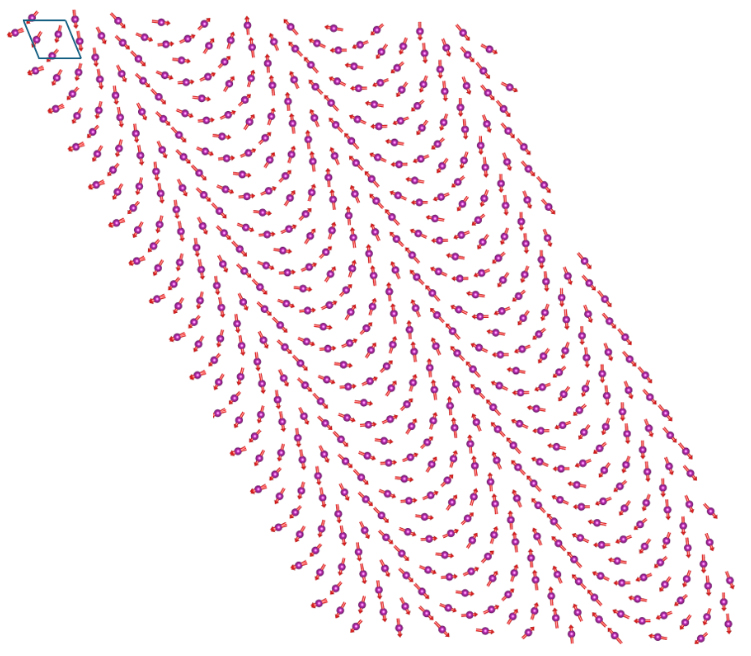
The FSU research team showed that their approach can be used to generate much more complex patterns of spins. These patterns are important because they determine a material's overall magnetic properties. In contrast to the traditional magnets, the spins in this new material form repeating swirls, also known as spin textures.
How it works
The researchers combined two chemically similar compounds with different symmetries in their crystal structures. This structural mismatch leads to "frustration," which indicates that both structure types become inherently unstable at the boundary between two chemical compositions.
"We thought that maybe this structural frustration would translate into magnetic frustration,'" said co-author Michael Shatruk, a professor in the FSU Department of Chemistry and Biochemistry. "If the structures are in competition, maybe that will cause the spins to twist. Let's find some structures that are chemically very close but have different symmetries."
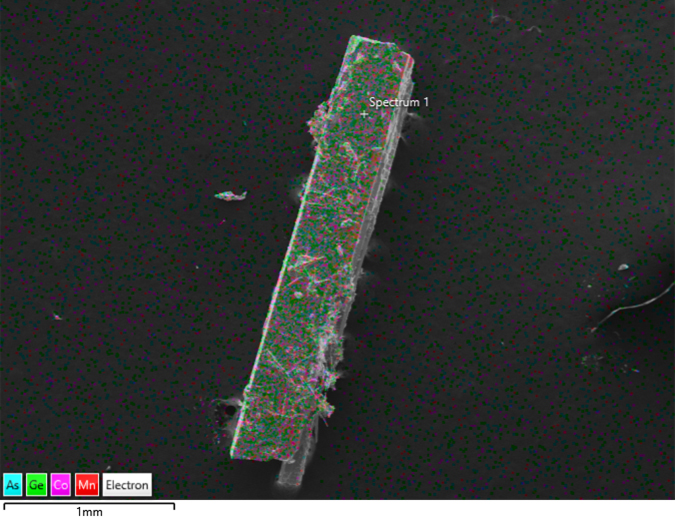
They combined a compound of manganese, cobalt and germanium with a compound of manganese, cobalt and arsenic. Germanium and arsenic are neighbors in the periodic table.
After the mixture solidified into crystals, the research team examined the product and found the distinctive cycloidal spin textures that they were seeking. Such swirls of spins are known as skyrmion-like spin textures, and the search for more ways to find and manipulate skyrmion-hosting materials is a cutting-edge research area within chemistry and physics.
To determine this skyrmion-like magnetic structure, the team collected single-crystal neutron diffraction data on the TOPAZ instrument at the Spallation Neutron Source, a U.S. Department of Energy Office of Science user facility at Oak Ridge National Laboratory.
Why it matters
This research could be used to develop hard drives with greater information density or improve electron-transport efficiency. Because using magnets to move skyrmions takes little energy, incorporating materials with these magnetic patterns into electronic devices could reduce power consumption. In massive supercomputers with thousands of processors, these lower power loads can lead to huge savings in electrical and cooling costs.
The research could also help point scientists and engineers toward promising materials that can help develop fault-tolerant quantum computing, which can protect fragile quantum information and operate reliably despite errors and noise - the holy grail of quantum information processing.
"With single-crystal neutron diffraction data from TOPAZ and new data-reduction and machine-learning tools from our LDRD project, we can now solve very complex magnetic structures with much greater confidence," said Xiaoping Wang, a distinguished neutron scattering scientist at Oak Ridge National Laboratory. "That capability lets us move from simply finding unusual spin textures to intentionally designing and optimizing them for future information and quantum technologies."
'Chemical Thinking' and materials by design
Previous research into skyrmions and related complex spin textures has been more like a hunt: considering different materials where these magnetic shapes were likely to be present and measuring their properties to confirm.
This study took a different approach. By creating a new material and leveraging the innovative idea of structural frustration, the researchers sought to better understand the principles that lead to the development of new magnetic patterns.
"It's chemical thinking, because we're thinking about how the balance between these structures affects them and the relation between them, and then how it might translate to the relation between atomic spins," Shatruk said.
That understanding of the fundamental science at work could point to promising directions for future research.
"The idea is to be able to predict where these complex spin textures will appear," said co-author Ian Campbell, a graduate student in Shatruk's lab. "Traditionally, physicists will hunt for known materials that already exhibit the symmetry they're seeking and measure their properties. But that limits the range of possibilities. We're trying to develop a predictive ability to say, 'If we add these two things together, we'll form a completely new material with these desired properties.'"
A benefit of that approach is the ability to expand the ingredient list for making materials that contain skyrmion-like spin textures, allowing for cheaper, easier-to-grow crystals and a more robust supply chain for future technologies that might benefit from such materials.
Oak Ridge National Laboratory Fellowship
Campbell completed part of this work at Oak Ridge National Laboratory, or ORNL, while on an FSU-supported fellowship.
"That experience was instrumental for this research," he said. "Being at Oak Ridge allowed me to build connections with the scientists there and use their expertise to help with some of the problems we had to solve to complete this study."
FSU has been a sponsoring member of Oak Ridge Associated Universities since 1951 and is also a core university partner of the national laboratory.
Through that partnership, FSU faculty members, postdoctoral fellows and graduate students have the opportunity to visit ORNL to use their facilities and develop research collaborations with ORNL staff members.
Collaboration and support
Other co-authors on this paper were YiXu Wang, Zachary P. Tener, Judith K. Clark, Jacnel Graterol with the FSU Department of Chemistry and Biochemistry; Andrei Rogalev and Fabrice Wilhelm from the European Synchrotron Radiation Facility; Hu Zhang and Yi Long from the University of Science and Technology Beijing; Richard Dronskowski from RWTH Aachen University; and Xiaoping Wang from Oak Ridge National Laboratory.
This research was supported by the National Science Foundation. The study used facilities at Florida State University and Oak Ridge National Laboratory.


