For the first time, a study analyses and compares the intensity and expansion of the phenomenon of gentrification (replacement of a population of lower socioeconomic status by another with higher purchasing power) in Spain over a period of ten years. According to the study, which has just been published by the UAB's Centre for Demographic Studies (CED), the phenomenon is consolidated in Madrid and Barcelona and is already reaching medium-sized cities in Spain. Researchers have created a gentrification index that allows x-raying this phenomenon in the 10 most populous Spanish cities and an interactive map.
The gentrification measurement tools presented in the study can be "very valuable for the design of public policies that guarantee the right to the city, especially in areas where gentrification is beginning to manifest itself", researchers point out.
Gentrification, the process of replacing neighbourhoods with inhabitants of lower socioeconomic status with more affluent individuals, is now present in medium-sized cities in Spain. This is one of the main conclusions of the study entitled How Gentrification Has Redefined Spanish Cities: Expansion of the Process in the Decade from 2011 to 2021, carried out by researchers at the CED-UAB, published recently in the journal Perspectives Demogràfiques. The study compares the intensity and expansion of gentrification in the ten most populous Spanish municipalities between 2011 and 2021. The study shows for the first time its comparative magnitude over a decade. This analysis reveals that, while in Madrid and Barcelona the transformation is more intense and widespread, smaller cities are also experiencing significant changes but in more localised areas.
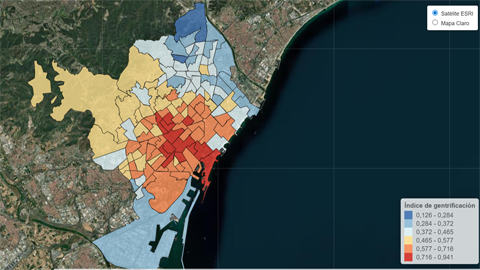
The study presents an interactive map of the 10 cities and uses a purpose-built index, the gentrification index, which works like a gauge and summarises the intensity of each city's process in a single value between 0 and 1. This indicator combines both the speed of change registered in the decade and the socioeconomic intensity based on eight demographic, socioeconomic and rental market variables.
Spanish cities have recorded an increase in these variables, although there are differences among regions: while Barcelona and Madrid lead in almost all aspects of this evolution, the rest stand out in particular facets. Palma and Las Palmas de Gran Canaria record greater levels of rejuvenation and attract international populations, while in Valencia and Bilbao there is a strong increase in university population and workers from the highest labour categories, as well as an acceleration in the arrival of a more educated population.
Regarding rent, which is one of the key facets in the gentrification processes, all cities have suffered notable increases, except Zaragoza and Murcia, where these increases have been limited to very specific areas. The cases of Barcelona, Valencia, Malaga and the two island municipalities of Palma and Las Palmas de Gran Canarias, which have experienced significant increases, are particularly noteworthy.
Based on the 2011 and 2021 Population and Housing Censuses of the National Institute of Statistics, and the rental price index of the Ministry of Housing and Urban Agenda between 2011 and 2019, the study was carried out by researchers Carlos Sanz Pérez, Antonio López Gay and Riccardo Valente from the UAB's Centre for Demographic Studies.
The results confirm that gentrification not only transforms the urban landscape, but also profoundly alters the social structure of cities: "We are facing a process that redefines who can live in which neighbourhood. Areas that seemed not to be affected by gentrification are now beginning to show high values of the index, which anticipates new waves of residential displacement", says Carlos Sanz Pérez, one of the authors of the study.
The study warns that this gentrification contributes to an increase in socio-spatial segregation, the expulsion of vulnerable populations, the loss of social diversity, and the intensification of inequalities within the city.
The gentrification measurement tools presented in the study can be "very valuable for the design of public policies that guarantee the right to the city, especially in areas where gentrification is beginning to manifest itself", researchers highlight. According to them, "In this context, guaranteeing the residential use of housing and avoiding the expulsion of residents from their homes become fundamental priorities for building a more equitable and just urban society."
The 10 most populated cities and the gentrification process
In Barcelona, the city in which the gentrification process has been most intense during the decade studied, the process is expanding towards neighbourhoods such as Sagrada Familia and Sant Antoni, and towards neighbourhoods in the interior of the Sant Martí and Sants–Montjüic districts. In Madrid, the process moves towards the popular district of Tetuan, in the north, and Arganzuela, in the south. In addition, relatively high values are observed in the districts of Carabanchel and Latina, located on the other side of the M-30, the city's traditional socioeconomic border.
In medium-sized cities, gentrification has been concentrated mainly in historic centres, although it is beginning to spread to adjacent neighbourhoods or, in coastal cities, along the coast. In Valencia, the process is advancing towards Extramurs and Russafa in the Eixample. In Malaga, the dynamics are similar: from its centre westward to La Trinidad and Mármoles. In Zaragoza, gentrification has progressed more smoothly: it is expanding from the historic centre southward to Juntas de Centro and Universidad. In Seville, the process is also advancing from the historic centre toward the Triana neighbourhood.
The most gentrified areas of the island cities are their historic centres (in the case of Palma, in the eastern part of the centre) and the coast, especially in the case of Las Palmas de Gran Canaria (the Guanarteme area). In Bilbao, the most gentrified area is in Abando, the district where the city's economic activity is concentrated, followed by the historic centre. Murcia presents a more complex case: the most gentrified area corresponds to a set of districts that belong to the city, but are disconnected from the rest of the urban fabric. The highest value can be found in the western part of the urban centre, although without any clear patterns of expansion.