Consider the sweeping arc of a ship's hull, or a modern concert hall roof. These curved structures can be built by gently bending flat surfaces like sheet metal into beautiful curves. By defining the geometry of such interesting, undulating structures, we can understand their properties, replicate and manipulate them.
To describe the most complex of shapes, we tend to take a backwards approach, carefully studying the shape first and choosing the mathematical descriptors that can most closely approximate it. Now, researchers at the Okinawa Institute of Science and Technology (OIST) have pioneered a forward path to complex curved structures, characterizing a new class of shapes along the way: ortho-arc curves (OACs). The study is published in ACM Transactions on Graphics.
Dr. Vishesh Bhat of OIST's Mechanics and Materials Unit, first author on the study comments, "Whether designing new molecules that lock together, or enabling mass-fabrication of complex structures, being able to mathematically define shapes is essential across many different industries. We wanted to create a simpler, faster approach to access new curved shapes with controllable properties such as symmetry, chirality or topology."
Accessing ortho-arc curves
The researchers started out with a simple polyhedron, a 3D shape with flat sides and straight edges, positioned inside a curved support surface. They connected the corners of the polyhedron with smooth curves, generating a new curved path. This, they termed an 'ortho-arc curve' (OAC), because the path formed from circular arc sections positioned at right angles (orthogonal) to the support structure surface.
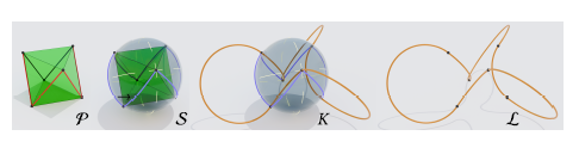
"By starting from polyhedrons, we give ourselves a massive design space to work with, opening lots of possibilities for new shapes," says Bhat. "We were able to use these relatively simple shapes to describe very complex structures in an elegant way."
The team then tried to develop these OAC paths into looping band structures. However, not every polyhedron worked as the starting shape - some didn't enable loops to close in the same plane, due to path rotation. By adjusting the dimensions of the starting polyhedron, the researchers could change the angle of the path at its closing point. That way, they could ensure their path created a flat, smoothly curving loop that perfectly joined.
Möbius structures, Mario Kart and materials science
Using their framework, the researchers explored a wide range of structures, including twisted Möbius structures, which possess one continuous surface, and intertwined band structures, featuring layered, interlocked shapes. In addition to bands, they modeled 3D tubes. They even highlighted examples of how such shapes could be used in modern design and manufacturing, presenting a table structure supported by interlocking legs within an OAC scaffold.