The UAB School for a Culture of Peace publishes today its annual report—one of the main yearbooks in Spain on conflictivity, human rights and peacebuilding. The report identifies 40 wars currently existing in the world, the highest figure in the past decades, and warns about the increase of international conflicts and humanitarian consequences.
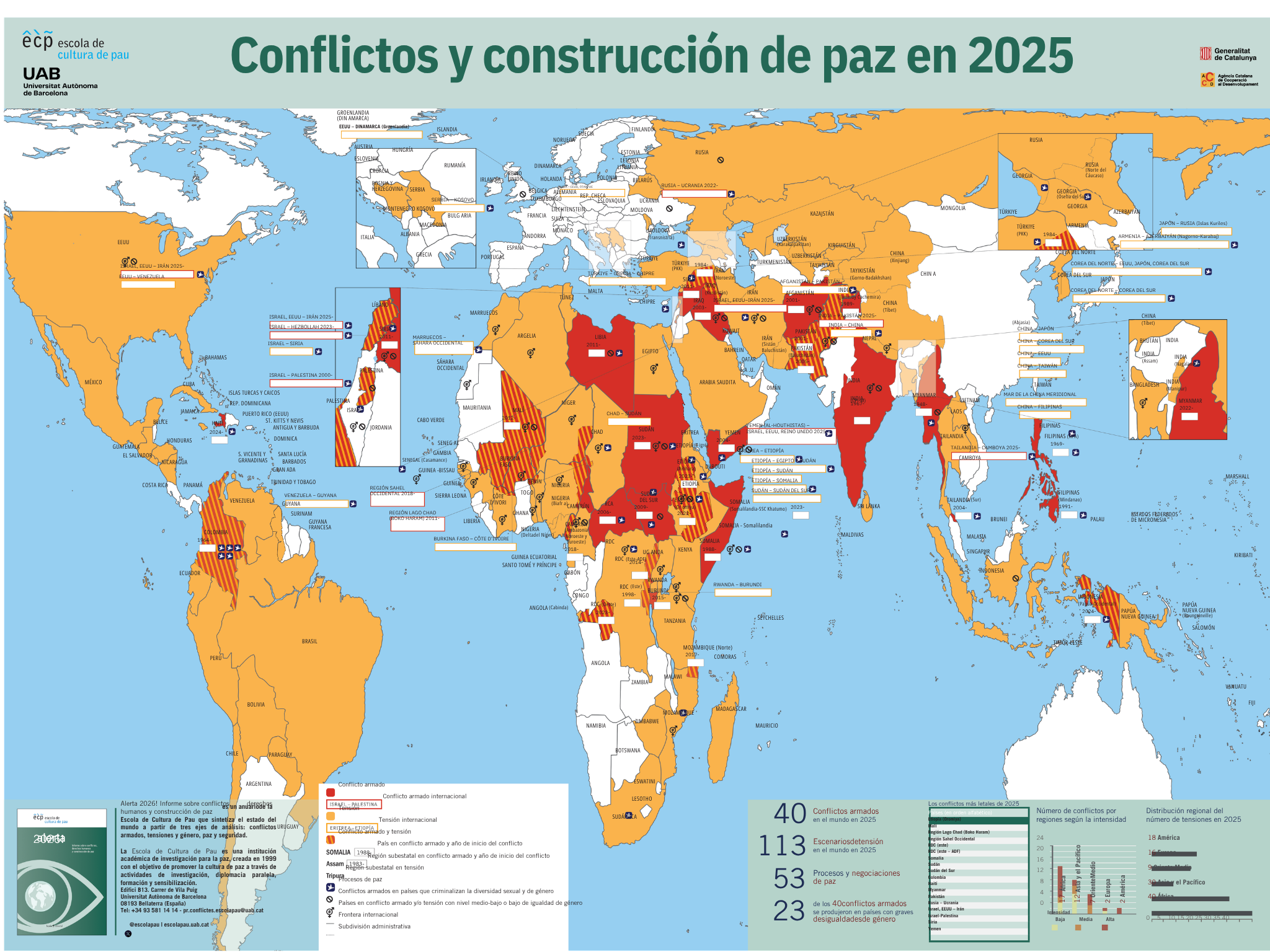
The world is experiencing a new upsurge in global armed violence. In 2025, 40 active armed conflicts were registered (37 in 2024), the highest number since 2011 and one of the highest since the School for a Culture of Peace (ECP) of the Universitat Autònoma de Barcelona has been producing its annual reports on international conflict. This is one of the main conclusions of the report Alert 2026! Report on conflicts, human rights and peacebuilding, published on 3 June. The report is mainly based on qualitative analysis of studies and information provided by the United Nations, international organisations, research centres, media and NGOs, among others, as well as the experience acquired in field research.
According to the study, there were 40 armed conflicts and 113 scenarios of socio-political tension around the world in 2025. Africa continues to concentrate the highest number of wars (17), followed by Asia and the Pacific (12), and the Middle East (7), while Europe and America register two armed conflicts each.
Rise in international conflicts
The report particularly warns of the increase in international conflicts. In 2025, nine clearly internationalised wars were recorded, the highest number since the ECP uses its current classification methodology. Among the new armed conflicts identified are the confrontation between India and Pakistan, the serious escalation between Thailand and Cambodia, and the war between Israel, the United States and Iran, known in 2025 as the "12-day war" and which was reopened in 2026. The ECP research team warns that this evolution reflects a deterioration in global security and is a reflection of an international system in which many powerful actors do not prioritise prevention, addressing the root causes of disputes and supporting dialogue.
Sudan, Gaza, Haiti and Ukraine: worsening of the humanitarian situation
The report concludes that almost half of the world's armed conflicts worsened during 2025. Among the most serious cases are the Western Sahel region, Sudan, Haiti, Somalia, Gaza, Myanmar and the war between Russia and Ukraine. The ECP warns of the increase in civilian casualties, the bombing of populated areas, the destruction of infrastructure and the violations of international humanitarian law.
Setbacks in women's rights
Coinciding with the 25th anniversary of UN Resolution 1325 on Women, Peace and Security, the report warns of a global backsliding in women's rights. According to the study, 70% of the highest-intensity armed conflicts take place in countries with low or medium-low levels of gender equality. Twenty-three of the 40 armed conflicts that took place in 2025 took place in countries with low or medium-low levels of gender equality, and 16 of the 20 high-intensity armed conflicts in 2025 (80%) took place in countries where the International Lesbian, Gay, Bisexual, Trans and Intersex Association had documented legislation or policies that criminalise LGBTIQ+ people.
Moreover, women's participation in UN-led peace processes continues to decline. The UN verified more than 4,600 cases of conflict-related sexual violence in 2024, a 25% increase over the previous year. A total of 93% of the victims were women and girls.
Over 117 million forcibly displaced people
The report notes that forced displacement remains at historically high levels. In mid-2025, there were 117.3 million forcibly displaced people worldwide, including refugees and internally displaced persons. Although the figure represents a slight decrease from the previous year, partly attributed to the return of people to countries such as Syria, Afghanistan and Sudan, the ECP highlights that the overall volume remains extraordinarily high. Afghanistan, Syria, Sudan, Ukraine and Venezuela account for 65% of the world's refugee population.
An internationally renowned report
Alert 2026!, which this year reaches its 25th edition, is one of the main yearbooks produced in Spain on conflict, human rights and peacebuilding. The study combines data from the United Nations, international organisations, research centres and specialised fieldwork. The objective of the report is to offer tools for analysis and preventive warnings to political leaders, international organisations, the media and actors involved in the peaceful resolution of conflicts.
UAB School for a Culture of Peace report:
Alert 2026! Report on conflicts, human rights and peacebuilding