
Islamist armed groups and Malian armed forces and their allies have committed serious abuses against civilians since fighting escalated in Mali in April 2026, Human Rights Watch said today.
On April 25, the Al-Qaeda-linked Group for the Support of Islam and Muslims (Jama'at Nusrat al-Islam wal-Muslimin, or JNIM) carried out coordinated attacks across Mali. JNIM joined forces with Tuareg fighters of the Azawad Liberation Front (Front de libération de l'Azawad, or FLA), who are seeking to overthrow the military junta led by Gen. Assimi Goïta and backed by Russian fighters from Africa Corps (formerly the Wagner Group). All parties have unlawfully attacked civilians and some parties destroyed and looted their homes and shops. On April 28, JNIM announced a "total siege" of the capital, Bamako, threatened to kill civilians obstructing its operations, and attacked civilian vehicles. Malian armed forces responded with apparent reprisals against Fulani communities and two apparent airstrikes killing civilians.
"As fighting flares up again, the warring parties in Mali are once again carrying out grave abuses against civilians, repeating former patterns of harming civilians," said Ilaria Allegrozzi, senior Sahel researcher at Human Rights Watch. "All parties are obligated to respect international humanitarian law, take all feasible steps to avoid civilian harm, and facilitate access to humanitarian aid."
Human Rights Watch remotely interviewed 34 people between April 26 and June 9, including 30 witnesses to abuses, as well as civil society members, community leaders, and journalists. Human Rights Watch also verified and geolocated four videos posted online and six photographs and analyzed satellite imagery showing destroyed shelters. Human Rights Watch sent a letter to Mali's justice minister on June 11 but received no response.
On April 25, clashes between JNIM and allied FLA fighters against Malian and Africa Corps forces in the northern cities of Gao and Kidal killed 13 civilians and wounded at least 25. Between May 6 and 21, JNIM fighters burned more than 40 civilian vehicles bound for Bamako, accusing passengers of violating the siege of the capital, and publicly executed a man in the northern town of Tonka. Between May 14 and 17, the military also conducted abusive counterinsurgency operations against Fulani communities in central Mali, killing 38 civilians, including 23 children. Mali's military carried out two apparent drone strikes in the central villages of Guimbé on April 25, which killed 12 children and teenagers, and Tené on May 17, which killed 10 men and women.
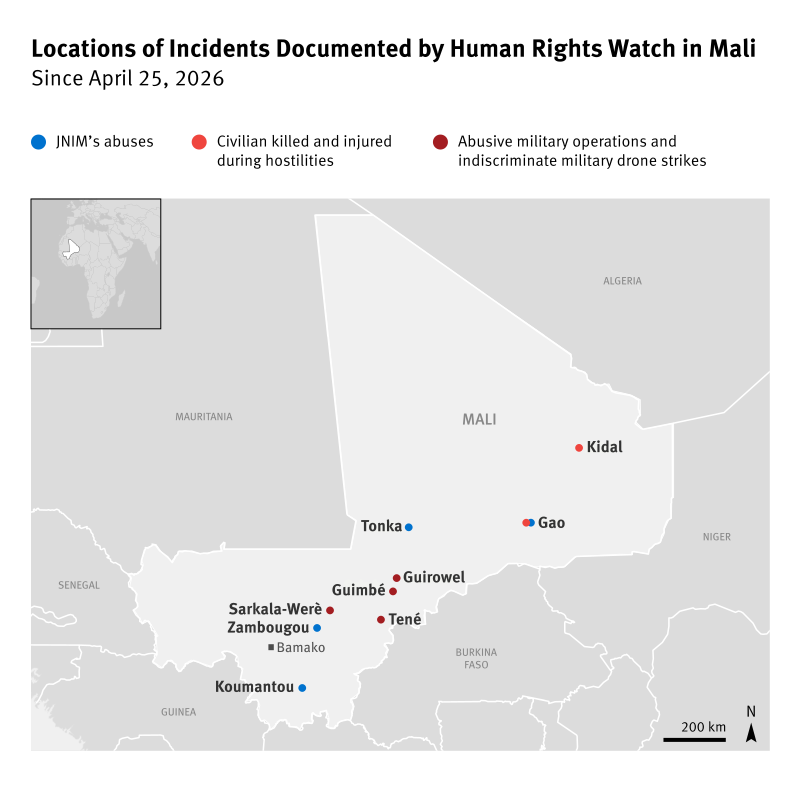
A 38-year-old man in Kidal said he heard gunfire early on April 25 which escalated into heavy fighting as JNIM and FLA fighters entered the town, attacked the military base, and looted the town market, while Malian and Africa Corps forces returned fire. "I was struck by bullets in the right shoulder and left thigh," he said. "I don't know who shot me because gunshots were coming from all directions, but I know soldiers evacuated me to the Gao hospital by helicopter."
On May 14, the FLA spokesman, Mohamed El Maouloud Ramadane, told Human Rights Watch: "We took sufficient measures so that civilians are not collateral victims of the fighting. We wrote several times to communities located around the city [of Kidal] to tell them to leave and not to approach military sites."
On the night of May 17, an explosive munition, apparently dropped from a drone believed to have been operated by the military, killed at least 10 civilians in Tené village, as residents gathered for a traditional wedding. The groom, who had gone with others to collect his bride and the wedding food, was among those killed. "I heard a noise coming from the sky and then an explosion and then there were screams everywhere," said a 45-year-old man. "We rushed there and found that the damages were enormous, with dead and injured people."
Human Rights Watch has previously documented how Malian military forces have conducteddrone attacks that caused civilian casualties.
On May 9, 10 days after JNIM announced the start of the siege of Bamako, JNIM fighters burned at least 40 civilian vehicles in the village of Zambougou, about 60 kilometers from the capital. A 43-year-old bus passenger said: "A jihadist said: 'Didn't we warn you that Bamako is under siege? Get out!' Then they set the buses on fire." There were no military forces in the vicinity and none of the vehicles carried weapons or military equipment.
Since September 2025, JNIM has cut off fuel supplies into Mali, blocking and attacking tanker truck convoys from neighboring countries and killing truck drivers, triggering severe shortages that have halted transport, disrupted education and electricity, and paralyzed daily life in Bamako and elsewhere. While the laws of war do not prohibit sieges, warring parties must take all feasible precautions to avoid harming civilians and comply with the principles of distinction and proportionality. Siege tactics that prevent civilians getting access to items essential for their survival are prohibited.
In a June 15 reply to Human Rights Watch, JNIM said civilians "violating some of the rules of order enforced by JNIM in its areas of controls or on the siege … are deterred proportionately to their violation as per the Sharia [Islamic law] rulings regarding offenders - leniently in some cases and strictly in others."
All parties to Mali's armed conflict are bound by international humanitarian law, notably Common Article 3 of the Geneva Conventions of 1949 and customary laws of war. Deliberate or indiscriminate attacks against civilians or civilian property are prohibited. Individuals who commit serious violations of the laws of war with criminal intent or are responsible as a matter of command responsibility may be prosecuted for war crimes.
Mali's international partners, including the United Nations and the African Union, should work closely with the UN Independent Expert on the situation of human rights in Mali and Mali's National Human Rights Commission to document serious human rights abuses by all sides and press authorities to investigate those responsible.
"Longstanding impunity continues to fuel the cycle of abuses against civilians in Mali," Allegrozzi said. "The UN and the AU should support independent accountability efforts, including a fact-finding mission that can lay the groundwork for criminal investigations and prosecutions."
For additional details about Mali's armed conflict and the recent attacks, please see below.
Mali's Armed Conflict
Since 2012, successive governments in Mali have battled Islamist and separatist armed groups. In 2024, JNIM, an Al-Qaeda-linked coalition seeking to expand Islamist rule across the Sahel, and the FLA, a Tuareg separatist coalition seeking independence for northern Mali, entered into an alliance despite their ideological differences, and joined forces during the April 2026 offensive. Their cooperation includes, among others, weapons transfers, training, and intelligence sharing.


