
Hezbollah unlawfully fired widely banned cluster munitions into a town in northern Israel on March 4, 2026, and again on March 15, Human Rights Watch said today.
The attacks, neither of which caused civilian casualties, took place during a major escalation in the conflict between Israel and Hezbollah beginning on March 2 as part of the wider war in the region involving Iran and the United States.
"Cluster munitions should not be used under any circumstances, and their use may amount to a war crime," said Patrick Thompson, crisis, conflict and arms researcher at Human Rights Watch. "Not only are they inherently indiscriminate, but unexploded submunitions can kill and injure civilians long after hostilities conclude."
Cluster munitions are fired in rockets, missiles, and projectiles, or dropped from aircraft. They typically disperse in the air, spreading dozens of explosive submunitions, or bomblets, indiscriminately over a large area. Many fail to explode on initial impact, leaving duds that can kill and maim, like landmines, for years or even decades, unless cleared and destroyed.
Human Rights Watch researchers visited Metula in May and confirmed the use of cluster munitions, analyzed the impact sites, and interviewed four witnesses. Hezbollah claimed responsibility on social media for rocket attacks against Metula on March 4 and 15, but in response to a Human Rights Watch request for comment, denied using or even possessing cluster munitions.
Despite ceasefires that went into effect on April 17 and June 20, Israeli attacks have killed at least 4,381 people in Lebanon since the beginning of the escalation, including 261 children, 399 women, and 135 medical workers, according to Lebanon's Health Ministry. Israel has continued to issue orders to Lebanese civilians to leave their homes, displacing over one million people in what may amount to the war crime of forced displacement.
Hezbollah rocket attacks in northern Israel between March and June killed two civilians, the Times of Israel reported on June 30. Hezbollah also fired unguided rockets into populated areas in Israel, according to the United Nations Office of the High Commissioner for Human Rights. The use of these weapons, which cannot distinguish between military objectives and civilians and civilian objects, is unlawfully indiscriminate and poses a foreseeable and long-lasting danger to civilians, in violation of the laws of war.
Human Rights Watch has previously documented Israel's extensive use of cluster munitions in southern Lebanon and Hezbollah's use of them in Israel. The Guardian reported that Israel used cluster munitions in southern Lebanon again in 2025.
The March 4 attack struck a residential street on the southern side of Metula near the cemetery. Hagai, 57, whose full name is not used for his safety, lives in the town with his wife and two children, and said that he and his family ran to their shelter outside their house as they heard sirens at around 4 p.m. They had just closed the door when they heard multiple explosions outside.
As instructed by the Israeli authorities, they waited 10 minutes before leaving the shelter. But soldiers outside told them to stay inside until the next day as they were clearing the area of submunitions.
The submunitions damaged his two cars beyond repair, and a submunition landed on the roof of his house. Twelve windows were damaged, and submunitions cut two water pipes. He fears for his children's safety.
"My son plays basketball here," he said. "If the ball goes down the hill into the grass, I tell him to leave it. They checked the whole area for unexploded bombs, but who knows, I don't know how thoroughly they can check the bushes."
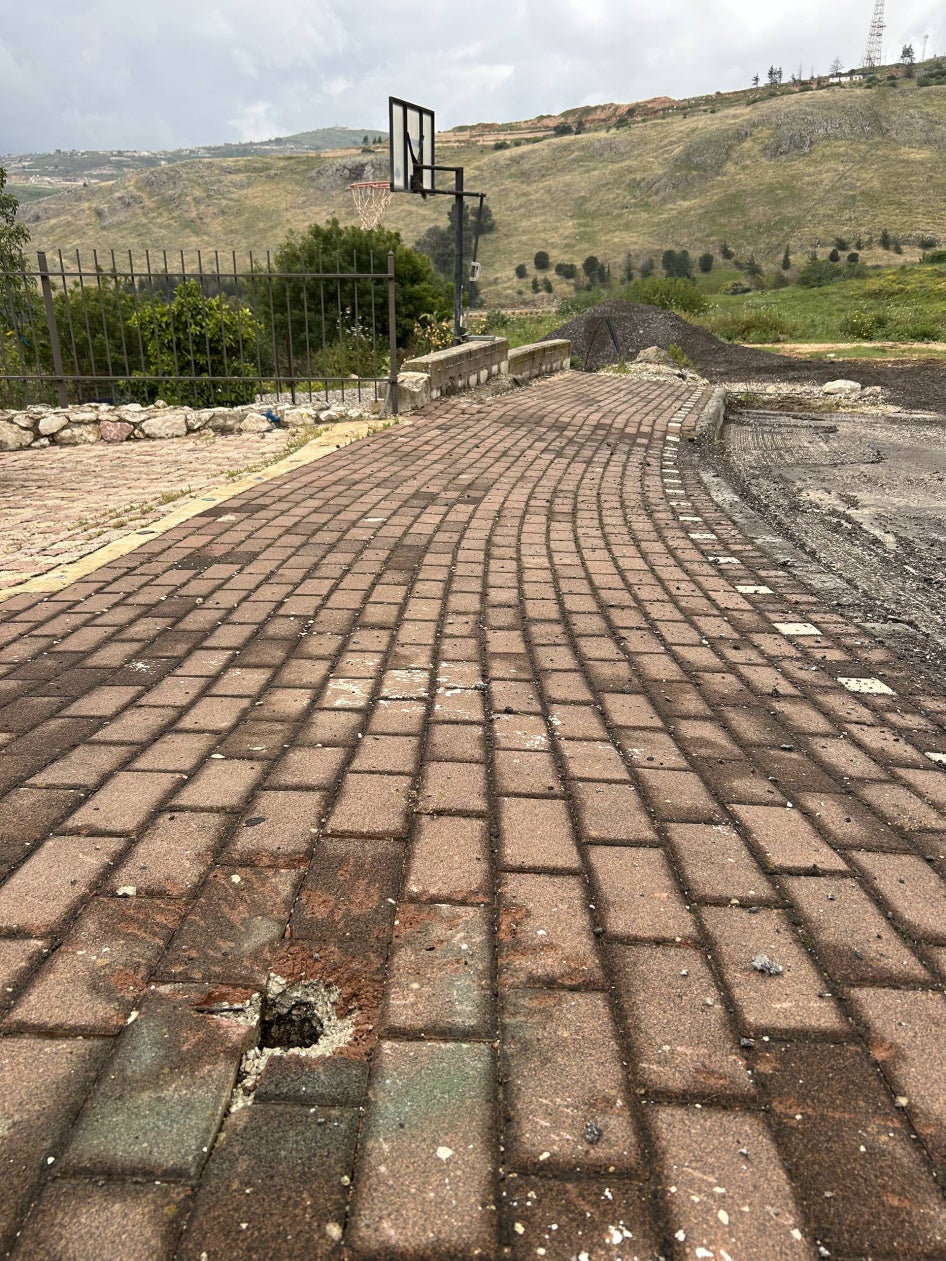
He said the military counted approximately 50 impact craters. The road had been repaved by the time Human Rights Watch researchers arrived, but they identified seven impact craters consistent with submunition impacts, due to their relatively small size and distribution pattern.
Human Rights Watch analyzed photographs from a journalist taken before the road was repaved that showed additional craters outside Hagai's house. Fragmentation from the submunitions affected another house about 50 meters away, damaging windows. The homeowner, who wished to remain anonymous, said there were multiple unexploded submunitions outside her house.
On March 4, an Israeli police spokesperson reported from Metula that a cluster munition had struck northern Israel. The report was accompanied by a photograph of what appears to be an unexploded BRB1-type submunition. This submunition is dispensed from a 122mm rocket, which reportedly contains between 45 to 56 BRB1-type submunitions.
Human Rights Watch was unable to confirm the location of the photograph, but researchers did not find a version of the photograph online uploaded before March 4. Witness reports of approximately 50 submunition impacts in Metula on March 4 are consistent with numbers reportedly contained in the BRB1 delivery system, as are the craters Human Rights Watch analyzed. These submunitions were previously identified in southern Lebanon in September 2024. A statement from the Cluster Munition Coalition at the time suggested that they were ejected from a storage facility that was attacked.
The March 15 attack struck near the town's entrance. One nearby resident said that she heard multiple near simultaneous explosions. City authorities had notified a residents' security WhatsApp group that a cluster munition had fallen. The witness said the army told residents not to leave their homes for 24 hours while they cleared explosive hazards.
The road was being repaved when Human Rights Watch visited, yet researchers found one crater consistent with a submunition impact. Researchers geolocated a video uploaded to Telegram on March 15 that shows approximately 30 small explosions around the entrance gate consistent with a cluster munition attack. Researchers were able to identify the area as the one where witnesses reported seeing the cluster munition strike. There were no reports of civilian casualties or major damage to infrastructure.
The 2008 Convention on Cluster Munitions, which has 112 states parties and 12 more states have signed, comprehensively prohibits these weapons and requires clearing contaminated areas and assisting victims. Although Lebanon is a state party, the treaty does not formally bind Hezbollah as a non-state armed group.
Nonetheless, Hezbollah is bound by international humanitarian law, otherwise known as the laws of war. International humanitarian law requires parties to a conflict to take constant care during military operations to spare the civilian population, and to "take all feasible precautions" to avoid or minimize the incidental loss of civilian life and damage to civilian objects.
International humanitarian law also requires all parties to distinguish between military objectives and civilians and civilian objects, and to target only military objectives. Individuals who commit serious violations of the laws of war with criminal intent-that is, intentionally or recklessly-may be prosecuted for war crimes.
As cluster munitions spread submunitions over a wide area and unexploded submunitions pose a danger long after hostilities are over, their use in civilian areas amounts to a violation of the principles of precaution and distinction. Intentionally directing such attacks against the civilian population is a war crime.
Israel is not a party to the Convention on Cluster Munitions. It should urgently join the convention and cease the manufacture, transfer, and use of cluster munitions, as well as commit to clearing unexploded cluster munitions in all areas under its effective control.
"The use of cluster munitions in civilian areas is a flagrant violation of international law," Thompson said. "Hezbollah and all parties to the conflict should abide by the laws of war."


