
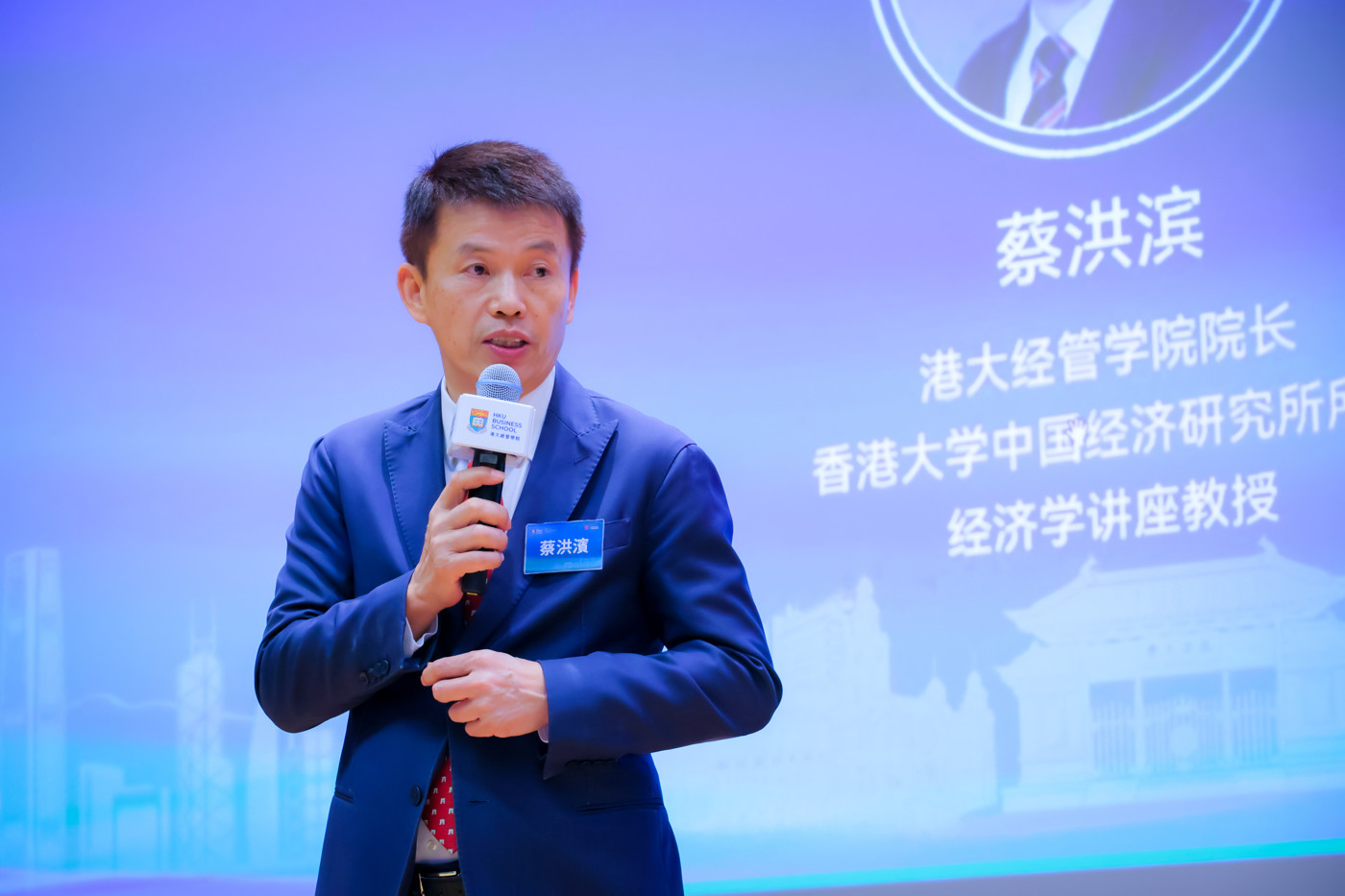
On 1 November, the 12th HKU Quarterly Forum on the Chinese Economy cum 2026 Fudan Chief Economists Hong Kong Forum was successfully held at the Rayson Huang Theatre, The University of Hong Kong. The event was co-hosted by the Institute of China Economy of HKU Business School and the Alumni Association of the School of Economics, Fudan University. In anticipation of the upcoming APEC Economic Leaders' Meeting, and against the backdrop of the rapid advancement of artificial intelligence (AI) and profound shifts in the global economic landscape, this year's forum was themed "New Stage, New Cycle, New Landscape: Coordinated Domestic and Global Economic Development and Outlook for 2027". The forum brought together a number of renowned scholars and experts, attracting more than 300 business leaders, academics, alumni, and students in attendance, while over 29,200 viewers watched the event online.
Professor Hongbin CAI, Dean and Chair of Economics of HKU Business School and Director of Institute of China Economy, in the welcome remarks said, "HKU Business School has continued to strengthen three key dimensions in recent years: the height of thought leadership, the depth of China engagement, and the breadth of global outreach. We have attracted world-class scholars, deepened collaboration with partners across the Chinese Mainland, and expanded our international network. By integrating these three dimensions, we aspire to become a global leader in AI research, education, and practice.
He added, "A deep understanding of China's economic development and policy evolution is of vital importance. For this reason, the Institute of China Economy has organised the Quarterly Forum of Chinese Economy over the past three years, establishing it as an important platform for exchanging views on China's economic policies. With the aim of enhancing society's discussion and understanding of policy issues, the Forum will continue to uphold three core principles: a commitment to scientific rigour and seeking truth from facts; the encouragement of diverse perspectives and equal dialogue; and staying true to its original mission of fostering positive and constructive discourse."
Professor Zhenhua MAO, Professor of Practice in Economics of HKU Business School and Member of the Chief Executive's Policy Unit Expert Group in HKSAR, presented the keynote report, "China's economy is currently characterised by a 'strong divergence with weak recovery'. High-tech industries and exports, particularly those led by AI, remain the bright spots and the most important drivers of China's economic growth. However, domestic demand continues to face challenges, with consumption and investment remaining relatively weak. Meanwhile, traditional sectors such as real estate, manufacturing and infrastructure construction continue to experience downward pressure." As a result, he expects China's economic growth to reach approximately 4.5% to 4.6% this year, at the lower end of the government's target range.
Looking ahead to 2027, Professor Mao projected that China's economic growth could remain at around 4.5% with stronger policy support, but could slow to 4% otherwise. He stressed the need to boost innovation, accelerate the upgrading of traditional industries through new technologies. At the same time, it is important to make use of traditional countercyclical policy tools to stabilise employment, growth, and market expectations. He also called for sharing the benefits of technological progress more broadly, deepening income distribution reform, introducing targeted cash subsidies, and supporting the restructuring and optimisation of traditional industries. Hong Kong can also leverage its role as an international financial centre to support
Chinese firms' global expansion. He added that China needs to rebalance supply and demand, restore business and consumer confidence, ease the pressure of divergence across sectors and promote sustainable growth.
Two distinguished keynote speakers were invited to share their insights. Professor Levin ZHU, former President and CEO of China International Capital Corporation, Visiting Professor of Management Practice at Tsinghua University, and Specially-appointed Professor, Institutes of Science and Development, the Chinese Academy of Sciences, said, "AI automation, coupled with demographic changes, will have a profound impact on traditional models of employment, income distribution and retirement in the long term. On international trade, trade balances are determined by multiple macroeconomic factors. Taking the US as an example, its trade deficit is likely driven by various factors, including its own structural economic needs and the global division of labour. Relevant measures introduced since 2018 have shifted some sources of imports, but have not reversed its trade deficit trend. The price advantage of Chinese goods is a competitive edge shaped by independent market choices. Facing universal challenges such as global warming, the international cost of solar power generation has fallen significantly, and the international community should work together to ensure that green energy benefits all countries across the world."
Another keynote speaker, renowned economist Professor Jun ZHANG, Dean of the School of Economics and Senior Professor of Humanities and Social Sciences at Fudan University, examined the evolution of China's demand structure since the 1980s. He noted that the drivers of China's economic growth have shifted significantly: the contribution of net exports to GDP growth rose from 18.1% in 2007 to 32% last year, while that of investment declined from 42.7% to 16%.
Professor Zhang noted that efforts to boost domestic demand face challenges amid slowing potential GDP growth. He said that stabilising the property market in first- and second-tier cities is crucial in the short term, while in the longer term, deeper financial reforms are needed to improve capital allocation, thereby enhancing overall economic efficiency so as to create favorable conditions for demand expansion.
There were two sessions of roundtable discussion. The first session was moderated by Professor Hongbin CAI. Panelists included Mr. Changchun HUA, Chief Economist for Greater China and Managing Director of Global Macro and Asset Allocation, KKR; Mr. Jianguang SHEN, Vice President and Chief Economist of JD.com; Mr. Bin SHI, Managing Director of UBS Asset Management; Mr. Robin XING, Managing Director and Chief Economist of China of Morgan Stanley, and Mr. Yidong ZHANG, Executive Committee Member, Chief Economist and Head of Research of Haitong International Securities Group Limited. The speakers examined the prospects for China's economic development amid geopolitical challenges, analysing the key drivers of economic growth from multiple perspectives, including industrial momentum, social policies, and the expansion of domestic demand, etc.
Another session of roundtable discussion was moderated by Ms. Fangli LIAO, Distinguished Research Fellow, China Development Institute (Shenzhen). Panelists included Mr. Bingye YANG, Product Expert of WorkBuddy Overseas at Tencent; Mr. Hongjuan LIU, Chief AI & Data Officer, Hong Kong and Macau of Manulife (International) Limited; Professor Ye LUO, Associate Professor of Economics and Finance and Associate Director of Institute of Digital Economy and Innovation at HKU Business School, Director of Fintech Research Institute at HKU Business School Shenzhen Research Institutes; Professor Feida ZHU, Associate Dean (Partnerships and Engagement) of School of Computing and Information Systems at Singapore Management University, Adjunct Senior Principal Scientist of Agency for Science, Technology and Research (A*STAR), Chairman of Blockchain Association Singapore. The speakers discussed how AI can enhance business efficiency, as well as the safety considerations surrounding its use. They also referenced Tencent's AI Office agent, WorkBuddy, which, once authorised, can autonomously plan, break down and execute multi-step tasks, finally delivering complete outputs formatted to meet user expectations.


