
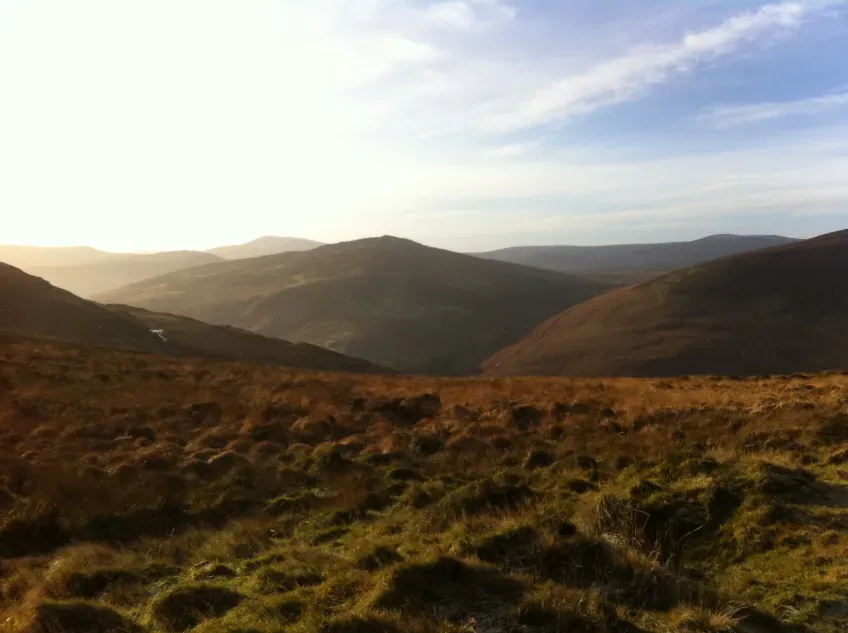
When the late summer sun falls over Ireland's Wicklow Mountains, the slopes turn purple with blooming heather. Honeybees are moved to the heathlands for the sought-after heather honey, but their presence affects wild bumblebees.
An Irish-Swedish research team has shown in a new study that wild bumblebees change their behaviour and are smaller in size when the number of beehives increases. The researchers compared sites with anywhere from 0 to 35 beehives and tracked the bumblebees' movement patterns during several weeks.
"We saw that the bumblebees adapted quite quickly once the honeybees were moved in," says Lina Herbertsson, biology researcher at Lund University.
Significant Impact
The results show that the bumblebees stayed on the heather flowers for shorter periods and moved on faster - a sign that there was less nectar and pollen in the flowers. What was even more surprising was that the bumblebees were smaller in the studied areas. This could be because large bumblebees, with the ability to fly far from the nest, flew to areas with fewer honeybees, while smaller bumblebees, which normally care for the brood in the nest, went out to help with foraging when the larger bumblebees couldn't keep up.
"This is not something we expect in places that are absolutely teeming with flowers. The effect was noticeable both near the beehives and up to a kilometer away," says Lina Herbertsson.
The study is important far beyond Ireland. Honeybees, bumblebees, and other wild bees are vital for pollinating wild plants, fruit, berries, and other crops. Wild pollinators are already under pressure from declining flower-rich habitats, and more beehives mean more mouths to feed at the same buffet. At the same time, beekeeping is a cultural tradition and part of food production - making the balance between honeybees and wild bees a central issue for both the environment and food security.
"We hope our results can help beekeepers and conservation biologists plan beehive placement so that both honeybees and wild bumblebees can thrive. Ultimately, we want to preserve all pollinators, something that is essential for both farming and wild ecosystems," concludes Lina Herbertsson.
Publication:
Link to the article in Proceedings of the Royal Society B:
Honeybees have consequences for foraging bumblebees in Irish heathlands


