
NIH R01 grant awarded to assistant professor Natale Sciolino to explore the neuroscience of taste
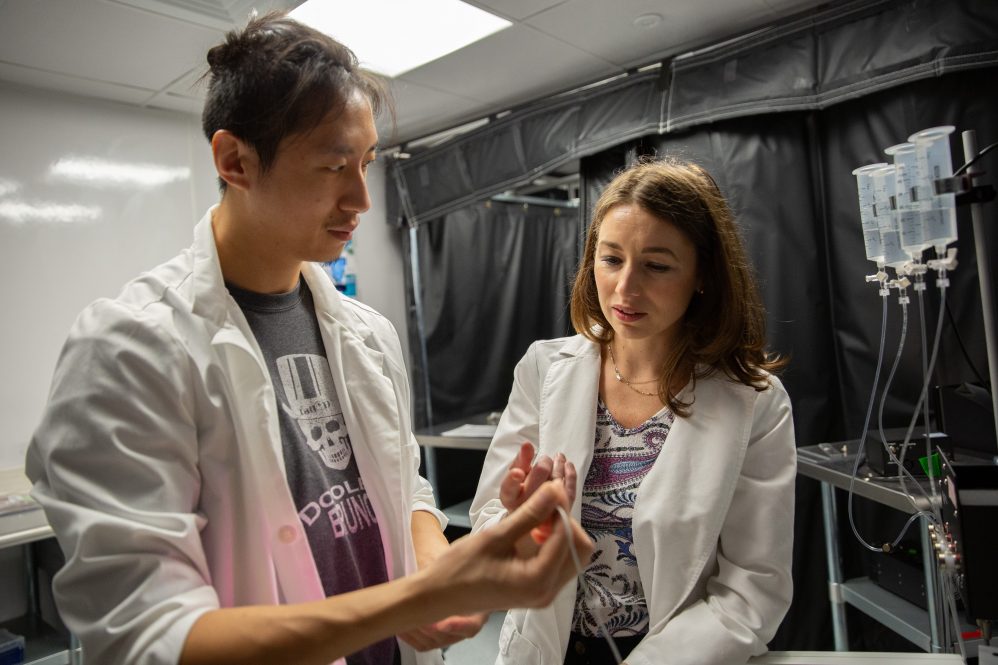
Qichen (Will) Fan (left), a Ph.D. student in the Sciolino Lab, and Dr. Natale Sciolino (right) discuss an experiment. (Bri Diaz/UConn Photo)
The National Institutes of Health (NIH) has awarded an R01 research grant to the lab of assistant professor of physiology and neurobiology Natale Sciolino, Ph.D., to study how the brain chemical norepinephrine influences taste perception - work that could deepen understanding of why taste changes with behavioral state, age, illness, and neurological disease.
Our sense of taste changes over the course of our lives. It's why kids tend to turn up their noses at vegetables, while adults can find appreciation for the bitter notes of leafy greens. Taste can also shift with age, during temporary illnesses such as a cold, or as a result of chronic neurological conditions such as Parkinson's disease or Alzheimer's disease.
These changes matter because taste plays a central role in eating behavior. Whether someone is nine or 99 years old, they'll be less likely to consume foods that don't appeal to them, regardless of how nutritious those foods may be. Changes in taste can also affect appetite, nutrition, quality of life and, in some cases, a person's overall health.
Researchers in Sciolino's lab have received nearly $565,000 for the first year of their NIH R01 grant award to better understand how complex processes in the brain shape taste perception. Their work could eventually help people experiencing taste loss, including those affected by long COVID or neurological disease. As the basic science advances, it could also help clinicians track changes in patients' palates over time, providing a useful biomarker of health and aging.
Sciolino's lab focuses on norepinephrine, also known as noradrenaline. This neurotransmitter is produced largely in a small region of the brainstem called the locus coeruleus, or LC. The lab studies how norepinephrine influences motivated behaviors, including eating and the fight-or-flight response.
"Norepinephrine is a neuromodulator, which means it can change how neural circuits process information," explains Will Fan, a Ph.D. candidate leading this research. "Rather than carrying one simple message from one neuron to another, neuromodulators can tune the activity of many neurons at once. In this project, we're asking what happens when norepinephrine is released in the parts of the brain that process taste. Does it change neural activity? And if so, does that change how an animal perceives a taste and decides whether to consume it?"
"We felt it was super important to investigate this gap," adds Sciolino. "How is norepinephrine regulating taste information in the brain, and ultimately, taste-guided behaviors - that is, do we like or dislike the food, and do we ultimately consume or reject it?"
Prior research in the field has shown that taste is linked to a mammal's internal state, or level of behavioral arousal. For example, when an animal or human is in a low-arousal state (like boredom), it may be more likely to perceive taste along a broad dichotomy of "good" or "bad" rather than identifying individual tastes. Similar effects occur during sickness.
But, says Sciolino, "No one knows how those brain states switch. We think that norepinephrine can be that potential mediator."
Sciolino believes findings from this research are "going to be very important for advancing the field of not only taste, but also the broader field of chemosensation," which includes both taste and smell.
Scientists have previously studied how individual neurons in the LC respond to sensory stimuli. What makes this work different is its focus on how systems of neurons behave. With a more holistic view of how the brain is processing taste, the researchers hope to unlock a better understanding of how it computes and responds to different types of sensory input.
To test their hypotheses, the researchers stimulate the release of norepinephrine in the LC in mice as they are exposed to different tastes, using a method called optogenetics. Using miniature microscopes, they closely monitor its effects on the activity of the brain's gustatory cortex to see how the mice perceive the tastes, a process known as palatability encoding. Mice provide a powerful model for this work because researchers can precisely study the brain circuits involved in taste perception while observing how changes in neural activity affect taste-guided behavior.
Research reported in this story was supported by the National Institute on Deafness and Other Communication Disorders of the NIH under Award Number R01DC023564. Related research in Sciolino's lab has also received support from the Brain Research Foundation (BRF) Seed Grant under Award Number BRFSG2023-09. The content is solely the responsibility of the authors and does not necessarily represent the official views of the NIH or BRF.


