
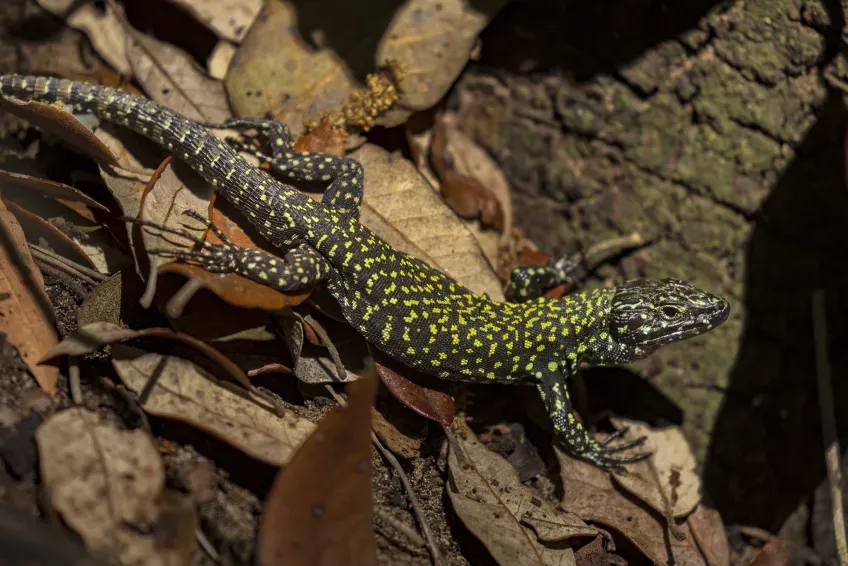
A myriad of colours that survived millions of years of evolution have disappeared in a short period of time. The culprit? A bright green, aggressive, and sexually dominant wall lizard that has wiped out several colour variants within its species.
Many animal species display clearly defined colour variants, or colour morphs. These are not just superficial differences, but are often linked to different strategies for securing access to territories, mates, or similar advantages.
The common wall lizard (Podarcis muralis) is a species widespread in the Mediterranean region, and can have three different throat colours: white, yellow, and orange. These have coexisted within the same populations for millions of years and served as a textbook example of stable evolutionary balance. However, in a new study published in Science, a research team led from Lund University shows that this balance has now been broken.
"We are seeing how the coexistence of several different colour morphs, something that has been stable for millions of years, is being lost over a very short evolutionary time scale," says Tobias Uller, professor of evolutionary biology at Lund University.
Data from over 10,000 lizards
The researchers analysed colour data from about 240 populations of wall lizards, totaling more than 10,000 individuals. The results speak for themselves. The so‑called Hulk lizards - large, aggressive lizards with a characteristic appearance - have shifted the balance within the species.
As the Hulk‑looking lizards spread across the landscape, the yellow and orange throat colours also disappear. Only the white colour remains.
"The aggressive behaviour disrupts the finely tuned social systems that previously enabled several colour strategies to coexist," says Tobias Uller.

Evolution not always slow
The colour study is unique. It shows how long‑lasting sets of colours within a species can be surprisingly vulnerable. Evolution is not always slow and balanced - sometimes a single new, powerful player is enough to rewrite the rules.
"By showing how colour variants that have coexisted for millions of years are wiped out, we now better understand how the emergence of new traits changes competition in nature," concludes Tobias Uller.


