
While technological advances have dramatically improved the world's ability to observe the climate system, speakers agreed that data alone is not enough. Effective climate services require coordination between institutions, common standards, scientific expertise, sustained investment and a clear understanding of users' needs.
Opening the session, Joanna Drake, Deputy Director-General of the European Commission's Directorate-General for Research and Innovation, highlighted the importance of maintaining strong climate observation systems at a time when support for climate science is coming under pressure in some parts of the world, despite growing evidence of accelerating climate change.
Véronique Bouchet, Senior Director of the WMO Department of Sciences, Services and Capacity Development, argued that the priority is ensuring that observations can be translated into intelligence, operational services capable of supporting decisions on the ground.
For Yana Gevorgyan, Director of the GEO Secretariat, one of the strengths of iClimateAction is its ability to bring together organisations that have traditionally worked alongside one another rather than through fully integrated approaches. She described the initiative as a model for international collaboration, connecting GEO, WMO and GCOS around shared objectives and practical demonstrators.
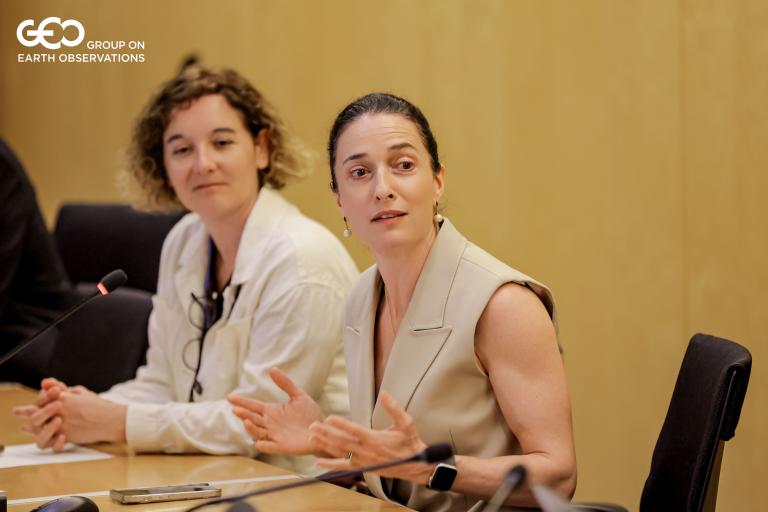
Those demonstrators focus on urban heat resilience and ecosystem extent mapping. Both seek to demonstrate how the capture, processing, and dissemination of Essential Climate Variables (ECVs) can move beyond scientific monitoring and support concrete planning, policy and adaptation decisions.
The discussion quickly turned to a challenge familiar to many in the Earth observation community: fragmentation. Climate information is often spread across multiple platforms, produced using different methodologies and presented through systems that are not always interoperable. For many users, identifying the right information and understanding how to apply it remains a significant obstacle.
Against this backdrop, artificial intelligence emerged as both an opportunity and a challenge. Participants recognised its potential to simplify access to complex datasets, accelerate analysis and support the development of new climate services. At the same time, speakers warned that questions around trust, transparency, interoperability and equitable access must be addressed if AI is to deliver meaningful benefits without leaving any country behind.
The growing role of the private sector also featured prominently in the discussion. Monica Miguel-Lago, Senior Project Manager at the European Association of Remote Sensing Companies, noted that companies are increasingly involved not only in the delivery of climate services but also in the production of climate data itself. She argued that future services must be designed - in a holistic and agile approach, considering social and economic dimensions - around local realities and user needs rather than purely scientific workflows.
Other panellists included Mark Dowell of the European Commission's Joint Research Centre, representing the Committee on Earth Observation Satellites (CEOS) Working Group on Climate, and Osamu Ochiai of the Japan Aerospace Exploration Agency (JAXA). Both stressed the importance of international standards, interoperability and long-term cooperation between space agencies, climate institutions and service providers.
Throughout the discussion, a common message emerged: technology alone will not bridge the gap between climate observations and climate action. Better governance, stronger partnerships, shared standards and greater coordination remain essential if climate information is to become truly actionable.


