
When postdoctoral researcher Matthew Zipple releases lab mice into a large, enclosed field just off Cornell's campus, something remarkable happens.
The mice, which have only ever lived in a cage a little larger than a shoebox, rear up on their back legs, sniff the air, move into the grass and begin to bound over it, a new way of moving and a totally new experience for them. It's one of many they'll have as "rewilded" mice, and in a new study, Cornell researchers have found that the novel environment changes the mice's behavior and reverses anxiety, even when anxieties are well established.
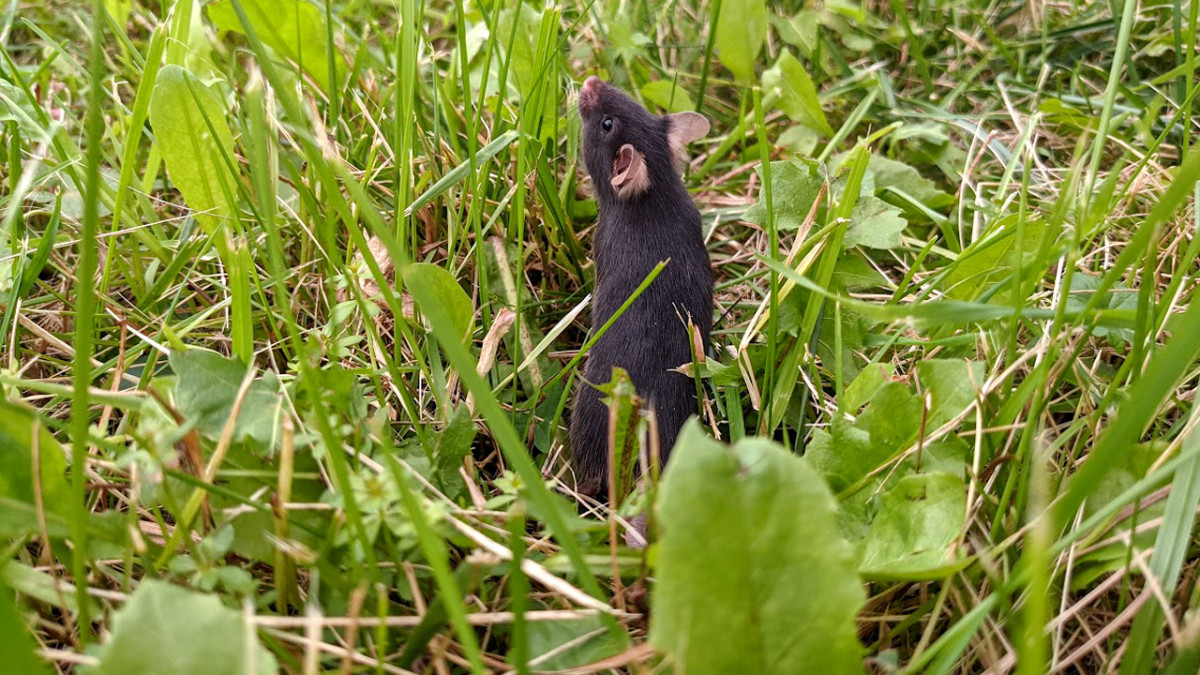
When researchers "rewilded" lab mice to large, enclosed fields, even well-established anxieties in the mice disappeared.
In the study, published Dec. 15 in Current Biology, researchers rewilded multiple cohorts of lab mice over two years and found that their fear response in a classic assay used to assess anxiety was reduced and even reversed after living in the field - even after a single week.
"We release the mice into these very large, enclosed fields where they can run around and touch grass and dirt for the first time in their lives," said senior author Michael Sheehan, associate professor of neurobiology and behavior and a Nancy and Peter Meinig Family Investigator in the College of Agriculture and Life Sciences. "It's a new approach to understanding more about how experiences shape subsequent responses to the world, and the hope is that what we learn from these mice will have more generalizability to other animals and to ourselves as well."
The researchers used the most common (and one of the most humane) mazes for studying anxiety - known as the elevated plus maze - to gauge anxiety in the mice. The maze has two arms the mice can explore: One is enclosed by walls, where the mice feel safer, and another is open and elevated like a plank, where the mice feel exposed. In thousands of studies, researchers have measured the amount of time mice spend in each area and have widely documented the development of a fear response to the maze; after initial exposure, mice spend less time in the open, exposed areas.
The Cornell team exposed groups of lab mice to the maze before rewilding half of them. In subsequent trials, those that continued to live in the lab showed the traditional response to the maze: spending less and less time in the "open" arms. But when the rewilded mice were re-exposed to the maze, they behaved differently.
"The rewilded mice show either no fear response or a much, much weaker response," said Zipple, first author and a Klarman Fellow in the College of Arts and Sciences.
The team also found that mice exposed to the maze multiple times in the lab - mice that had an established fear response - reversed their anxiety after living in the field.
"We put them in the field for a week, and they returned to their original levels of anxiety behavior," Zipple said. "Living in this naturalistic environment both blocks the formation of the initial fear response, and it can reset a fear response that's already been developed in these animals in the lab."
The study echoes research in human psychology that finds that a greater range of experiences increases a sense of agency and reduces anxiety.
"We think this change in behavior is about agency, at its core," Zipple said. "What I mean by agency is the ability of an animal to change its experiences in an environment through its own behavior."

Co-author Daniel Chang Kuo '23 (left) and postdoctoral researcher Matthew Zipple track the behavior and location of the rewilded mice.
The rewilded mice can move freely, Zipple continued, can burrow and climb, can find their own food and navigate weather, seasons and each other. In general, they can encounter challenges and overcome those challenges through their own movement, he said, which could give them greater confidence in the maze. The range of experiences also gives the mice a richer context for encountering anything new.
"If you experience lots of different things that happen to you every day, you have a better way to calibrate whether or not something is scary or threatening," Sheehan said. "But if you've only had five experiences, you come across your sixth experience, and it's quite different from everything you've done before, that's going to invoke anxiety."
The study has implications for how behavioral research with mice is conducted. And it speaks to a longstanding debate in the scientific community about the translation of findings based on mouse models, with some arguing that mice are insufficient models for human health.
"What we show is that yes, this is an example where the lab animal doesn't generalize more broadly, but we also provide a solution that's different, which is to study a real organism that's living in a real environment," Zipple said.
Sheehan said future research questions using the field setup abound: How much time, exactly, in the field is needed to reverse a fear response? Does the age of the mice make a difference?
"This opens a lot of possibilities for asking interesting questions about how our library of experiences shapes our response to novel experiences, because I think that's essentially what anxiety is - when you have an inappropriate response to something that isn't actually scary," Sheehan said.
Sheehan said the research, while not directly addressing human behavior, still resonates for him in meaningful ways. "One of the things that could be causing a rise in anxiety in young people is that they're living more sheltered lives," he said. "There are conversations around modernity and our own lives that are echoed in this research that make it really interesting."
Daniel Chang Kuo '23 is a co-author.
External funding for the study came from the National Science Foundation and the National Institutes of Health.


