
MLIP calculations successfully identify suitable dopants for a novel photocatalytic material, report researchers from Institute of Science Tokyo. As demonstrated in their latest study, a materials informatics approach could predict which ions can be stably introduced into orthorhombic Sn3O4 , a promising and recently discovered photocatalytic tin oxide. Their experiments revealed that aluminum-doped samples achieved 16 times greater hydrogen production than the undoped material, paving the way for next-generation clean energy applications.
Improving the Performance of an Emerging Photocatalyst Using Materials Informatics
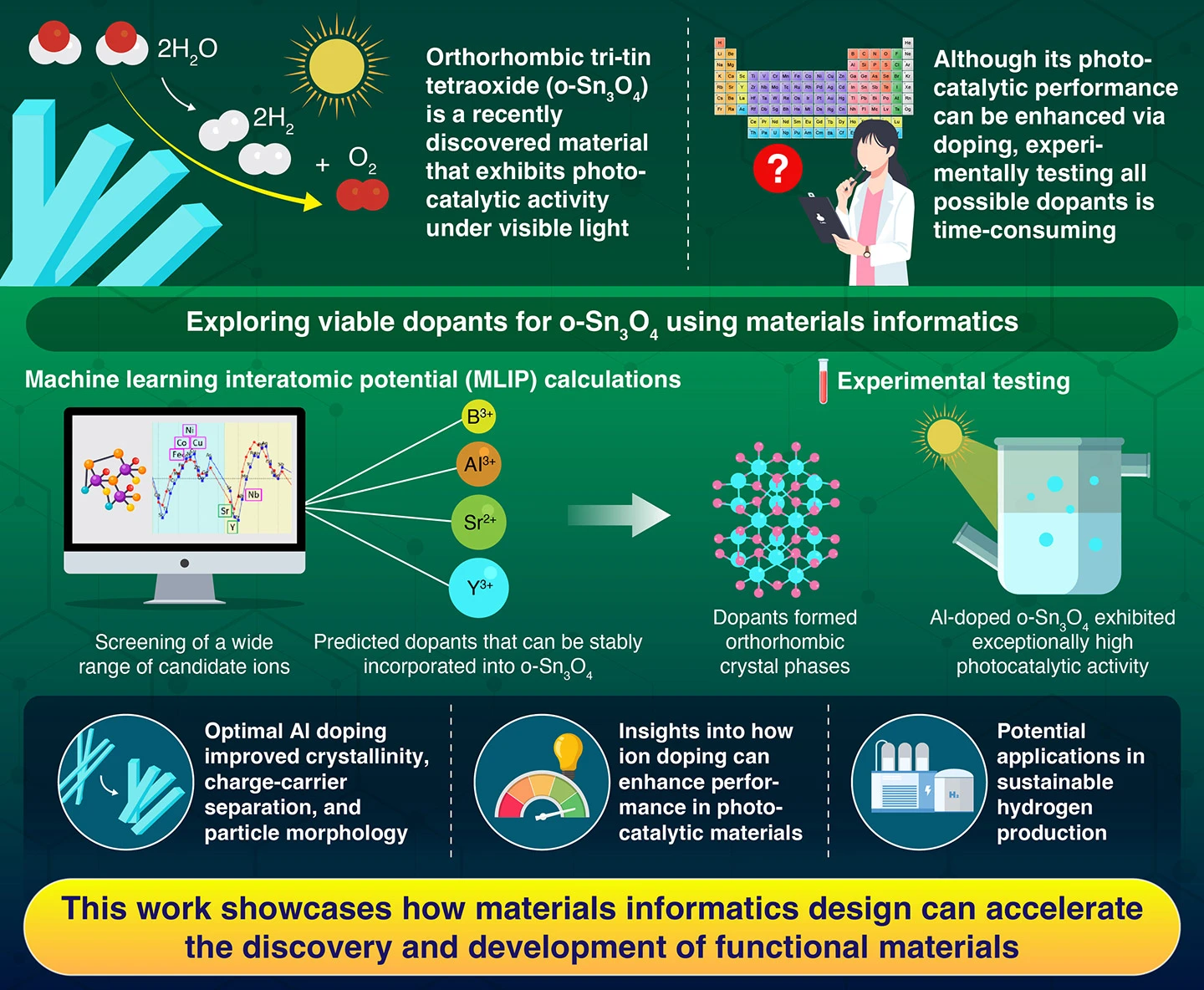
Building a sustainable hydrogen economy requires clean and efficient ways to produce hydrogen at scale. One particularly attractive approach is photocatalysis-using materials called photocatalysts to split water into hydrogen and oxygen utilizing sunlight. Among the many materials explored thus far for this purpose, tin oxides have drawn much attention because of their low toxicity, stability, and low cost. Notably, in 2023, researchers reported a new polymorph of tin oxide called orthorhombic tri-tin tetraoxide (o-Sn3O4), highlighting it as a promising contender for solar-powered energy applications.
Despite its potential, improving the photocatalytic performance of o-Sn3O4 has proven challenging. One well-known strategy for enhancing photocatalysts is doping, which involves introducing foreign ions into a material's crystal lattice to modify its properties. However, for newly discovered materials like o-Sn3O4 , identifying which dopants will actually work is largely a matter of trial and error. Since testing every possible candidate element experimentally is quite slow and resource-intensive, there is a pressing need for smarter approaches to guide dopant selection.
To address this challenge, a research team led by Professor Masahiro Miyauchi, along with graduate students Mr. Sho Uchida and Mr. Yuta Sekine, Assistant Professor Yohei Cho, Associate Professor Akira Yamaguchi from the Department of Materials Science and Engineering, Institute of Science Tokyo, Japan, Associate Professor Toyokazu Tanabe at the National Defense Academy, Japan, and Dr. Kenji Yamaguchi at Mitsubishi Materials Corporation, Japan, turned to materials informatics technique to streamline the search. Their latest paper, made available online on February 03, 2026, and published in the Journal of the American Chemical Society on February 18, 2026, describes how they used computational screening to identify viable dopants for o-Sn3O4 and then validated their predictions experimentally.
The team employed a technique called machine learning interatomic potential (MLIP) calculations, a materials informatics approach that estimates the thermodynamic stability of doped crystal structures far more efficiently than conventional calculation methods. By simulating how different ions behave when introduced into the o-Sn3O4 lattice, the researchers were able to predict which dopants would be stably doped. "This screening identified several stable candidates, including Al3+, B3+, Sr2+, and Y3+," says Miyauchi.
Guided by these predictions, the researchers synthesized doped samples using a hydrothermal method. Their experiments confirmed the computational results; ions predicted to be stable successfully formed the orthorhombic phase, while others led to different crystal structures. Among all the tested samples, aluminum-doped (Al-doped) o-Sn3O4 stood out, producing 16 times more hydrogen under visible light than the undoped material.
To better understand why Al doping worked so well, the researchers also fabricated thin-film forms with different doping densities. They found that 5% Al doping led to the best performance, because it improved crystallinity, optimized particle shape, and enhanced the separation of charge carriers generated by light. "Our study demonstrates the effectiveness of MLIP calculations for accelerating the discovery of functional materials and establishes Al-doped o-Sn3O4 as a promising next-generation visible-light photocatalyst," concludes Miyauchi.
Beyond this specific material, the team's work showcases how to leverage MLIP calculations effectively. By simplifying the search for candidate dopants and focusing experimental efforts where they matter most, this strategy could significantly speed up the development of next-generation clean energy technologies.
Reference
- Authors:
- Sho Uchida1, Yuta Sekine1, Yohei Cho1, Akira Yamaguchi1, Toyokazu Tanabe2, Kenji Yamaguchi3, and Masahiro Miyauchi1
- Title:
- Computational and Experimental Realization of Metal-Ion-Doped Orthorhombic Sn3O4 for Visible-Light-Active Photocatalysis
- Journal:
- Journal of the American Chemical Society
- DOI:
- 10.1021/jacs.5c15962
- Affiliations:
- 1Department of Materials Science and Engineering, Institute of Science Tokyo, Japan
2Department of Materials Science and Engineering, National Defense Academy, Japan
3Innovation Center, Mitsubishi Materials Corporation, Japan


