
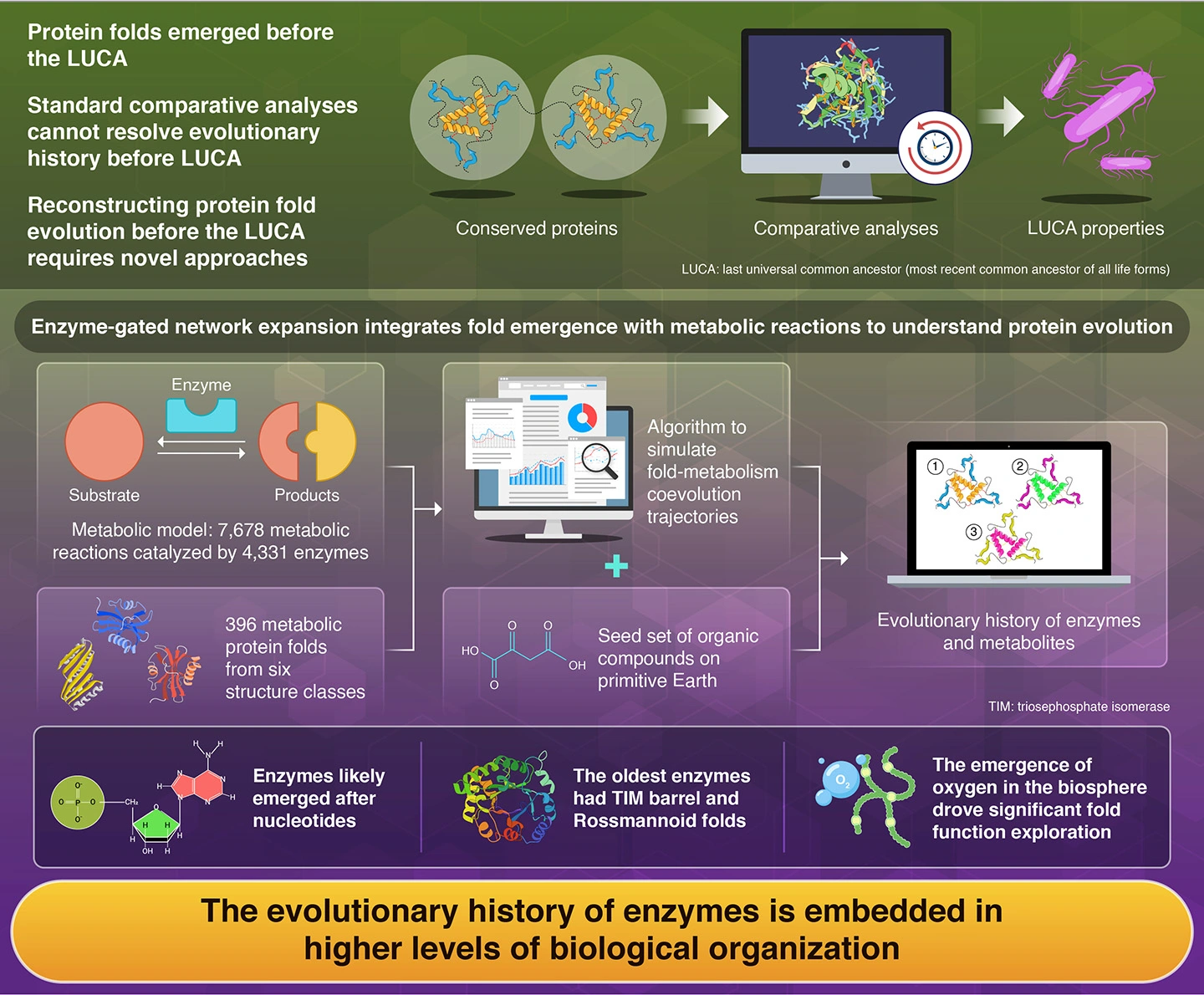
Enzymes emerged before the last universal common ancestor, making comparative genetic analyses insufficient to understand the earliest stages of enzyme evolution. Researchers at Science Tokyo have combined protein fold structure data and metabolic reaction networks to create a predictive model called enzyme-gated network expansion. The model predicts that the earliest enzymes were predominantly α/β folds, suggesting that the origin of enzyme-mediated metabolic reactions may have been sparked by a single enzyme structure type.
Metabolic Reactions Reveal Early Enzyme Evolution
Background
The enzymes we see in modern organisms are complex proteins, often with multiple folded sub-structures and specialized catalytic sites. As we know, proteins are coded by genes. If we trace the history of enzymes across all living creatures using comparisons of genes, it brings us to the last universal common ancestor (LUCA), a hypothetical organism that existed around 4 billion years ago and is believed to be the ancestor of lifeforms on Earth.
However, even the LUCA's proteins must have been complex to run the core machinery of a living cell. Because comparative analyses will not help us understand how proteins evolved before the LUCA emerged, alternative approaches are needed to reveal the earliest enzymes. One possible alternative is to look at the evolution of enzymes that catalyze metabolic reactions, which includes the breakdown of molecules in the cell to extract energy and the synthesis of complex metabolites. Metabolic reactions are layered, meaning the end product of one reaction becomes the raw material for another, resulting in a complex web. "Emphasizing the layered structure of metabolism has produced significant insights into the chemistry of primitive metabolic systems and the environment of the earliest life. Here, we use this approach to study the evolution of the first enzymes," notes Dr. Liam M. Longo, Specially Appointed Associate Professor from the Earth-Life Science Institute (ELSI), Institute of Science Tokyo (Science Tokyo), Japan.
Longo and Specially Appointed Associate Professor Harrison B. Smith, together with doctoral student Tatsuya Corlett, both from ELSI at Science Tokyo, led an international research effort to reconstruct the history of enzymes based on the layers of metabolism. Their findings were made available online on August 11, 2026, and were published in Volume 123, Issue 33 of the journal Proceedings of the National Academy of Sciences on August 18, 2026.
Results
Longo's team first turned to large databases of metabolic reactions and protein structures. Using a model of metabolic evolution based on biochemical data from the Kyoto Encyclopedia of Genes and Genomes, they identified 4,294 metabolites and 7,678 reactions mediated by 4,331 enzymes and their variants. From the Evolutionary Classification of Domains database, they identified 396 metabolic protein folds that each adopt one of six structure types.
With this data as the foundation, the team developed a model of metabolic layering starting from simple molecules that were believed to exist on Earth before the LUCA. They used the reactions associated with simple compounds at the heart of metabolism to infer which enzymes may have been present at the earliest stages of metabolic evolution. They called this model "enzyme-gated network expansion."
This model produced multiple interesting results. First, most early enzymes created by the model had α/β structures, whereas enzymes in all modern organisms and the LUCA include α alone, β alone, as well as mixtures of these elements. This finding showed that α/β catalytic sites could have driven many early metabolic reactions. "The outsized role of α/β proteins in metabolism may relate to their special ability to bind phosphate, which is a key component of many cofactors," remarks Longo.
The team then looked at a major transformative event in evolutionary history-photosynthesis, which introduced large amounts of oxygen into a largely anaerobic atmosphere. Did entirely new enzymes evolve in response to this new metabolic environment? Some new enzymes did emerge, but most oxygen-metabolizing enzymes were adapted variants of enzymes that already existed, highlighting the importance of re-functionalization in enzyme evolution.
What do these findings mean for our understanding of protein evolution on a primitive Earth? The model tells us the likely structures of the very first enzymes, and the relative versatility or specialization of different fold structures. Combining this approach with comparative studies of highly conserved structures like ribosomes could tell us more about enzymes and metabolic evolution. "This work is a key step toward building an integrated history of protein evolution, where enzymes, cofactors, and metabolic reactions are considered," concludes Corlett, the first author of the study.
Reference
- Authors:
- Tatsuya Corlett1, Harrison B. Smith1,2,3*, Eric Smith1,4, Joshua E. Goldford2,3,5, and Liam M. Longo1,2


