
Key points
- The Australian Government partnered with CSIRO to understand climate change impacts and management options for three Ramsar wetlands in the Murray-Darling Basin.
- Wetland ecosystems depend on regular rainfall, runoff and flooding - all of which are expected to decline sharply, even in best-case climate scenarios.
- Researchers came together with collaborators to map out adaptation pathways for wetlands in NSW, Victoria and South Australia.
The Murray-Darling Basin – Australia's largest river catchment – is home to some of the most biologically diverse ecosystems on Earth. Across the Basin there are 16 wetlands internationally recognised under the Ramsar Convention for their rich biodiversity and valuable ecosystems.
These wetlands play a critical role in improving water quality, reducing flood and erosion risk, and providing habitat and breeding grounds for native flora and fauna. Their ecosystems are already impacted by river regulation and water extraction. Today, climate change is rapidly adding to those pressures – and introducing new ones.
The Ramsar Convention – an international treaty adopted in 1971 in Ramsar, Iran – aims to halt the worldwide loss of wetlands, and conserve those that remain. So how do we best manage these nationally and internationally significant ecosystems into an uncertain future?
CSIRO has partnered with the Australian Government's Department of Climate Change, Energy, Environment and Water (DCCEEW) to chart a course for three Ramsar-listed wetlands through the mounting impacts of climate change.
Wetlands are becoming hotter, drier and more water-stressed
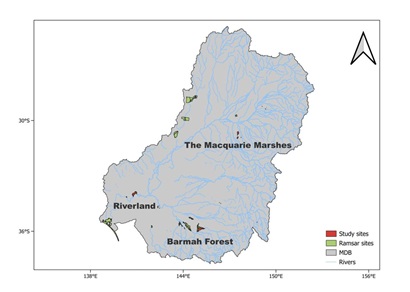
Three Ramsar wetlands from New South Wales, Victoria and South Australia were selected: the Macquarie Marshes, Barmah Forest and Riverland respectively. These sites represent a range of climates and wetland types across the Murray-Darling Basin's vast expanse.
The researchers combined multiple lines of evidence to develop a clearer picture of wetland vulnerability under a range of climate change scenarios. They analysed expected ecological changes to envision what the wetlands might look like in the future.
They found that all three sites are on course to become hotter, drier and more water-stressed. Temperatures have already risen around 1.4°C since 1910 and are projected to increase a further 1.7–2.4°C by 2050 if greenhouse gas emissions continue to rise.
Droughts, fires and extreme, short-lived rainfall events are all expected to become more intense. Rainfall remains highly variable across the Basin, and runoff could decrease significantly under drier scenarios. The frequency of multi-year droughts is expected to double.
Iconic and threatened species are at risk
Principal Research Scientist Dr Ashmita Sengupta explained that major changes to river flows cause major impacts at all three sites.
"This doesn't just affect habitat within the channel of the rivers – it also reduces how far and how often water goes over the banks to flood these wetlands," Dr Sengupta said.
"That inundation is critical to wetland ecosystems – it doesn't just provide habitat, it also brings a lot of nutrients.
"Decreased inundation impacts the flora and fauna that make these sites special.
"Iconic species like river red gums could experience dieback, water birds and fish would have fewer places to breed and threatened species like the Southern Bell Frog and Murray Cod will face even greater challenges to their survival."

People come together to manage climate threats to the wetlands
The wetlands of the Murray-Darling Basin hold significant social, cultural and economic value for the people who live and work there, too.
That's why researchers held three workshops at each site, involving representatives from local, state and federal governments, Aboriginal Corporations and groups, wetland managers, recreational users, conservation organisations, industry groups, landholders, non-governmental organisations, educational institutions and local businesses.
Principal Research Scientist Dr Rebecca Doble explained that the research used a co-delivery method: where everyone involved is invited to offer input throughout the project and participate in its design and methodology.
"When scientists work together with local managers and community to talk through scientific evidence, on-ground observations and lived experience, everyone comes away with a richer understanding of these wetlands," Dr Doble said.
"Our aim with this project was to develop long-term thinking about what climate impacts might look like, to assess how wetlands are being managed now, and what would have to change to support healthy – but potentially quite different – ecosystems into the future," she said.
"Together, we acknowledged that these wetlands are facing large pressures, and there are likely to be substantial ecological changes.
"We aimed to map out management and adaptation strategies to support these ecosystems in a proactive way, building on what we know about future pressures and changes."
Braiding together diverse perspectives to manage wetlands into the future
Planning for the wetlands' future requires a clear understanding of how climate change may reshape these environments over time. At the workshops, everyone worked together to develop future visions of what their local Ramsar wetland could look like under different climate change scenarios.

These future scenarios considered factors such as changing rainfall, flooding patterns, water availability, pests and ecosystem health. They were developed using climate science, ecological knowledge and input from local experts and managers.
This process helped people better understand the effects of climate change and management decisions, how they may interact, and what changes may occur in the years ahead.
As a result, it was recognised that some conservation goals may become harder to achieve, as the impacts of climate change intensify. In response, researchers and stakeholders collaboratively developed "climate-ready" objectives, which are more flexible and better suited to future environmental conditions.
The next step was to map out practical pathways of action that would help wetlands adjust over time as conditions change. This approach supports long-term planning and helps decision-makers prepare for gradual or even major ecological change.
Dr Sengupta said the findings highlighted the importance of bringing different groups together to plan for climate change.
"It was fabulous to see the braiding of scientific, local, and Indigenous knowledge systems: everybody learned something from those exchanges," Dr Sengupta said.
"Developing adaptation pathways now helps everyone work together to better support these wetlands into the future."
This scientific approach, which brings people together to help safeguard the future of their local ecosystems, is designed to be replicated across other sites in Australia and internationally.
CSIRO has worked with partners in the Murray-Darling Basin over the past three decades to understand a system under growing pressure, as demand and climate change reduce water security for communities, industries and ecosystems. Ongoing research informs management that supports equitable use of water, sustainable and productive industries, safe communities and healthy ecosystems.


