National brain cancer research partnerships are being strengthened with new Innovation Partner Node Funding from the Mark Hughes Foundation Centre for Brain Cancer Research (MHF Centre) at the University of Newcastle.
Building on a 10 year commitment to Mark Hughes Foundation Innovation Grant Funding, with over $10 million allocated to blue sky projects, the MHF Centre is now honing their investments in brain cancer research with targeted project funding for key partnerships.
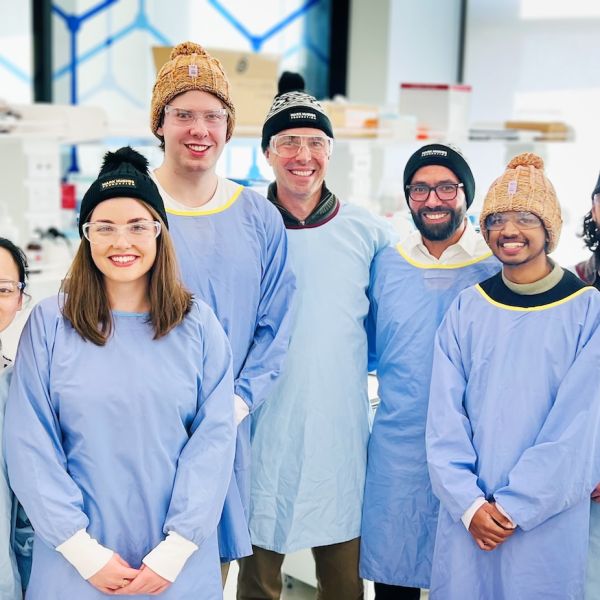
Professor Ivan Kempson, Professor of Biophysics at Adelaide University and his team are leading the first Partner Node project, which has been awarded $240,000 to advance radiation biology research.
"I'm so honoured to be formally a part of the Centre," he says.
"Kirralee and Mark Hughes, along with Professor Mike Fay, have been inspirational in unifying research with a holistic approach to brain cancer care."
"We need to take a Team Australia approach toward solving the puzzle of brain cancer," says MHF Centre Director Professor Mike Fay. "So we have identified strong research teams and partnerships like Professor Kempson's to build capacity and advance brain cancer research across the nation."
Professor Kempson and his team are working to reinvigorate fundamental science around radiation biology. "There is still so much that is unknown about brain cancer, at the molecular and organ level and right up to the whole-body level and how radiation can trigger an immune response," he says.
"A lot of the previous assumptions around radiation effects originated in the 1960s and 70s, and many of these actually don't hold up," Professor Kempson explains. "We've been looking at a lot of novel approaches that are going back to basics, challenging some underlying assumptions and we're already seeing some fascinating results."
"We have a couple of tools that we've implemented that are the first in Australia for looking at DNA damage, and particularly at DNA damage from radiation," Professor Kempson adds. "It's the first time that we've actually been able to quantify the effects of radiation at a DNA level.
"We're looking at how we can enhance DNA damage in tumour cells, but protect DNA in normal cells as well."
Professor Kempson's team have paired up with the Royal Adelaide Hospital to do lab studies in a real-life clinical environment: using high-energy equipment to explore how it changes the immune cell populations in a tumour.
"We can draw quite different conclusions now using the clinical facilities compared to lab-based facilities," Professor Kempson explains. "This is opening up new opportunities to explore how we promote immune responses in brain cancer."
"Thanks to this support from the MHF Centre, it's allowed us to build our personnel who are really committed and dedicated to brain cancer research."
"This new stream of partner node funding has been designed to build on previously-funded projects and to increase capacity in national collaborations so teams can work to their strengths, each working to solve the challenging puzzle that is brain cancer," Professor Fay adds.
The Mark Hughes Foundation Centre for Brain Cancer Research is a partnership between the Mark Hughes Foundation and the University of Newcastle. Established in 2022, with further funding committed in 2026, the MHF Centre aims to drive national research collaborations to improve patient outcomes in brain cancer.
This is the first of three 2026 Innovation Partner Node projects to be announced.
*Ivan Kempson is a Professor of Biophysics at Adelaide University, The Future Industries Institute and the Centre for Pharmaceutical Innovation, School for Pharmacy and Biomedical Science in the College of Health at Adelaide University.