
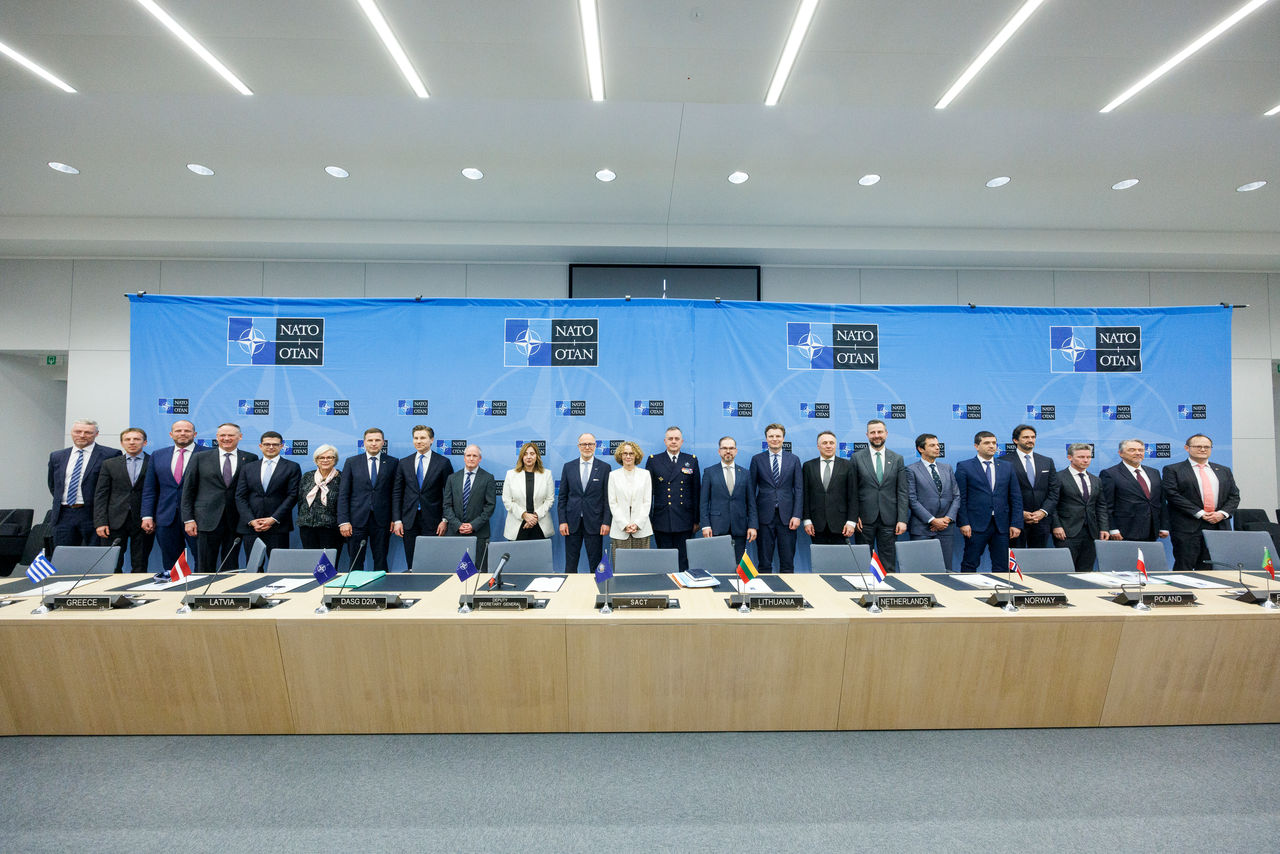
On Thursday (12 February 2026), NATO Allies took further steps to enhance deterrence and defence through multinational cooperation and the development of cost-effective, innovative solutions.
At a signing ceremony held at NATO Headquarters, NATO's Deputy Secretary General Radmila Shekerinska welcomed the four multinational initiatives as a fundamental step towards achieving the commitments made at the NATO 2025 Summit in The Hague and ensuring that Allies have the capabilities, resources, resilience and warfighting readiness needed to defend the Alliance.
Seven Allies (Belgium, Denmark, France, the Netherlands, Norway, Türkiye, United Kingdom) have agreed to work together to strengthen their defence against ballistic missiles through the development, acquisition and implementation of capabilities such as sensors, interceptors and tactical control systems complementing existing Allied air and missile defence capabilities. This new High Visibility Project responds to NATO's capability targets and national operational requirements in the area of Integrated Air and Missile Defence (IAMD).
Under another new High Visibility Project, five Allies (Denmark, Lithuania, the Netherlands, Poland, Türkiye) will collaborate on innovative drone-based deep precision strike capabilities to meet existing and future operational requirements more efficiently. The initiative will also explore new development and acquisition mechanisms to accelerate adoption and involve non-traditional defence companies.
The airworthiness of military aircraft ensures fitness to fly at the highest safety standards, structures the entire technical life cycle, and can be challenging in times of crisis or conflict, when operational demands are high, and resources scarce. Fifteen Allies (Albania, Canada, Denmark, Finland, France, Germany, Greece, the Netherlands, Norway, Poland, Portugal, Romania, Slovakia, Sweden, Türkiye) have committed to exploring multinational approaches to enhancing air power resilience, readiness and interoperability in such times. These can include new solutions for design, modification, maintenance, repair and servicing, as well as adapting procedures to ensure air operations can be carried out at the highest achievable level.
Finally, Sweden has joined NATO's Air Battle Decisive Munitions (ABDM) High Visibility Project, bringing the total number of participating nations to 17. Launched in 2014, ABDM is a key multinational initiative that supports the acquisition of essential air-launched munitions under more favorable conditions as well as strengthening interoperability among Allies.


