
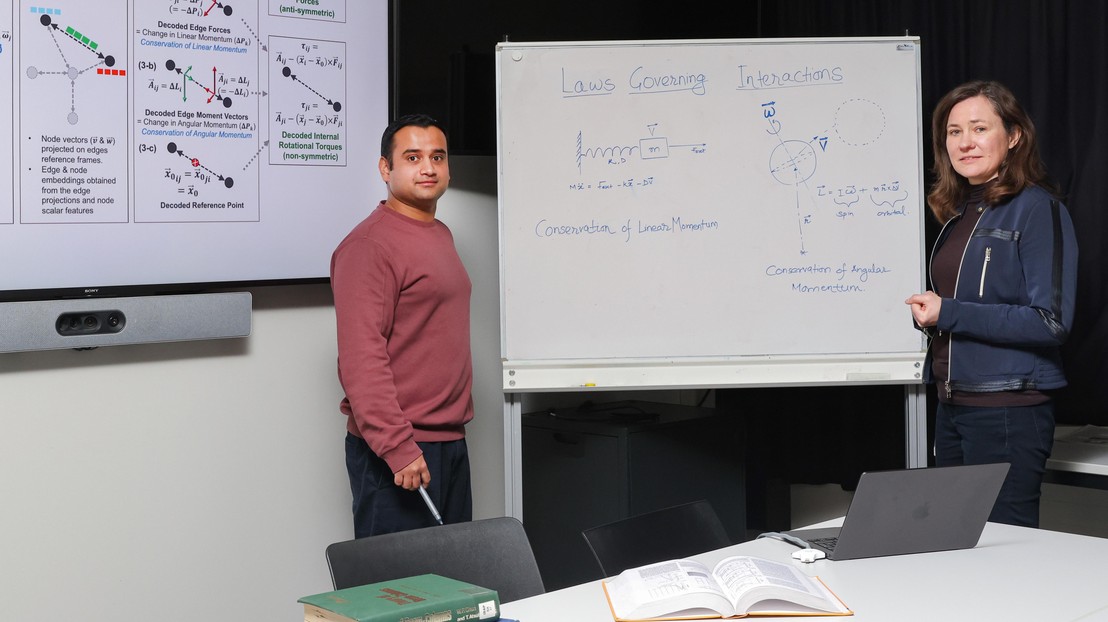
Vinay Sharma et Olga Fink, du Laboratoire IMOS, ont développé une IA capable de simuler des systèmes complexes tout en respectant les lois fondamentales de la physique © 2026 Alain Herzog
A team of EPFL researchers has developed an AI algorithm that can model complex dynamical processes while taking into account the laws of physics - using with Newton's third law.
Artificial intelligence has enabled major breakthroughs in several fields, but the models still struggle to obbey the fundamental laws of physics. As humans, we know intuitively that objects fall, bounce and exert a force. We also can easily transfer this knowledge between different objects and different sizes of objects - but machines don't have that insight. This is a particularly limiting problem for scientists and engineers: even their most sophisticated AI models get lost when trying to apply concepts from basic physics to predict complex processes evolving in time like the movement of the human body, colliding particles and the gear mechanisms in industrial equipment and robots. The models end up making completely incoherent predictions about physical system behavior as time progresses and errors accumulate. At the other end of the spectrum, classical models follow the laws of physics to a T, but they require an inordinate amount of calculation time and processing power for systems with a wide array of objects and interactions. and the simulations may not be fully consistent with the real systems and their observations. And classical models require remodeling to deal with entirely new conditions or system configurations.
To provide researchers more reliable AI tools, scientists at EPFL's Intelligent Maintenance and Operations Systems (IMOS) laboratory have developed an algorithm called Dynami-CAL GraphNet that enables AI models to continuously obey the laws of physics.
By incorporating Newton's third law, we transitioned from an AI model that tries to infer physical behaviour from data to one that's designed to obey the underlying physics.
Writing Newton's third law into AI architecture
In the physical world, there's no avoiding Newton's third law, which says that every action has an equal and opposite reaction. When walking, we push against the ground to move forward; when we throw a ball against a wall, it bounces back; and when we start up an engine, the resulting force causes motion in the opposite direction. Newton's law is a pillar of physics and applies universally - to molecules and grains of sand as well as human bodies and machines. The AI algorithm used by the IMOS researchers is a graph neural network (GNN), or a kind of model in which interacting objects are represented by nodes and the interactions between them by edges in a network. This makes GNNs particularly well-suited to modeling systems comprising several interacting components. For Dynami-CAL GraphNet, the researchers embedded Newton's third law directly into the AI architecture, ensuring the algorithm produces physically consistent predictions and preventing unrealistic or incoherent force estimates - even in previously unseen situations. "We transitioned from an AI model that uses statistics to try and guess the physical behavior of objects to a model that's built to follow that behavior," says Vinay Sharma, a PhD student at the IMOS lab. "Our approach can't replace all physics equations, but it can ensure that interactions are modeled in a coherent way and enable researchers to run stable, credible simulations."
Most other models break down after just a few iterations, but Dynami-CAL GraphNet can model over 16,000 steps in a row without straying from the laws of physics.
Because Newton's third law is universal, their approach does not depend on the scale or type of system. "That's what lets our model not just generalize - that is, apply what it has learned to similar situations - but also extrapolate, by producing reliable predictions in entirely new situations," says Prof. Olga Fink, head of the IMOS lab. "This extrapolation is something that machine learning algorithms rarely do well." Dynami-CAL GraphNet - unlike other AI models - can effectively handle systems involving large numbers of objects, higher speeds, unusual configurations and different environments. "Most other models diverge after just a few iterations, whereas Dynami-CAL GraphNet remains stable for over 16,000 steps consecutive steps while still respecting the laws of physics," says Fink.
The IMOS researchers tested their algorithm on real-world scenarios. They started by modeling collisions among granular spheres like those found in a silo or industrial mixer, where thousands of particles collide, roll, bounce and rub up against moving walls. Trained on just four simulations of simple systems with dozens of particles contained in a stationary box, Dynami-CAL GraphNet was able to extrapolate to thousands of particles contained in a mixer with rotating cylindrical walls. The system was also tested on human motion and was able to predict a person's gait using simple motion capture data and without being provided with information on the force exerted by the ground. "We also examined how the system performs at a microscopic scale by modeling the dynamics of protein molecules in solvent," says Sharma. "It successfully predicted the tiny deformations that occur over time."
Training models on very little data
Fink sees two big advantages to Dynami-CAL GraphNet. The first is that it can be trained on very little data and still generalize to new system configurations, different operating and boundary conditions, as well as larger systems, provided that the governing relationships remain the same. "For example it can learn the dynamics by predicting one time step ahead from postures of a walking human, and then infer the entire future motion trajectory." The second is that its output, in addition to being more stable and reliable, is also transparent and interpretable to users. That's important because the users of a computer model need to know when and how the laws of physics are applied in order to properly evaluate and trust its results. And unlike some AI models that appear to be black boxes, Dynami-CAL GraphNet calculates physical quantities such as forces, torques and exchanges of angular momentum step by step, in a way that users can interpret. "All the intermediate calculations are consistent with the laws of physics," says Fink. "For example, an engineer using our system can check whether it followed the linear and angular momentum conservation laws. That's what builds trust in a model, especially when it comes to critical systems."


