
Key Takeaways
- Researchers developed a process that converts kraft lignin, an underused byproduct of the pulp and paper industry, into a valuable chemical used to make several common products.
- The process, found to be economically relevant, can be applied to other types of lignin.
- This work is part of ongoing research focused on making use of and adding value to lignin.
The pulp and paper industry, which manufactures everything from tissue paper to cardboard, also generates a significant yet often overlooked byproduct - a complex polymer called lignin. Around 100 million tons of lignin are produced each year. Despite being the largest natural source of aromatic carbon on the planet, most of it ends up burned for energy. This is due to its complex structure, which is notoriously difficult to process. Researchers are exploring ways to leverage industrial lignin by developing methods to convert it into useful bio-based chemicals.
A new study led by researchers at the Department of Energy's Lawrence Berkeley National Laboratory (Berkeley Lab) established a scalable process for converting one of the toughest types of lignin, called kraft lignin, into benzylamines - a valuable chemical used in the production of pharmaceutical ingredients, dyes, fertilizers, and pesticides.
Benzylamines are typically made from a chemical that is highly toxic. Producing them from lignin provides a unique, more environmentally friendly alternative - while also making use of this cheap, abundantly available resource that often goes to waste.
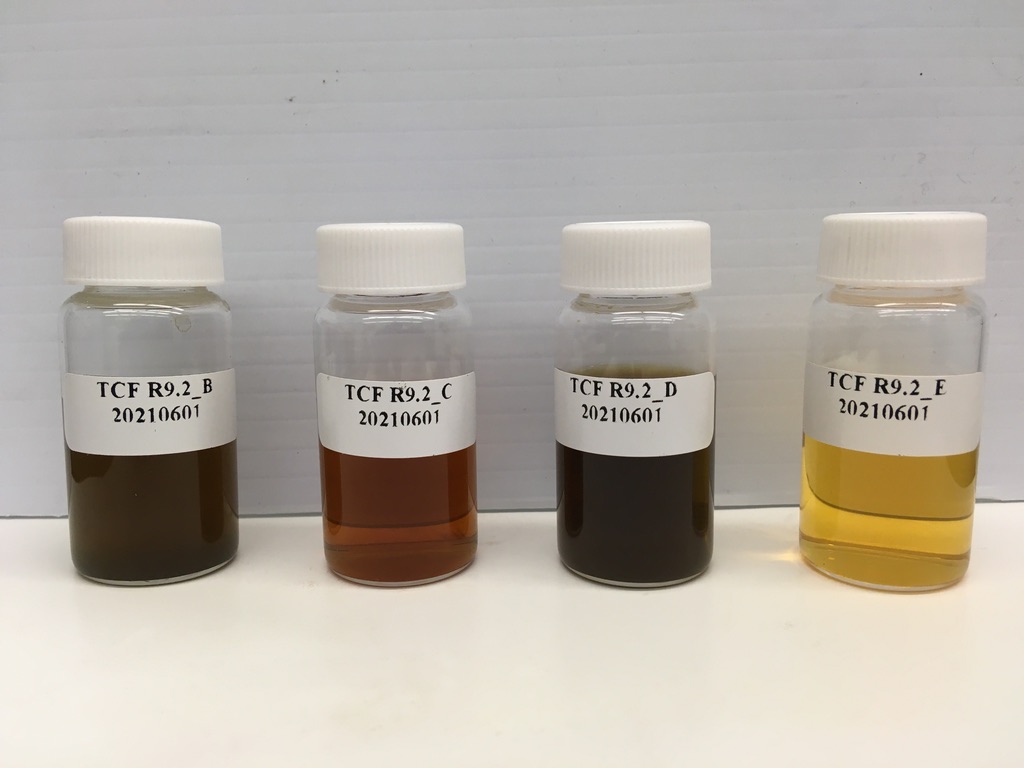
Lignin-derived products resulting from the methanol solvent-based process using different catalytic reagents. The different colors indicate different reaction levels. These substrates serve as intermediates for benzylamines.
"Recently, there has been interest in converting lignin into benzylamines," said Chang Dou, the lead author of the study and a principal scientific engineering associate at Berkeley Lab's Advanced BioProcess Development Unit (ABPDU), a scale-up facility that enables innovative biotechnologies to advance from the lab to commercial relevance. "We gained a better understanding of how lignin reacts to different solvents, and the process we developed can be applied to different types of lignin."
The first step in converting lignin into benzylamines involves breaking it down into individual units that can then be upgraded. To do this, researchers tested different solvents and catalytic reagents, which speed up chemical reactions. The type of solvent used ended up as the most critical factor, with methanol identified as optimally efficient.
While different types of solvents impacted yields, the product distribution - the ratio of products that are generated - remained largely the same across all solvents. However, different catalytic reagents affected the types of products they were able to make.
"This suggests that solvent choice primarily governs yield, whereas catalyst selection is critical for steering toward desired chemical products," said Ning Sun, a staff scientist at ABPDU and one of the study's corresponding authors.
The use of kraft lignin in this research is also significant. Kraft lignin is one of the most challenging types of lignin to process due to its condensed structure, which results from being exposed to harsh conditions.
"We've shown that even the most stubborn industrial lignin can be upgraded into valuable chemical building blocks." – Chang Dou
"The running joke in the industry is that you can make anything but money from lignin," said Dou, a process analytical chemist. "We've shown that even the most stubborn industrial lignin can be upgraded into valuable chemical building blocks."
ABPDU staff collaborated with researchers at the Joint BioEnergy Institute (JBEI) to analyze the economics of this method and found that a methanol solvent-based process performed the best at large scales. The addition of catalytic reagents didn't have a significant enough impact on benzylamine yields to justify using them in the procedure.
"This moves us beyond a largely academic exercise toward a more practical, scalable, and economically relevant chemical manufacturing strategy," Sun said.
Researchers from the Queens University of Charlotte in North Carolina and Sandia National Laboratories also collaborated on this research, which was funded by a Technology Commercialization Fund Award from the DOE's Alternative Fuels and Feedstocks Office (AFFO), formerly known as the Bioenergy Technologies Office. JBEI is a Bioenergy Research Center funded by the DOE Office of Science.


