
Key Points
Research has confirmed that water's molecular dynamics change dramatically between about -35°C and -20°C when it becomes glassy
The findings have relevance for cryopreservation of biological materials, food freezing technologies, and understanding water in living cells, where it is often also confined at the nanoscale
The research team used neutron and synchrotron techniques at ANSTO to observes dynamic changes at the molecular scale
An international collaboration of researchers has used ANSTO's facilities to find something new about the properties one of the most fundamental everyday materials, water, and answered an important scientific question.
The findings published in Nature Communications have practical implications for understanding water at very low temperatures. The findings have relevance for cryopreservation of biological materials, food freezing technologies, and understanding water in living cells, where it is often also confined at the nanoscale.
Water is one of the most familiar substances on Earth, yet it still presents many scientific mysteries. One of the biggest unanswered questions is finding where the transition from a liquid to glass occurs. With many other materials this has been discovered by cooling them very quickly or 'quenching' to freeze the atoms in place without any organised (crystalline) arrangement.
Although we know glassy water exists on Earth within polar clouds, scientist have been unable to observe the liquid to glass transition, because water forms crystalline ice too rapidly.
To approach this problem, rather than looking at bulk water, this team trapped tiny amounts of water within extremely thin layers of lipid-like membranes - made of the molecule phytantriol.
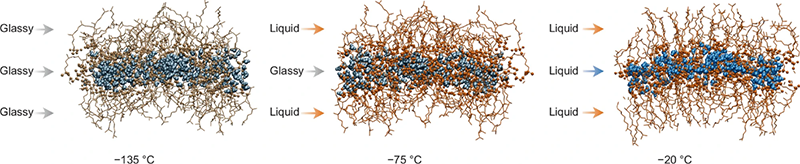
A 'soft nanoconfinement' prevented water from crystallising into ice. The team found that water enters a previously hidden glassy state over a much wider temperature range than previously thought."
The use of multiple complementary techniques at ANSTO allowed the team to probe water's behaviour across timescales ranging from trillionths of a second to microseconds.
Experiments on the Small Angle and Wide Angle X-ray Scattering (SAXS/WAXS) beamline was essential in the study to characterise. the structure and low-temperature behaviour of phytantriol-water mixtures.
Researchers could directly observe how water remains confined within nanoscale layers at temperatures well below its normal freezing point. These measurements provided the structural foundation for the broader investigation into the liquid-to-glass transition of nanoconfined water.
"During his visit to the Australian Synchrotron, Dr Patrick Züblin of Monash University worked closely with the SAXS/WAXS team to further develop and optimise low-temperature measurements, to temperatures as low as -120°C," said Dr Ashish Sethi, Beamline Group Manager.
The research team also used two of instruments at the Australian Centre for Neutron Scattering, the High-Resolution Backscattering Spectrometer Emu and the Time-of-Flight Spectrometer Pelican, that can detect molecular vibrations, atomic excitations, or the breaking apart the target structure itself.
Because neutrons are uniquely sensitive to hydrogen atoms, they are an ideal probe for studying water. The researchers were able to directly track the movement of water molecules and determine when that motion slowed enough for the water to become glassy. These experiments provided crucial evidence that water's molecular dynamics change dramatically between about -35°C and -20°C.
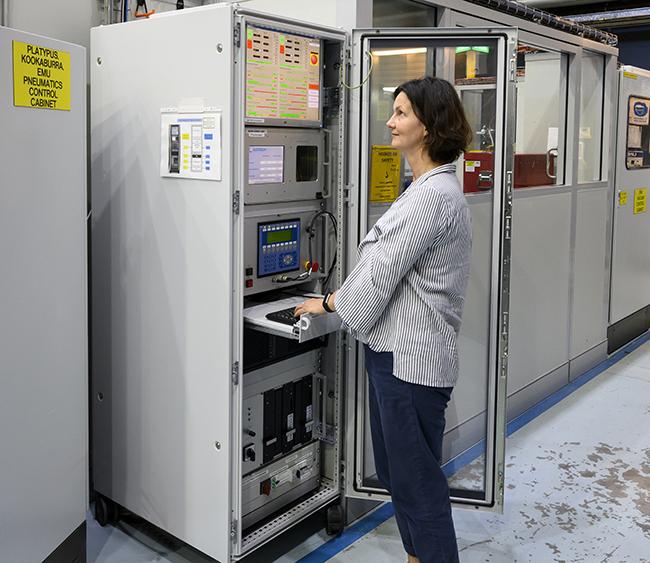
"The neutron signal, detected by our instrument, is dominated by the motions of hydrogen atoms in water. This allows us to selectively measure water dynamics even when the water is confined within a complex soft matrix," said Dr Alice Klapproth, Principal Instrument Scientist.
Importantly, neutron also scattering complemented by deuteration at the National Deuteration Facility allowed the researchers to distinguish the behaviour of the water from that of the surrounding lipid material, something that is extremely difficult to achieve with most other techniques. In this unexpected state, water becomes glassy while the surrounding membranes remain mobile and fluid.
The broad experimental approach also included measurements at the Soleil Synchrotron in France, as well as low temperature microscopy, nuclear magnetic resonance spectroscopy and computer simulations.
Thanks to Dr Helen Maynard Casely for her contribution.


