
The University of Oxford is to co-lead one of three new UK-Japan quantum technology projects, announced today during the Prime Minister's visit to Japan . The three projects are funded by an investment of £4.5 million by the Engineering and Physical Sciences Research Council (EPSRC) and just over ¥1.1 billion (£5.2 million) by the Japan Science and Technology Agency (JST).
By fostering deep integration between leading UK and Japanese teams and their respective programmes, we aim to create a coherent, full-stack architecture and deliver concrete integration outcomes that amplify the value of current national efforts, rather than duplicating foundational developments.
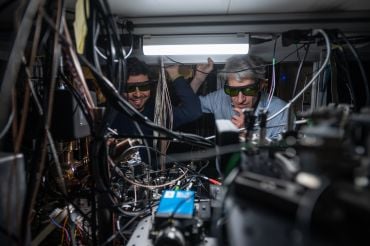
Professor David Lucas , Department of Physics, University of Oxford
Instead of working through problems step by step, quantum methods can explore many possibilities at the same time, making them much faster at certain tasks. This holds immense promise to transform computing, communication, and scientific discovery.
However, unlocking this potential requires moving beyond isolated lab experiments to build large-scale, interconnected quantum systems. The project 'Distributed and secure quantum computation' will address this by building the foundations of a quantum internet using ion-trap nodes and photonic links. By integrating advanced hardware and privacy-preserving protocols, this will enable ultra-secure communication and faster scientific discovery, while training future specialists to strengthen global quantum networks.
The project, which will run for five years, is jointly led by Professor David Lucas (Department of Physics, University of Oxford) and Professor Mio Murao of the University of Tokyo in Japan.

Professor Lucas said: 'Similar to how the internet connects classical computers, future quantum advances depend on networking quantum processors together. This presents profound scientific and engineering challenges, particularly in ensuring these networks are scalable, secure, verifiable, and integrated. Addressing this complex challenge effectively demands a unified approach and international collaboration, leveraging complementary strengths.'
The project brings together world-leading researchers from the UK and Japan - nations at the forefront of quantum technologies - to tackle this critical task. Professor Lucas's research group is a leader in quantum networking of qubits based on trapped ions, while other UK partners bring expertise in verification and ion/photon interfacing. Meanwhile, the Japanese team members bring complementary strengths in quantum communication theory, ion trap hardware, and advanced manufacturing, guided by its Quantum Technology Innovation Strategy and ASPIRE programme.
Professor Lucas added: 'By fostering deep integration between leading UK and Japanese teams and their respective programmes, we aim to create a coherent, full-stack architecture and deliver concrete integration outcomes that amplify the value of current national efforts, rather than duplicating foundational developments.'
The key aim of the collaboration is to design, build, and demonstrate an integrated blueprint for distributed and secure quantum computation using ion trap nodes - small, high-precision quantum processors based on trapped atoms - and photonic links, which use single particles of light to securely connect these processors into a network.
By pioneering a full-stack co-design approach, the researchers will develop all layers of the system concurrently - from the fundamental hardware to end-user applications - ensuring they function as a coherent whole. The integrated architecture will be rigorously tested using Federated Quantum Machine Learning: a technique allowing AI models to be collaboratively trained on decentralised data without compromising privacy. This will enable the researchers to demonstrate the readiness of the integrated software framework for future, more powerful quantum hardware.
Besides the University of Oxford, the UK collaborators include the University of Edinburgh, the University of Manchester, and the University of Sussex.
Further information about the funded projects can be found on the UKRI website .


