
Poly(N-isopropylacrylamide) (PNIPAM) hydrogel undergoes significant but precise changes in size between 20 and 40 °C, making it an excellent candidate for use in variable-size deterministic lateral displacement (DLD) array devices. Researchers from Science Tokyo have built a tunable DLD cell-sorting platform and verified its ability to sort cancer cells of defined sizes from blood samples. This platform could offer high-resolution size-based cell sorting for a wide variety of biomedical applications.
Tunable Cell-Separation Device Changes Selectivity Based on Temperature
Isolating specific kinds of cells from their surrounding tissue is a crucial step in many medical diagnostic processes. For instance, detecting cancer cells in the blood is necessary to identify whether cancer has metastasized. Size-based cell sorting techniques, such as deterministic lateral displacement (DLD), have grown popular in recent years, thanks to their high-throughput and preservation of metabolic activity in the isolated cells.
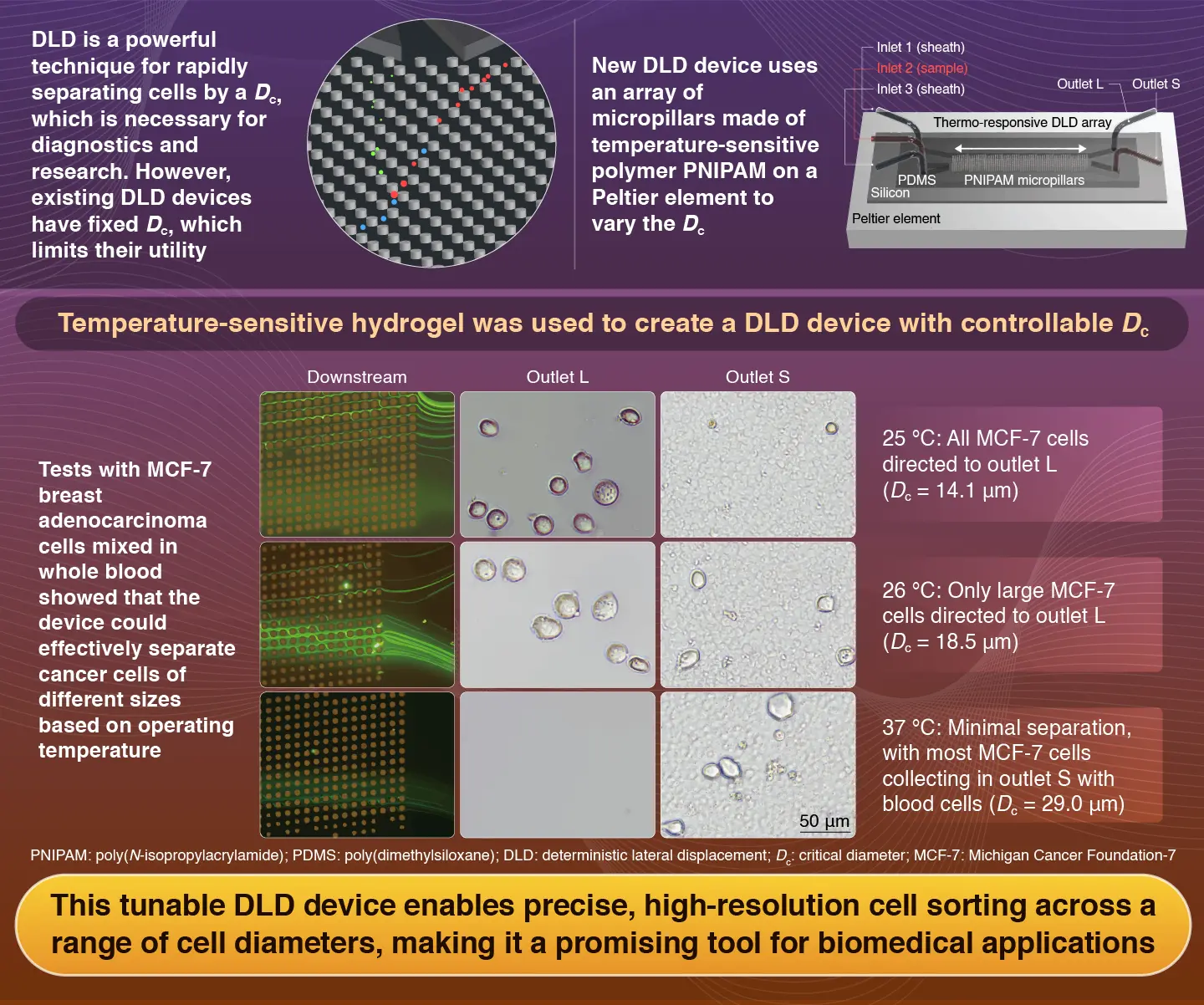
DLD uses arrays of precisely spaced micropillars. Cells smaller than a certain critical diameter (Dc) are diverted to one side of the array, while those larger than Dc are diverted to the opposite side. However, this means that a typical DLD device can only sort cells based on one specific Dc, which limits its utility. This also means that DLD devices are at risk of fouling and blockage, since there is no effective way to remove large-diameter objects that get caught within the array.
A team of researchers from the Institute of Science Tokyo (Science Tokyo), Japan, has created a tunable DLD device using poly(N-isopropylacrylamide) (PNIPAM) hydrogel micropillars. This project was led by Associate Professor Takasi Nisisako and Assistant Professor Yusuke Kanno of the Institute of Integrated Research, Science Tokyo, together with graduate student Ze Jiang from the Department of Mechanical Engineering, School of Engineering, Science Tokyo, Japan. Their work was published in the journal Lab on a Chip on September 3, 2025.
PNIPAM undergoes precise changes in size between 20 and 40 °C, making it an excellent candidate for a DLD with variable Dc. "In our previous work, we demonstrated a thermo-responsive DLD array on a glass substrate using hydrogel micropillars composed of PNIPAM within a poly(dimethylsiloxane) (PDMS) microchannel," Nisisako says, adding, "The PNIPAM-based approach requires no complex external field-generating equipment, offers a simpler fabrication process, and facilitates size-based separation through direct temperature-driven modulation of pillar dimensions."
The latest version of the team's DLD device consists of a silicon base on a Peltier element. PDMS microchannels that are plasma-bonded to silicon carry the liquid sample and sheath fluid to the PNIPAM microarray. Two outlets—L and S—at the far end of the array allow sorted cells to be separated from the rest of the sample. "The use of silicon, chosen for its superior thermal conductivity, enabled more precise Dc control," says Nisisako, listing the improvements in this version. He adds, "Plasma bonding of the PDMS channel to the silicon substrate allowed stable, positive-pressure operation across a range of flow rates. Furthermore, by employing a new PNIPAM-based photoresist with higher polymer concentration, we fabricated micropillars up to 30 μm in height, suitable for processing diverse biological particles."
The team verified the tunability of their device using blood samples spiked with Michigan Cancer Foundation-7 (MCF-7) breast adenocarcinoma cells. With an average diameter of 17 μm, MCF-7 cells are significantly larger than blood cells. The team passed the sample through the array at 25 °C (Dc = 14.1 μm) and achieved 90% sorting efficiency of MCF-7 cells into outlet L. At 26 °C (Dc = 18.5 μm), similar numbers of MCF-7 cells were seen in both outlets, but those at outlet L were consistently larger than those at outlet S. At 37 °C (Dc = 29 μm), all MCF-7 cells were at outlet S.
Buoyed by the successful validation of their tunable DLD device, Nisisako aims to verify its performance when used with actual biological samples from patients. "The precision, versatility, and reliability of this platform underscore its potential for high-resolution size-based sorting, making it a promising tool for a wide range of biomedical applications," he adds, indicating exciting new uses for this technology.
Reference
- Authors:
- Ze Jiang1, Yusuke Kanno2, and Takasi Nisisako2*
*Corresponding author
- Title:
- Tunable cell separation using a thermo-responsive deterministic lateral displacement device
- Journal:
- Lab on a Chip
- DOI:
- 10.1039/D5LC00783F
- Affiliations:
- 1Department of Mechanical Engineering, School of Engineering, Institute of Science Tokyo, Japan
2Institute of Integrated Research, Institute of Science Tokyo, Japan


