
The US National Oceanic and Atmospheric Administration (NOAA) is forecasting a below-normal hurricane season for the Atlantic basin this year.
There is a 55% chance of a below-normal season, a 35% chance of a near-normal season and a 10% chance of an above-normal season, according to NOAA's hurricane outlook .
Forecasters predict a total of 8-14 named storms. Of those, 3-6 are forecast to become hurricanes, including 1-3 major hurricanes (category 3, 4 or 5 with winds of 178 km/h (111 mph) or higher). NOAA has a 70% confidence in these ranges.
An average season has 14 named storms with seven hurricanes, including three major hurricanes.
"The risks associated with tropical cyclones are both real and increasing. It only takes one landfalling tropical cyclone to roll back years of development. While risks are growing, so too is our capacity to anticipate and act to save lives and protect livelihoods," said WMO Secretary-General Celeste Saulo.
NOAA Administrator Neil Jacobs said rapid integration of advanced technology, including AI-based weather models, drones, and next-generation satellite data will deliver actionable science to safeguard lives and livelihoods.
"These new capabilities, combined with the unmatched expertise of our National Weather Service forecasters, will produce the most accurate forecasts possible to protect communities in harm's way," he said.
Key factors driving NOAA's forecast
The Atlantic season is expected to be below-normal due to competing factors. El Niño is expected to develop and intensify during the hurricane season, while ocean temperatures in the Atlantic are expected to be slightly warmer than normal and trade winds are likely weaker than average. El Niño conditions tend to support less tropical storms and hurricanes, while warmer ocean temperatures and low winds support a more active year.
"Although El Niño's impact in the Atlantic Basin can often suppress hurricane development, there is still uncertainty in how each season will unfold," said NOAA's National Weather Service Director Ken Graham. "That is why it's essential to review your hurricane preparedness plan now. It only takes one storm to make for a very bad season."
The scale of the threat was demonstrated in 2025 by the devastation caused in Jamaica by Hurricane Melissa - the strongest on record to make landfall in Jamaica. At its peak was classified as a category 5 storm based on the Saffir Simpson Hurricane Wind Scale, with life-threatening winds reaching around 200 km/h, with much higher gusts.
Melissa was responsible for more than 90 deaths across Jamaica, Haiti and the other island nations. It led to economic losses in Jamaica of approximately 12.2 billion US dollars, more than half of GDP. Even though Melissa had no historical precedent, Jamaican authorities used high-quality risk modelling to inform advance financial measures and disaster preparedness which limited the human toll and helped the island cope. Jamaica's Meteorological Service received high praise for its action.
The Atlantic hurricane season lasts from 1 June to 30 November and is carefully monitored by WMO's Tropical Cyclone Programme . The US National Hurricane Center acts as WMO's Regional Specialized Meteorological Center.
WMO is responsible for maintaining rotating lists of names , which serve to increase public awareness and protect public safety.
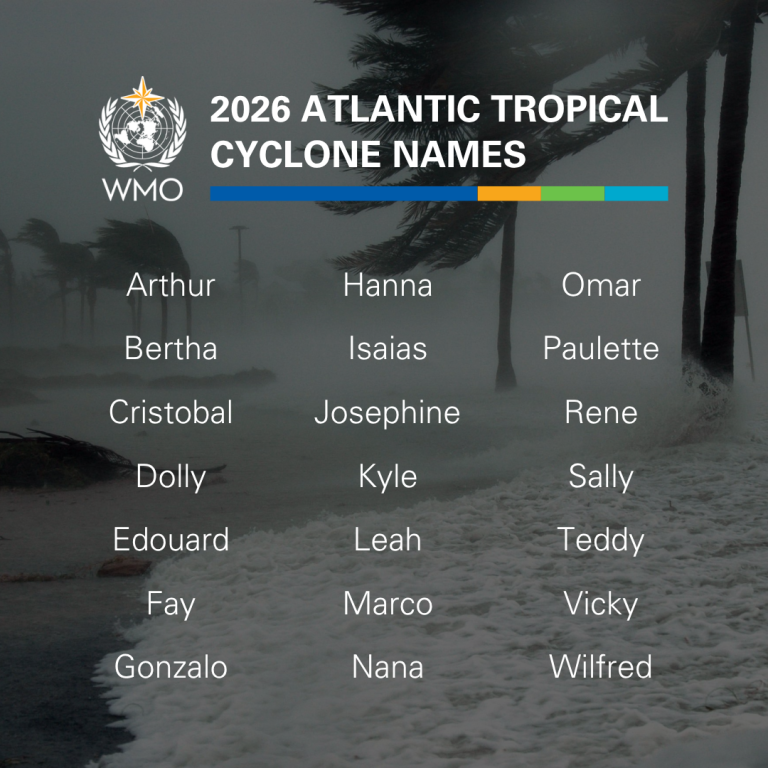
NOAA also issued seasonal hurricane outlooks for the eastern Pacific and central Pacific hurricane basins , with both anticipated to have active seasons.
Between 1970 and 2021 tropical cyclones (the generic term which includes hurricanes) were the leading cause of both reported human and economic losses worldwide, accounting for more than 2 000 disasters.
However, the death toll decreased from more than 350,000 in the 1970s to less than 20,000 in 2010-2019. Reported economic losses in 2010-2019 were at 573.2 billion dollars.
Early warnings by the WMO community and improved disaster risk management have dramatically reduced fatalities, but economic losses are rising.
This is why WMO and its partners have prioritized early warning action in small islands under the international Early Warnings For All initiative .
Read the NOAA press release here .


