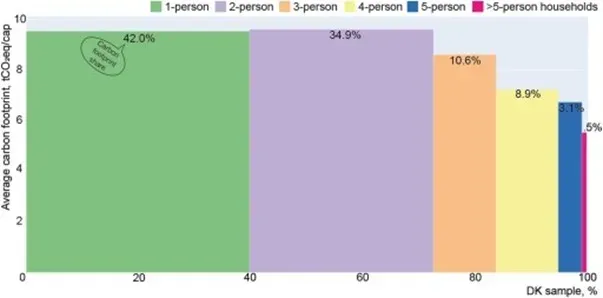
Solo living in your own home places a greater strain on the planet's resources than living with others, as everyone needs their own appliances - a toaster, a washing machine and so on. The Nordic countries stand out: almost half of all households are solo living households. Sustainability researcher Tullia Jack interviewed people who live alone about the reasons for this and hopes for new forms of co-living.
"Co-living is low-hanging fruit when it comes to reducing carbon emissions. That's why I wanted to explore why people live alone," says Tullia Jack, who has also researched other social norms that escalate resource consumption. (See fact box below.)
Tullia Jack approached the issue by conducting in-depth interviews with around 20 people living alone, representing a range of backgrounds, ages, socio-economic circumstances and genders. What several of them had in common was that living alone had not been a deliberate choice.
"Many of the people I interviewed would prefer to live with someone else - ideally a romantic partner, but also friends or in a co-living situation. Living alone was just something that had happened," says Tullia Jack. She adds that the housing market does not make it easy for people to share living arrangements: new buildings are designed for nuclear families or single people, and it is more difficult for people who are not in a relationship to share a lease or take out a mortgage.
Tullia Jack divided the interviewees living alone into four groups: those who had recently moved to a city, those who had "outgrown" shared living, those whose children had left home and those who actively sought solitude.
Among those who had recently moved to a city, there was a great willingness to share accommodation with others, but it is often easier to find a place of your own than to rent in a co-living space if you lack contacts. Furthermore, the range of co- living spaces is limited.
People who feel that, given their age, they have "outgrown" co-living have often lived with others in the past, for example while studying or for financial reasons. Many feel that the dynamics of co-living eventually became too demanding, or that this type of accommodation is seen as something for young people. At the same time, the sentiment was that those seeking co-living are becoming increasingly younger.
People in the group of single parents whose children had left home had often not given much thought to their housing situation; children move out and co-living arrangements for older people are quite rare.
Then there were those who, for various reasons, actively sought solitude and expressed a strong need for privacy and not to be disturbed by others.
Men are more dissatisfied with solo living
Tullia Jack noticed a pattern that it was mostly men who were unhappy about living alone and saw it as stigmatising. Among women, however - particularly older women who had been in previous relationships - there were more who were absolutely unwilling to share a home with a partner again, citing previous relationships where the division of household chores had been unequal. As one put it "I was free when we were together, but not free enough".
A recurring theme in the interviews was loneliness and a lack of social networks. "Half of those interviewed spontaneously mentioned that they felt lonely and isolated," says Tullia Jack.
"Some people who live alone lack the passive social capital that often comes from sharing a home. You might have lots of acquaintances, but no one to turn to when things get tough or you need practical help with everyday life," she says.
Tullia Jack believes that the social aspect is another driving force toward more climate-friendly co-living; she thinks that most people - though not everyone - could be better off living with others.
But certain steps are needed to get there. Some of the steps Tullia Jack highlights include creating more flexible forms of co-living, financial incentives for sharing a home and solutions that make it easier to be matched with the right people to live with - while respecting the individual's need for privacy.
Ultimately, it is not about forcing people out of their solitude, but about making it easier and more appealing to share - both for the sake of the climate and for people's wellbeing.
Examples from Tullia Jack's research on lifestyle and emissions
- Over cleanliness: Our everyday habits, such as doing the laundry, are largely governed by social norms about what is considered clean - often without us even realising it. The study shows that it may be more effective to change these shared norms than to try to alter the behaviour of individual people in order to reduce resource consumption. Nobody was dirty: Intervening in the unremarkable routine of doing the laundry. Journal of Consumer Culture
- Hair removal: Even small everyday choices, such as how we remove hair, give rise to huge industries with a significant impact on the climate. But simply choosing the "right" method is not enough - to make a real difference, we need to change the norms, information and the very objectives of the systems behind them. Feminist LCAs: Identifying leverage points for wellbeing within planetary boundaries. Sustainable Production and Consumption,
- Academic air travel: Before the pandemic, there was a great deal of air travel within the academic sector, resulting in high emissions. The study shows that when travel was halted during the Covid-19 pandemic, international collaboration was largely maintained digitally, and researchers developed new skills for networking, career opportunities and informal meetings. Online conferencing during the COVID-19 pandemic: an "already existing experiment" in academic internationalisation without air travel. Sustainability: Science, Practice and Policy.
- Ecological footprint: High-income earners have a larger carbon footprint than low-income earners and, at the same time, feel they have little scope to reduce it themselves, despite being environmentally conscious. Thus the researchers conclude that reducing emissions requires structural and policy changes rather than individual choices. How individuals make sense of their impact on the climate in the capitalocene: mixed-methods insights from calculating carbon footprints. Sustainability Science.