
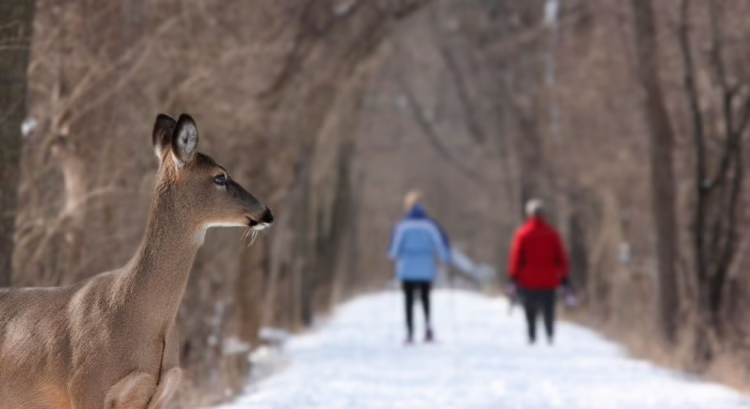
A new analysis of GPS tracking data from 37 animal species, paired with mobile phone location data from across the United States, shows that not only does animal behavior change when humans modify their environment, but that animals respond directly to the physical presence of humans themselves.
The study, an international collaboration led by the Smithsonian's National Zoo and Conservation Biology Institute; UC Santa Barbara; the University of St. Andrews; and, Yale University, published today, (Friday 21 May) in Science, also showed that animals' responses to landscape modification and human presence varies widely from species to species, suggesting that more nuanced approaches to wildlife management and animal conservation may be possible.
In 2020, COVID-19 lockdown policies went into effect that changed the way humans moved around. Despite the tragic circumstances that led to the lockdown, this situation gave the research team a rare opportunity to observe the effects of landscape modification and human presence on animal movements separately. During the same period in 2019 and 2020, the team analyzed GPS data on 4,581 mammals and birds across the continental United States on a weekly basis. But to measure the presence of humans, the team needed a more precise method than what is typically available.
Due to the dearth of publicly accessible human location data, scientists seeking to understand how human movement affects animals typically examine proxies for human presence such as urbanization, agriculture and, in the context of the COVID-19 pandemic, lockdown status. Yet these proxies do not offer a precise measure of human movement itself. So, the research team was the first to use anonymized geolocation data from people's cell phones at neighborhood-level resolution to study the impacts of human presence on animal movement.
"The cell phone data we used was made available to researchers during the pandemic to help reveal the impacts of COVID-19 shutdowns," said Scott Yanco, a research ecologist at the Zoo and co-lead author of the study. "Typically, these data are difficult or expensive to access, which made this a rare opportunity for us to quantify how human presence impacts wildlife, and to demonstrate that there is more to consider than just land modification to create robust conservation plans."
The research team studied human impacts on the physical area covered by each individual animal and each individual animal's environmental niche, a concept that describes how animals interact with habitats and resources. Overall, the team found that for most species, the impacts of humans cannot be understood without considering human presence.
As humans restricted their movements during the pandemic, about two-thirds of the mammal and bird species studied exhibited changes in the size of either the area they occupied or their environmental niche. For the species that were impacted by both human presence and landscape modification, more than half of those studied, the degree to which one factor affected an animal largely depended on the impact of the other. Further, about two thirds of mammal species and two fifths of bird species responded to human activity by shrinking their habitat, with human presence having the greatest impact in landscapes that were less modified, such as a national park versus a city.
The impacts seen among the animals varied widely among species. Wolves, for example, unlike the other animals studied, responded to humans by expanding their habitats, possibly due to their fraught history with humans and their desire to spread out and away from human activity. White-tailed deer, meanwhile, expanded their niches as landscape modification increased but shrank them as humans increased their presence, and sandhill cranes showed the opposite response.
"These findings highlight the critical importance of species-based conservation," said Ruth Oliver, an Assistant Professor at the University of California, Santa Barbara and a co-lead author on the study. "Every species has different habitat requirements, has its own behavioral tendencies and faces unique threats. Effective conservation requires that we understand the particular challenges that each species faces."
This study is a part of the COVID-19 Bio-Logging Initiative, which brought together researchers from around the world to investigate how wildlife responded to COVID-19 lockdowns, a period they termed the "anthropause." Previous work by this initiative has revealed widespread behavioral changes in mammals globally, dramatic shifts in marine traffic patterns and the importance of measuring human movements in understanding wildlife responses to the Anthropocene (the time period when human activities have had an environmental impact on the Earth).
"Through collaboration with over 600 partners around the globe, our initiative managed to collate tracking data for about 13,000 animals," said Professor Christian Rutz, from the School of Biology at the University of St Andrews and Chair of the COVID-19 Bio-Logging Initiative, "It is inspiring how this research community pulled together during a period of crisis to learn important conservation lessons."
The findings from this study highlight the opportunity for research using emerging technologies to study the movements of both animals and people to enable more nuanced and targeted approaches towards conserving wildlife. The data let the researchers consider not just landscape modifications but also the distinct interactions between human infrastructure and the presence of humans themselves and their impact on individual species.
Category Research


