
There is a tiny cyclops among your oldest ancestors, and humans share these remarkable ancestral roots with all other vertebrates. This according to new, surprising research on the evolution of the eye.
Researchers from Lund University and University of Sussex have found that all vertebrates evolved from a distant ancestor that had a single eye located at the top of its head. The study also reveals that the remnants of this so‑called median eye have today become the pineal gland in our brains.
"The results are a surprise. They turn our understanding of the evolution of the eye and the brain upside down," says Dan‑E Nilsson, professor emeritus in sensory biology at Lund University.
This cyclops‑like creature, which is our very distant relative, existed almost 600 million years ago. It was a small, worm‑like organism that had adopted a sedentary lifestyle and fed by filtering plankton from seawater. Previously, this creature had some form of paired eyes, like most other animals.
"We don't know whether the paired eyes in our branch of the evolutionary tree were just light‑sensitive cells or simple image‑forming eyes. We only know that the organism later lost them," says Dan‑E Nilsson.

The increasingly calm lifestyle meant that the worm‑like creature no longer needed paired eyes, and therefore that function was lost over the course of evolution. However, the animal kept a group of light‑sensitive cells in the middle of its head. These cells developed into a small, primitive median eye that could keep track of night and day, and sense what was up and down.
Over the following millions of years, our distant ancestor once again began to live an active, swimming life, increasing the need for paired eyes. From parts of the small median eye, new image‑forming eyes in pairs developed, the researchers conclude in the study.
"Now we finally understand why the eyes of vertebrates differ so radically from the eyes of all other animal groups, such as insects and squid. The film of our eyes - the retina - developed from the brain, whereas the eyes of insects and squid originate in the skin on the sides of the head," says Dan‑E Nilsson.
In other words, vertebrate eyes constitute a more modern model that evolved thanks to this peculiar detour via a cyclops' sedentary life. The conclusion that our modern eyes evolved through this specific evolutionary path, and not via some other ancient animal, is based on the researchers' extensive analysis of light‑sensitive cells in all animal groups, as well as the physiology and placement of these cells in the body.
"For the first time, we now also understand the origin of the neural circuits that analyse the image in our retina," adds Dan‑E Nilsson.
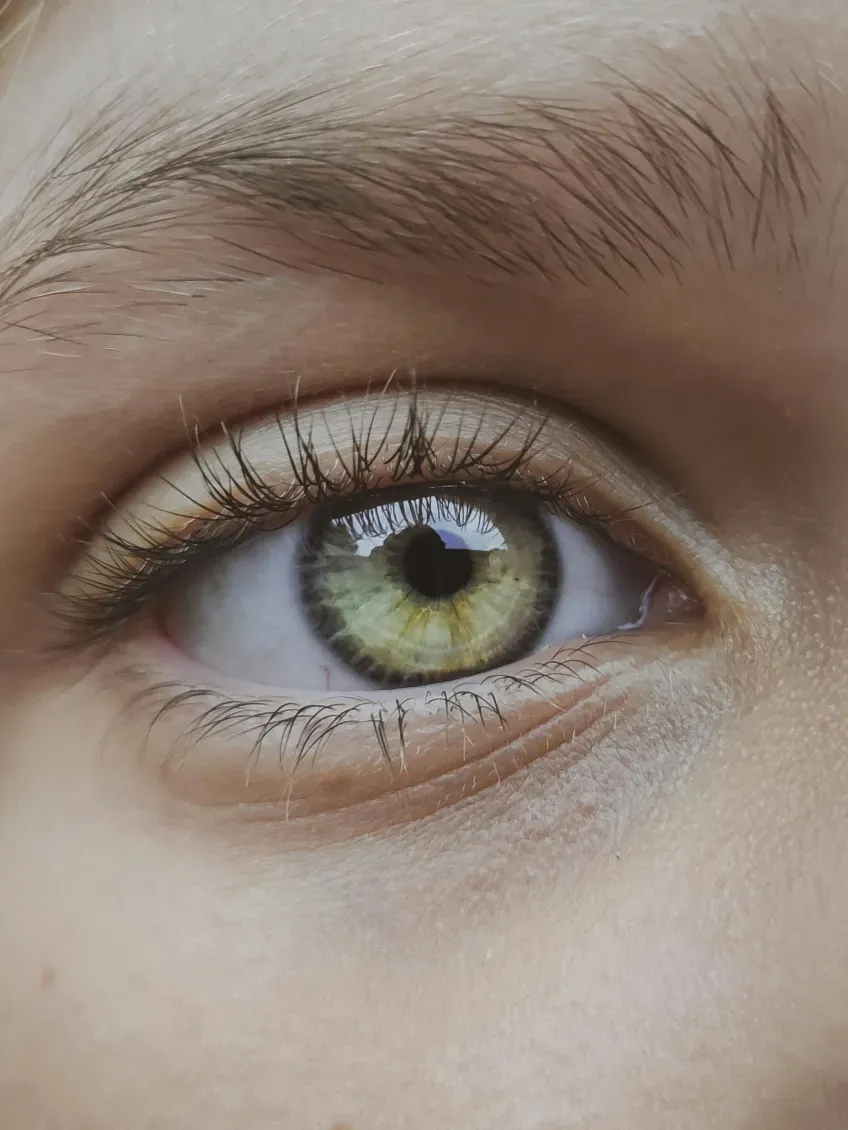
A fascinating fact is that remnants of the ancient parietal median eye from our distant ancestor actually remain in our heads today, transformed into the pineal gland. The pineal gland is a light‑sensitive organ in the vertebrate brain. It produces the hormone melatonin, which helps regulate the body's circadian rhythm.
"It's mind‑boggling that our pineal gland's ability to regulate our sleep according to light stems from the cyclopean median eye of a distant ancestor 600 million years ago," concludes Dan‑E Nilsson.
Publication:
Link to the article in Current Biology:
Evolution of the vertebrate retina by repurposing of a composite ancestral median eye


