A series of three OSCE-organized seminars on satellite and remote methods for methane emissions monitoring took place in Ashgabat from 24 to 26 November 2026.
The OSCE Centre in Ashgabat organized the event to strengthen participants' knowledge and technical capacities in satellite-based and other remote methods of methane emissions monitoring. The seminars also aimed to support the effective application of advanced technologies for methane detection, monitoring, and emissions reduction.
Three experts from AIRMO GmbH, a German climate-tech company specializing in advanced methane emissions monitoring and leak detection, delivered the sessions.
Opening the series, Olivera Zurovac-Kuzman, Economic and Environmental Officer at the OSCE Centre in Ashgabat, referred to the OSCE Ministerial Council Decision on "Strengthening Co-operation to Address the Challenges Caused by Climate Change," agreed upon by consensus by all 57 OSCE participating States, including Turkmenistan.
"The Decision underscores that reducing greenhouse gas emissions, including methane emissions, is an important part of the global response to climate change," she said.
"Given methane's significant contribution to global warming, strengthening our capacity to detect, monitor, and quantify emissions is essential. These seminars represent a practical contribution to translating international commitments into enhanced national technical capacities and more effective action on the ground," added Zurovac-Kuzman.
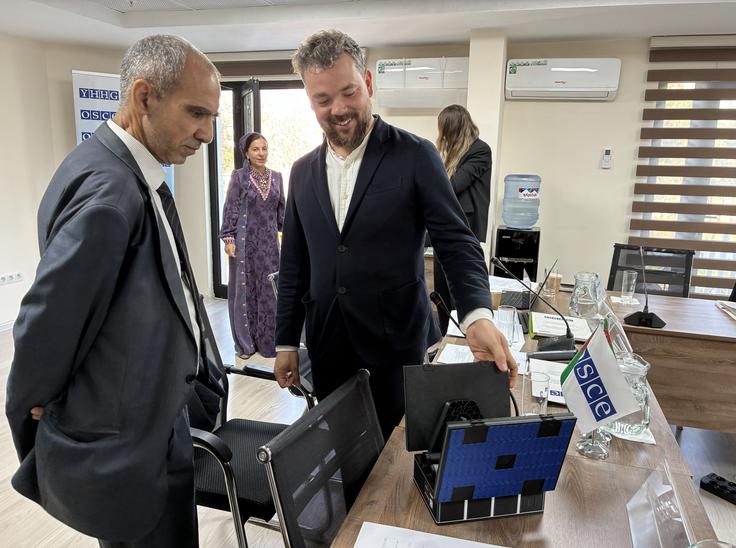
An AIRMO expert presents a satellite mock-up to a seminar participant during an OSCE-organized seminar on methane emissions monitoring, Ashgabat, 24 november 2026
During the first seminar, the experts addressed the assessment of methane emissions and monitoring methods, elaborating on Leak Detection and Repair (LDAR) programmes and quantitative assessment techniques. Participants gained insights into monitoring, reporting, and verification (MRV) systems, as well as remote Earth mapping and satellite-based methane analysis. Moreover, the economic and financial components of methane emissions management were addressed during the first day of the seminar, with a focus on the implications of EU requirements for gas exports and access to financing.
The second seminar presented high-potential satellite and aerial monitoring technologies, focusing on the development of measuring instruments for methane monitoring and possible models for combining satellite, airborne, and ground-based systems.
The third seminar covered the regulation and use of methane data, centering on climate reporting, risk assessment, and methane projects in carbon markets. A concluding session was dedicated to COP31 outcomes on methane, climate funding, and carbon markets.
The seminars brought together representatives from the State Concern (SC) "Turkmengas", the Research Institute of Natural Gas under SC "Turkmengas", SC "Turkmenoil", the Ministry of Environmental Protection, and the Ministry of Energy.