Brooks looks back in time to some of the oldest black holes in the universe
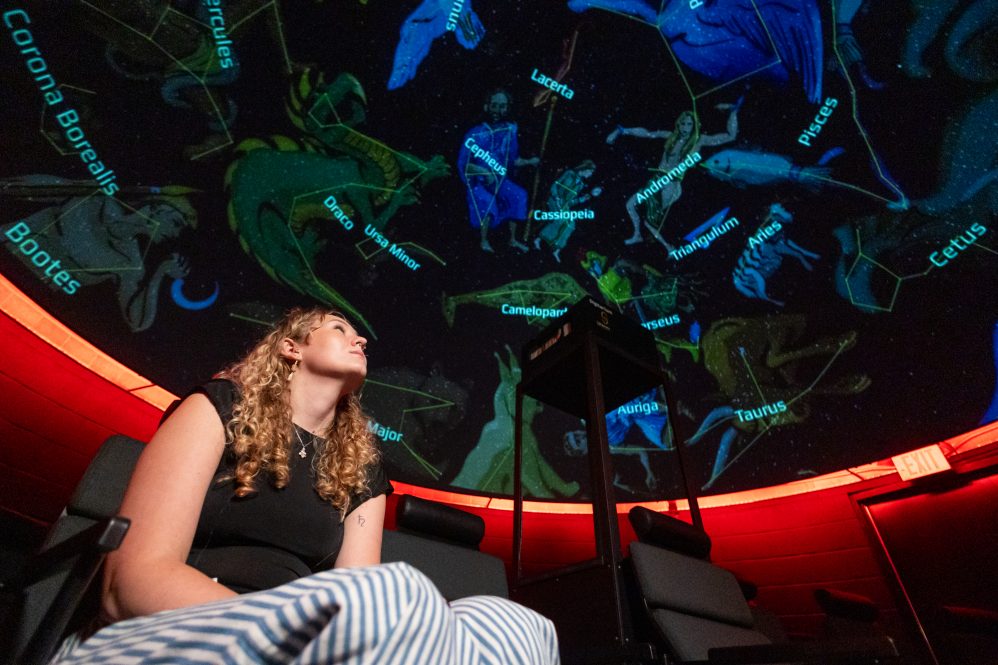
Madisyn Brooks, a Ph.D. candidate in physics, sits in the Cynthia Wyeth Peterson Memorial Planetarium on Thursday, Oct. 8, 2026. (Sydney Herdle/UConn Photo)
Madisyn Brooks, a doctoral student in the UConn Department of Physics and a finalist in Connecticut's Women of Innovation 2026 cohort, is helping uncover the mysteries of the early universe while inspiring others to pursue careers in science.
Brooks' fascination with space began long before she arrived at UConn.
"Growing up in Orlando, Florida, I used to love watching rocket launches from my backyard," she says.
That curiosity led her to the University of Central Florida, where she earned her bachelor's degree and conducted research on Saturn's rings. Working with data from NASA's Cassini-Huygens mission, she studied one of the most iconic planetary science missions in recent history.
"UCF is a very big planetary science school, and so naturally, my research was focused on planetary science," Brooks says. At UCF, she worked with data collected by the Cassini-Huygens mission, a space probe that orbited Saturn for 13 years.
"I won't be getting any more data from that mission," she says. "But it was an awesome dataset to work with, and it really pushed me to explore beyond our solar system and our galaxy."
Seeing an opportunity to pursue new discoveries in graduate school, Brooks shifted her focus from planetary science to astrophysics. She was drawn to the work of UConn physics professor Jonathan Trump, whose research examines active galaxies powered by accreting supermassive black holes.
"I wanted to research beyond our solar system and our galaxy, something with new data coming in," Brooks says.
Today, her work focuses on some of the earliest known black holes in the universe, studying objects that have existed since "cosmic dawn" — approximately 500 to 600 million years after the Big Bang. Brooks has received the highly competitive NSF Graduate Research Fellowship for her promising work on this topic.
"The universe itself is about 14 billion years old, so being able to see that far back in time through a telescope is incredibly cool," Brooks says. "It's like a time machine."
To conduct this research, Brooks uses observations from the James Webb Space Telescope. Because light from distant galaxies has traveled billions of years to reach Earth, the expansion of the universe stretches that light.
"Since the universe is expanding, the light from these very distant objects becomes redshifted," Brooks explains. "That's why we need an infrared telescope like Webb to observe them."
To help people understand the concept, Brooks uses a simple analogy.
"I like to think of the universe like a cookie with two chocolate chips that represent two galaxies," she says. "Before you bake the cookie, the chocolate chips are a certain distance apart. As it bakes and expands, the chocolate chips move farther away from each other."
One of the most exciting aspects of astronomy is the ability to look back in time. Because light takes time to travel across the universe, observing distant objects allows astronomers to see the universe as it appeared billions of years ago and better understand how it evolved.
While her research explores the furthest reaches of space, Brooks is equally passionate about sharing science with the public.
Alongside her graduate studies, she works at UConn's Cynthia Wyeth Peterson Memorial Planetarium, where she presents as a frequent host for public shows that are held every Tuesday at 5 p.m..
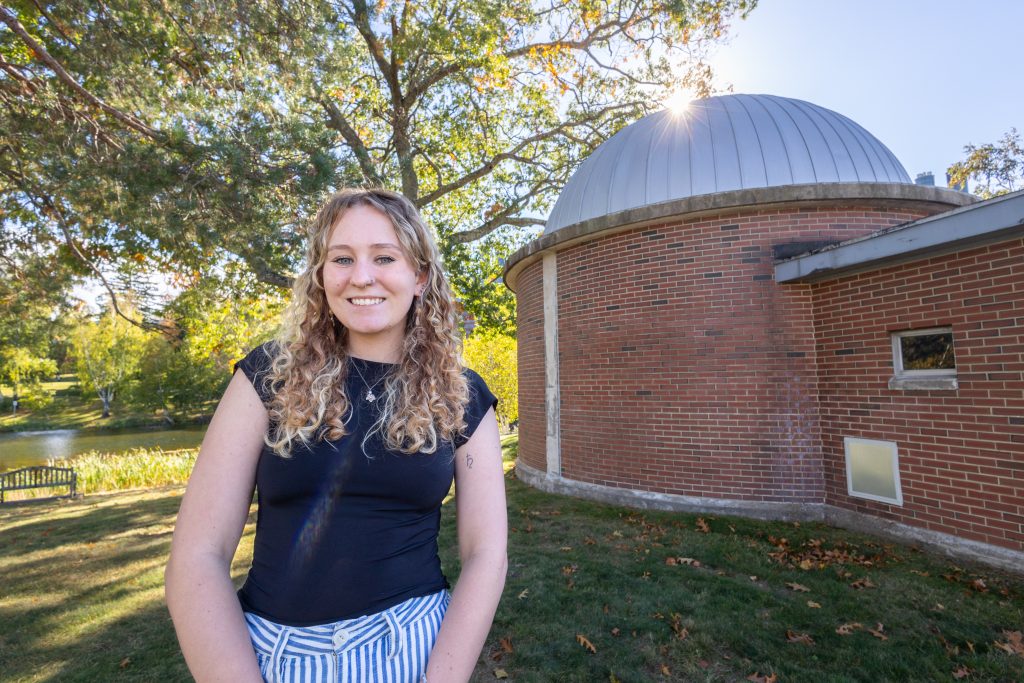
"I've always wanted to improve my scientific communication alongside my research," she says. "I thought, what better way to do that than to work at a planetarium?"
The experience has allowed her to connect to the broader UConn community while helping audiences develop a deeper appreciation for astronomy.
Like many women pursuing careers in STEM, Brooks has encountered challenges along the way, stating that she has faced sexism from other scientists. Those experiences have reinforced the importance of seeking and building supportive networks and creating opportunities through persistence.
"Being a woman in STEM really taught me that if you want to do something, you have to be willing to put in the effort to create that opportunity for yourself," Brooks says.
That perspective is one reason she became involved with the Women of Innovation program.
"I wanted to be part of a community of scientists that talks about these issues, and the Women of Innovation program is a large network of incredibly successful women I can look up to," she says.
Looking ahead, Brooks hopes to apply her research expertise in industry settings, potentially continuing her research in observational astronomy with organizations such as NASA or the Space Telescope Science Institute.
For now, she remains focused on exploring some of the oldest and most distant objects in the cosmos while encouraging the next generation of scientists to pursue their own ambitions through her work at the planetarium and working as a research mentor for undergraduate students.
She offers this advice for other aspiring scientists, especially women aspiring scientists: "It is crucial that you be a little pushy to make it happen for yourself."