
Researchers from the Okinawa Institute of Science and Technology (OIST) have created a spin-based microwave amplifier that operates near absolute zero, boosting signals by more than 1,000-fold while adding noise close to the bare minimum required by the laws of physics just to exist. As a more robust alternative to current state-of-the-art devices, the OIST device can handle much stronger signals and operate in magnetic fields, paving the way for practical quantum computing and higher-resolution sensing technologies.
"Despite being invented before optical lasers, masers - microwave lasers - have been left far behind because they often require cryogenic conditions to function, which made them impractical until very recently," explains Dr. Yuimaru Kubo, head of the Hybrid Quantum Device Team at OIST. "But now, with quantum computers operating at temperatures very close to absolute zero, we have given them new life as very promising candidates for amplifying quantum signals with very little noise."
The device is described today in Nature Communications and is now undergoing further development towards commercialization.
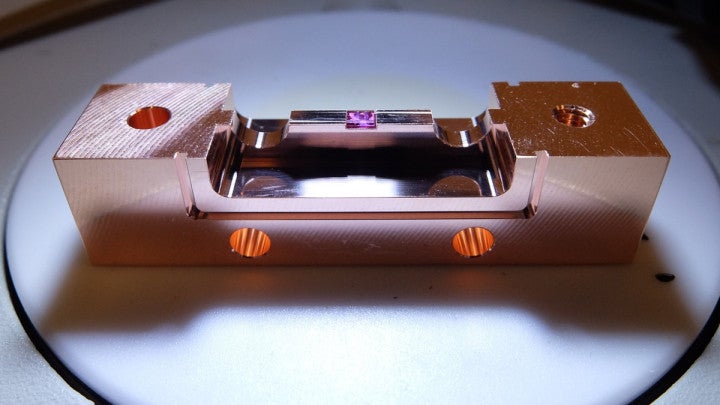
How to listen in on the quantum world
Reading out information in quantum computing is a bit like taking notes at a world leaders' conference from outside the room, so you don't disturb the discussions, with access only to audio from a single microphone inside.
If the room is full, the collective chatter makes it difficult to hear individual speakers. If there are just a few people scattered across the room, you might not be able to hear those farther from the microphone. Turning up the gain may help, but the recording equipment introduces a background hiss, even in an otherwise silent room. And if someone close to the microphone suddenly speaks loudly, the recording may become distorted. Missing or getting any of the quotes wrong could have serious ramifications.
Instead of recording voices in an air-conditioned conference room, amplifiers in superconducting quantum computers operate at temperatures very close to absolute zero to minimize thermal noise and accurately detect extremely weak microwave signals carrying quantum information. But even at such low temperatures, the amplifiers themselves introduce noise, like the hiss from a microphone. This noise is carried through subsequent amplification stages, making it harder to distinguish the true signal. In quantum computing, this can make it more difficult to accurately determine a qubit's state from a single measurement, producing errors.
Revisiting mid-century masers for future quantum technologies
Current state-of-the-art quantum-limited amplifiers can detect extremely weak microwave signals while adding very little noise. However, some of these devices, such as conventional Josephson parametric amplifiers, are prone to saturation when reading multiple qubits simultaneously, limiting how many can be read at once. Alternatively, kinetic inductance parametric amplifiers can handle much stronger input signals but typically require more electrical power and additional wiring, increasing cost and complexity as they scale up. In addition, some quantum computing platforms, such as semiconductor-based spin qubits, require magnetic fields that can overwhelm conventional superconducting amplifiers. Balancing low noise, high input power capacity, simple wiring, and compatibility with magnetic fields remains an important challenge for quantum computing.
The new device is built on the relatively old-fashioned technology of masers, which were first demonstrated in 1954, six years before the more famous successor technology of lasers. Light-emitting lasers and microwave-emitting masers both operate on the principle of stimulated emission: if the energy of an incoming photon matches the energy difference between an electron in its excited and ground states, another identical photon can be emitted.
Like most solid-state masers, the new diamond maser operates in a magnetic field, making it compatible with spin-qubit quantum computing platforms. It achieves more than 1,000-fold amplification of microwave signals with only 2.55 quanta of added noise - just slightly above the absolute quantum limit of 0.5, which any device emits just by existing - while handling much stronger input than conventional Josephson parametric amplifiers.
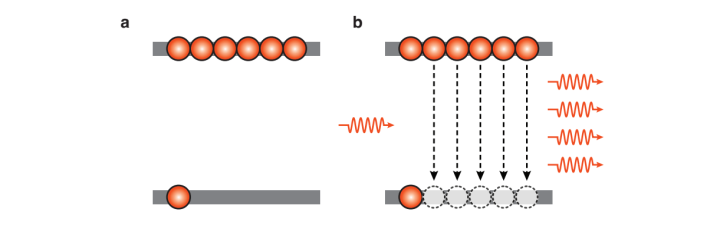
The OIST device leverages spins, the intrinsic magnetic state of electrons, within nitrogen impurities (so-called P1 centers) in a special diamond housed at the center of the amplifier. Applying a relatively weak microwave field to the diamond pumps most of the spins into a higher-energy state. When microwave signals enter the device, they cause the excited spins to release energy, thereby amplifying the incoming signals at the same frequency. "We were surprised by how much amplification we could achieve using such a small amount of microwave power," adds Kubo.
Beyond quantum computing, low-noise microwave amplification is relevant for a wide range of fields, including spectroscopy, nuclear magnetic resonance (NMR, the technology behind MRI scanners), and fundamental physics experiments, such as searches for dark matter.


