
Key takeaways
- Precious transition metals like platinum and palladium are used as catalysts to speed up chemical reactions that produce carbon-nitrogen bonds.
- UCLA organic chemists have figured out how to make inexpensive phosphine act like a transition-metal catalyst by using a light-reactive molecule to activate it.
- The achievement could be useful in the pharmaceutical industry and help bring down the price of some drugs.
A discovery by UCLA organic chemists may one day put catalytic converter thieves out of business. In new research, they've used abundant, inexpensive phosphorus as a catalyst in chemical reactions that usually require precious metals like platinum, one of the metals targeted in theft of the automotive components that convert chemicals in vehicle exhaust into less harmful forms. This advance, however, will likely be more useful in the pharmaceutical industry and could one day help bring down the price of some drugs.
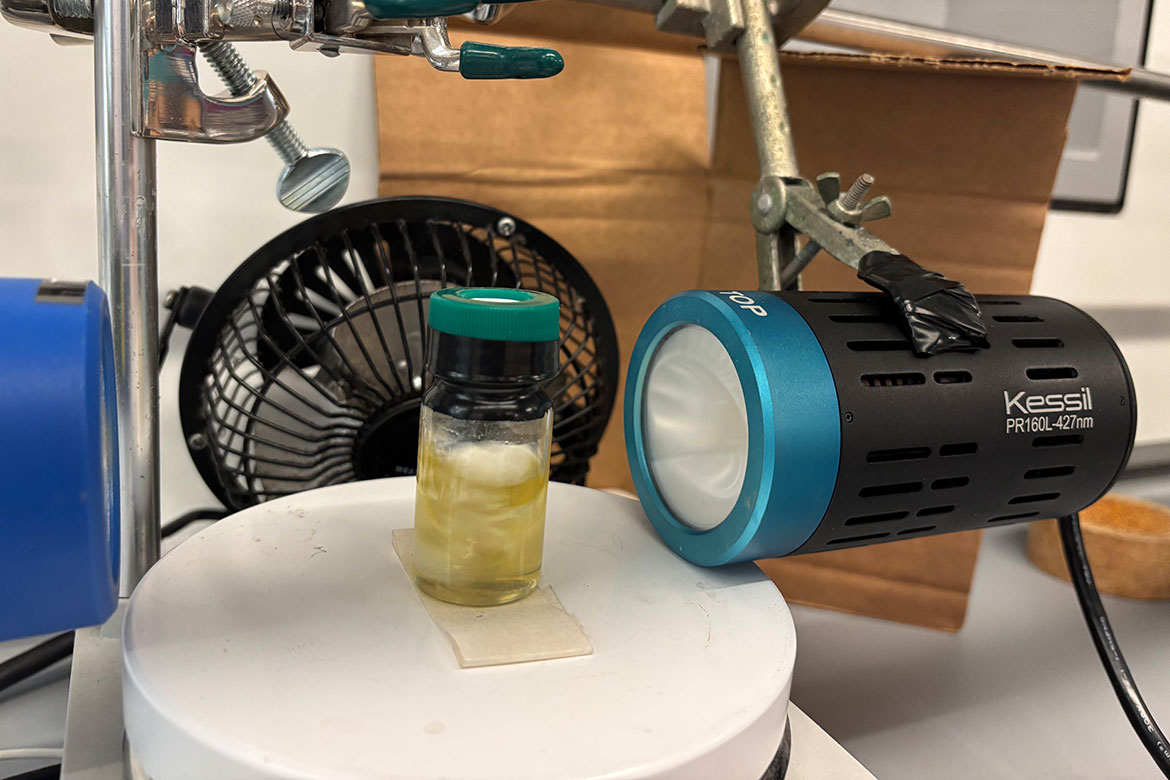
The new research, published in Nature, uses a light-reactive molecule, known as a photocatalyst, that reacts with an inexpensive phosphorous compound to couple nitrogen-containing compounds (often found in drugs) to a carbon-carbon double bond. This type of reaction, called hydroamination, is an effective way to make more complex structures.
"Carbon-nitrogen bonds are some of the most important kinds of bonds for drug discovery and manufacturing. Almost all medicines have nitrogen in them, but fixing that nitrogen into molecules is difficult, which is why we use precious transition metal catalysts," said UCLA chemistry professor Abigail Doyle, who is the paper's corresponding author.
Transition metals are shiny, electrically conductive metals such as gold, silver, copper, iridium, platinum and palladium. Under the right conditions, they react easily with many other elements, speeding up chemical reactions. They have therefore become essential industrial catalysts.
"These metals are used in catalytic converters in car engines, and to make a vast variety of materials, from components of denim jeans to medicines," said Doyle. "However, they can be very expensive to use, so there's a lot of interest in either finding less expensive transition metals to replace these, such as copper, nickel or iron, or to find a catalyst from a different block in the periodic table that is both abundant and can also react the way that metals do."
Phosphorus is an element essential to life. Phosphorous compounds are therefore very common in nature and widely used in organic chemistry.
"Chemists have developed all sorts of named reactions using phosphorus compounds, including examples where phosphines serve as catalysts," said Doyle.
Phosphines are molecules containing a phosphorus atom bonded with three carbon atoms. "But we've discovered a new reactivity mode for phosphorus that mimics a mode that transition metals like palladium and iridium commonly perform in catalysis," Doyle said.
The Doyle lab's discovery that light could be used to transform phosphines into something that could do the work of rarer and expensive catalysts was the serendipitous result of experimenting with ways to form carbon-nitrogen bonds.
"We were surprised to see high reactivity for a completely different product than what we expected. It was definitely a puzzle to try to figure out what was going on," said first author and doctoral student Flora Fan. Though initially not designed to perform this way, the team eventually determined that phosphorus had to be working like a metal in the reaction.
The reaction proceeds through a short-lived, highly reactive form of phosphorus. This form can react with carbon-carbon double bonds through pathways that closely resemble the ways metal catalysts activate these double bonds. While the phosphine mimics the behavior of metal catalysts, it also operates by fundamentally different rules.
The key difference is that the phosphine starts in a state that can undergo reactions that involve the transfer of both one and two electrons, whereas transition metal catalysts most commonly involve the transfer of two electrons. Because of this, the hydroamination reaction follows a unique route that enables more diverse nitrogen-containing compounds to be used.
Doyle's team hopes that these similarities and differences in reactivity inspire new strategies with phosphorus-based catalysts for designing chemical reactions.
"We're excited about trying to understand how far we can take this chemistry," said Fan. "Hopefully, it will open doors to more versatile methods for making drug compounds and other value-added chemicals."
Meanwhile, automobile owners can hope that the discovery eventually finds its way into catalytic converters that no longer appeal to thieves.
In addition to Doyle and Fan, the authors of the new study include UCLA doctoral student Alexander Maertens and Princeton Ph.D. Kassandra Sedillo. The research was funded by the National Institutes of Health.


